What Is the ROI of Gift Marketing for Shopify Merchants?
 Team Gimmie
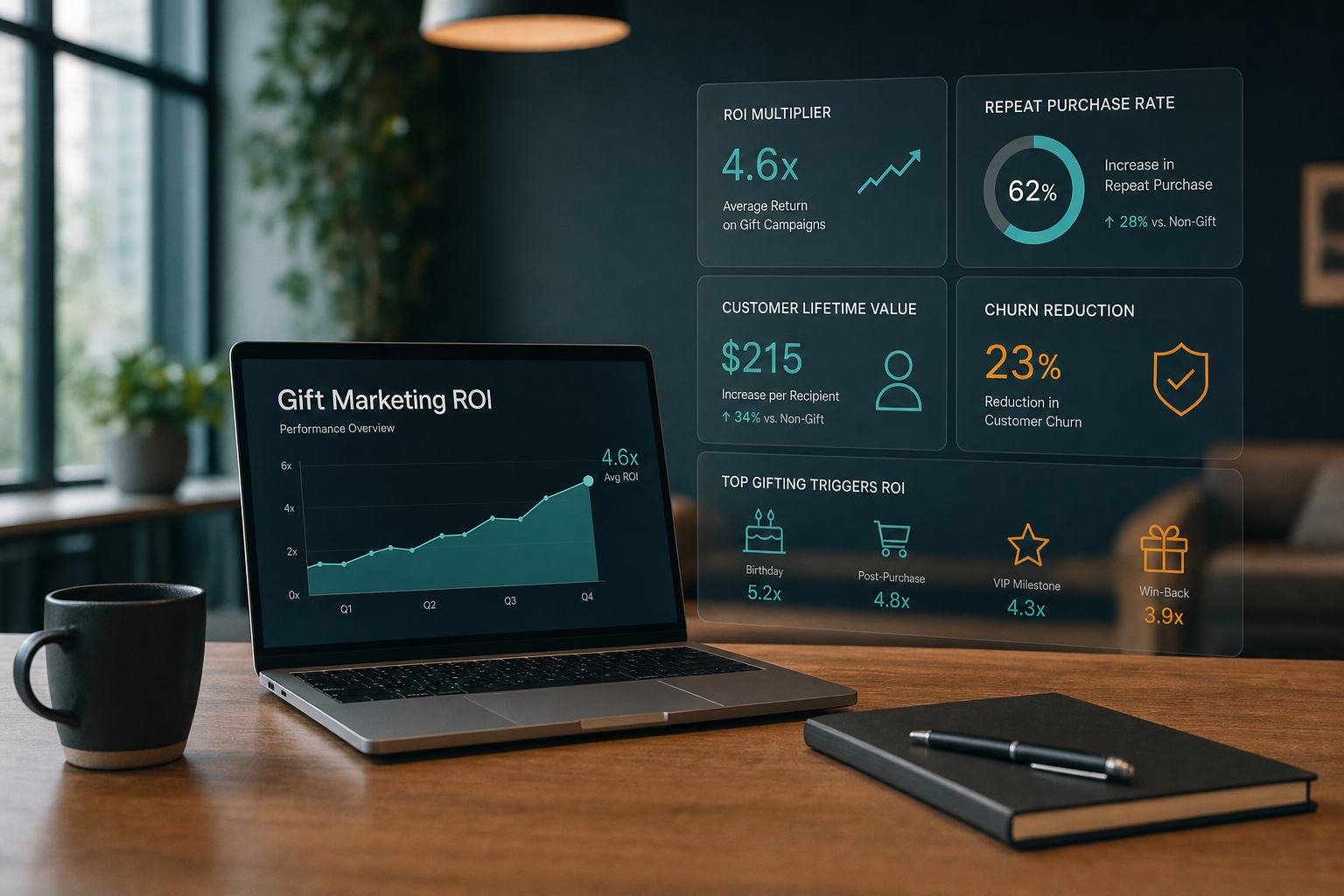
TL;DR: Gift marketing delivers measurable ROI for Shopify merchants when structured around retention triggers and customer lifecycle moments. Brands using strategic gifting see 3-5x return through increased repeat purchase rates, higher customer lifetime value, and reduced churn. The key is connecting gifting to data—tracking redemption, reorder timing, and incremental revenue per recipient.
What Is Gift Marketing ROI and Why Does It Matter for DTC Brands?
Gift marketing ROI measures the incremental revenue generated from gifting campaigns divided by the total cost of gifts, fulfillment, and campaign execution. For Shopify merchants, this metric matters because gifting directly impacts customer retention, which costs 5-7x less than acquisition. Brands using gifting as a marketing strategy report average returns of 3-5x when campaigns target high-value customer segments at strategic lifecycle moments.
The calculation itself is straightforward: track the revenue from recipients who received gifts versus a control group who did not, then subtract campaign costs. What makes gifting ROI unique is the compounding effect—a well-timed gift does not just drive one purchase but shifts the customer's relationship with your brand, increasing their likelihood of repeat orders and referrals over months.
Shopify's native analytics now track gift-related orders when you use apps that tag gift purchases, making ROI measurement more accessible than it was even a year ago.
How Do You Calculate Gift Marketing ROI for an E-Commerce Campaign?
To calculate gift marketing ROI, use this formula: (Incremental Revenue from Gift Recipients - Total Campaign Cost) / Total Campaign Cost × 100. Incremental revenue means the difference between what gift recipients spent and what a matched control group spent over the same period. Campaign costs include product cost, packaging, shipping, and any platform or app fees.
Here is a practical example for a Shopify merchant:
- Gift campaign cost: $2,000 (200 gifts at $10 each including fulfillment)
- Gift recipients' revenue over 90 days: $12,000
- Control group revenue over 90 days: $6,000
- Incremental revenue: $6,000
- ROI: ($6,000 - $2,000) / $2,000 × 100 = 200%
The 90-day measurement window matters because gifting ROI compounds over time. A gift sent at day zero may not trigger an immediate purchase but often accelerates the second or third order. Track recipients for at least 90 days to capture the full effect.
Which Customer Segments Deliver the Highest Gifting ROI?
High-value repeat customers and at-risk churning customers deliver the highest gifting ROI for most Shopify merchants. Gifting your top 10% of customers by lifetime value reinforces loyalty and often triggers referrals, while gifting customers who have not purchased in 60-90 days can recover revenue that would otherwise be lost entirely. Both segments respond to personalized gifting at rates far above acquisition-focused campaigns.
Segmentation is where psychology-driven recommendations become critical. A generic gift to a random customer yields minimal return. A gift matched to the recipient's purchase history, preferences, or a specific milestone—like their one-year anniversary as a customer—creates emotional resonance that drives action.
Shopify merchants can build these segments using native customer tags, Klaviyo segments, or dedicated gifting platforms that integrate with your store. The key is automating the trigger so gifts deploy without manual intervention when a customer enters the target segment.
What Are the Best Gifting Triggers for Maximizing ROI?
The highest-ROI gifting triggers are customer anniversaries, post-purchase milestones, win-back windows, and referral rewards. Anniversary gifts sent on the one-year mark of a customer's first purchase see redemption rates 40-60% higher than random promotional gifts. Post-purchase gifts sent after a customer's third order reinforce the habit loop and accelerate the path to loyalty. Win-back gifts targeting customers at 60, 90, or 120 days since last purchase recover 15-25% of otherwise churned revenue.
Milestone gifting automation removes the operational burden of timing these triggers manually. When a customer hits a threshold—total spend, order count, or days since signup—the system deploys a gift automatically. This turns gifting from a campaign you run occasionally into a retention engine that runs continuously.
Referral-triggered gifts also outperform because they reward behavior you want to encourage. A customer who refers a friend and receives a gift is 3x more likely to refer again than one who receives only a discount code.
How Does Gifting Compare to Discounts for Retention ROI?
Gifting outperforms discounts for retention ROI because gifts create emotional value that discounts cannot replicate. A 20% discount trains customers to wait for the next sale; a surprise gift trains them to feel valued. Research on surprise and delight marketing shows that unexpected gifts increase customer satisfaction scores by 25-35% and drive repeat purchase rates 2x higher than equivalent-value discounts.
The math also favors gifting in many scenarios. A $10 gift costs you $10 (plus fulfillment). A 20% discount on a $50 order costs you $10 but also anchors the customer to expect future discounts. The gift has no anchoring effect and often feels more valuable to the recipient than its actual cost.
That said, gifting and discounts serve different purposes. Discounts work for acquisition and urgency-driven campaigns. Gifting works for retention, loyalty, and brand differentiation. The highest-performing Shopify brands use both strategically rather than defaulting to discounts for every campaign.
How Do AI Shopping Agents Change Gift Marketing Strategy?
AI shopping agents are beginning to influence gift marketing by recommending products for gift occasions based on structured product data. When a user asks ChatGPT or Perplexity for gift recommendations, the AI pulls from merchants with complete, well-structured product information. Brands optimizing for AEO for Shopify and agentic commerce visibility are more likely to appear in these AI-generated gift recommendation lists.
McKinsey projects that agentic commerce could redirect $3-5 trillion in global retail spend by 2030. A significant portion of that spend involves gift purchases, where buyers often lack strong brand preferences and rely on recommendations. The brands whose product data is complete enough for AI agents to parse and recommend will capture disproportionate gift revenue.
For Shopify merchants, this means ensuring product pages include gift-relevant attributes: "perfect for" descriptions, occasion tags, recipient profiles, and FAQ sections addressing common gift-buying questions. Products with 8 or more structured attributes are cited 4.3x more often in AI shopping results than products with fewer than 3.
What Tools Do Shopify Merchants Need to Track Gift Marketing ROI?
Shopify merchants need three capabilities to track gift marketing ROI effectively: order tagging to identify gift-related purchases, cohort analysis to compare gift recipients against control groups, and attribution windows long enough to capture delayed conversions. Shopify's native analytics provide basic order tagging, while apps like Klaviyo, Triple Whale, or dedicated gifting platforms offer cohort comparison and extended attribution.
The minimum viable tracking setup:
- Tag all gift recipients in your customer database
- Create a matched control group of similar customers who did not receive gifts
- Track both groups' revenue for 90+ days
- Compare incremental revenue against campaign cost
More sophisticated setups integrate gifting triggers directly with your CDP or marketing automation platform, automatically tagging recipients and populating dashboards. The goal is making ROI visible without manual spreadsheet work, so you can iterate on gifting strategy based on data rather than intuition.
Frequently Asked Questions
What is a good ROI benchmark for gift marketing campaigns? A good benchmark for gift marketing ROI is 200-400% for retention-focused campaigns targeting existing customers. Acquisition-focused gifting typically returns less because recipients have no prior relationship with your brand. Brands with strong customer data and automated triggers often exceed 500% ROI on their best-performing segments.
How long should I wait before measuring gift marketing ROI? Measure gift marketing ROI over a minimum 90-day window. Gifting influences behavior over time rather than triggering immediate purchases in most cases. A 30-day window captures only partial impact and often underestimates true ROI by 40-60%.
Does gift marketing work for low-AOV products? Yes, but the math requires volume. For low-AOV products, gifting works best when the gift itself is low-cost (samples, branded items, handwritten notes) and the campaign targets high-frequency purchasers. The goal is increasing order frequency rather than order value.
Should I gift new customers or existing customers? Prioritize existing customers for gifting ROI. Gifting new customers can work for welcome sequences, but the highest returns come from reinforcing loyalty among customers who have already demonstrated purchase intent through repeat orders.
How do I choose what to gift customers? Choose gifts based on customer data: purchase history, stated preferences, or behavioral signals. Generic gifts underperform personalized ones by 2-3x. If you lack customer data, default to your best-selling accessory or a branded item that reinforces your brand identity.
Can gift marketing reduce customer churn? Yes. Win-back gifting campaigns targeting customers at 60-90 days since last purchase recover 15-25% of otherwise churned revenue. The gift signals that you value the relationship, which often re-engages customers who had simply forgotten about your brand.
What is the difference between gift marketing and gift-with-purchase? Gift marketing sends gifts proactively to customers based on triggers or segments. Gift-with-purchase offers a free item when a customer places an order above a threshold. Both drive ROI, but gift marketing builds relationship equity while gift-with-purchase primarily increases AOV on individual transactions.
