What Is the Psychology of Gifting and How Can Shopify Merchants Use It?
 Team Gimmie
TL;DR: The psychology of gifting explains why people give gifts and what makes a gift feel meaningful. For Shopify merchants, understanding these emotional triggers—reciprocity, identity expression, and relationship signaling—unlocks higher average order values, stronger customer retention, and content that AI engines cite when shoppers ask for gift recommendations.
Gift-giving is one of the oldest human behaviors, and it is driven by psychology far more than practicality. For DTC brands on Shopify, understanding the psychology of gifting is no longer just interesting—it is operationally essential. AI shopping assistants like ChatGPT and Perplexity now field millions of gift recommendation queries daily. The brands that structure their product data and content around gifting psychology get cited. The brands that treat gifting as an afterthought disappear from AI-driven discovery entirely.
With AI-referred traffic to Shopify stores growing 8x year over year and AI-attributed orders up 13x, the stakes are clear. This article breaks down the core psychological principles behind gifting and shows you exactly how to apply them to your Shopify store for both human shoppers and AI agents.
Why Does Gift-Giving Trigger Such Strong Emotional Responses?
Gift-giving activates deep psychological needs around connection, identity, and social bonding. When someone gives a gift, they are not just transferring an object—they are communicating care, signaling relationship investment, and expressing how well they understand the recipient. This emotional weight explains why gift purchases carry higher stakes than personal purchases.
The psychology literature identifies several core mechanisms:
- Reciprocity: Receiving a gift creates a felt obligation to return the gesture, strengthening social bonds
- Identity expression: Givers select gifts that reflect both their own identity and their perception of the recipient's identity
- Relationship signaling: The thoughtfulness of a gift signals the depth and quality of the relationship
- Anxiety reduction: Givers experience stress about whether the gift will be well-received, creating decision paralysis
For Shopify merchants, this means gift shoppers are fundamentally different from self-purchasers. They are more anxious, more willing to spend for confidence, and more responsive to guidance that reduces uncertainty.
How Does Decision Paralysis Affect Gift Shoppers?
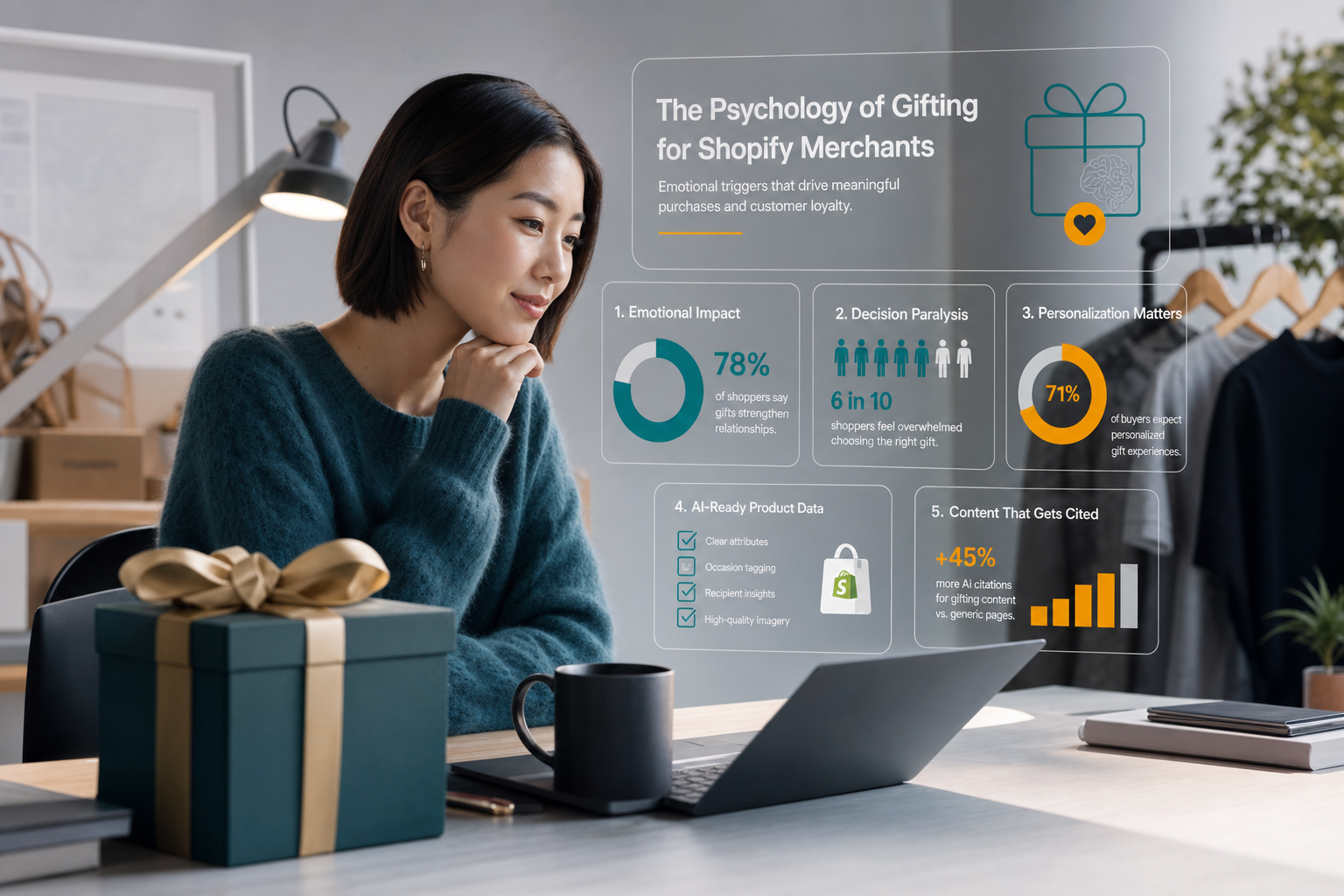
Decision paralysis is the stress and hesitation consumers experience when overwhelmed by too many choices or unsure if their selection will feel thoughtful. Gift shoppers experience this at far higher rates than self-purchasers because the stakes include relationship judgment, not just product satisfaction.
Research shows that when faced with too many options, shoppers often abandon the purchase entirely or default to generic choices like gift cards. For Shopify merchants, this creates both a problem and an opportunity:
- The problem: Unguided product catalogs overwhelm gift shoppers, leading to cart abandonment
- The opportunity: Brands that reduce choice friction through curated collections, guided quizzes, and clear "who this is for" messaging convert gift traffic at significantly higher rates
AI shopping assistants are particularly effective at solving decision paralysis because they can synthesize preferences and narrow options instantly. Products with complete structured data—including recipient profiles, occasion tags, and personality fit descriptions—are the ones AI agents recommend. Products without this data get skipped.
What Makes a Gift Feel Personalized Rather Than Generic?
A gift feels personalized when it demonstrates that the giver understands the recipient's personality, values, and preferences—not just their demographic category. The difference between a generic gift and a meaningful one is specificity: knowing someone loves hiking is generic; knowing they have been wanting to try a specific trail and selecting gear for that trip is personal.
For Shopify merchants, this translates to concrete content and data requirements:
- "Who this is for" sections: Every product page should explicitly state the personality types, interests, or occasions the product fits
- Recipient profile targeting: Structure product descriptions to answer "What kind of person would love this?" not just "What does this product do?"
- Occasion tagging: Tag products for specific gifting occasions (birthday, anniversary, thank-you, holiday) in your product data
- Comparison content: Create content comparing products for different recipient types, which AI engines cite heavily
Brands using psychology-driven recommendations that match emotional and psychological profiles to products see measurably higher gift conversion rates because they solve the personalization problem at scale.
How Can Shopify Merchants Structure Product Data for AI Gift Recommendations?
AI shopping assistants like ChatGPT and Perplexity recommend products based on structured data completeness, not just product quality. Products with 8 or more structured attributes are cited 4.3x more often in AI shopping results than products with fewer than 3 attributes. For gift recommendations specifically, this means your product data must answer the questions AI agents ask on behalf of shoppers.
The essential product data fields for gift visibility:
- Recipient type: Who is this gift for? (e.g., "outdoor enthusiast," "new parent," "minimalist")
- Occasion fit: What gifting occasions does this suit? (birthday, holiday, thank-you, just-because)
- Price tier: Is this a stocking stuffer, main gift, or luxury splurge?
- Relationship context: Is this appropriate for a close friend, acquaintance, or colleague?
- Personalization options: Can the product be customized with names, dates, or messages?
Shopify's Catalog syndication automatically feeds product data to AI shopping channels, but only complete data gets recommended. Merchants with sparse product attributes are invisible to AI gift discovery.
Why Does Gifting Content Perform Well for AEO and AI Citations?
Gifting queries are among the highest-intent informational searches, and AI Overviews now appear on 83% of "best product" searches. When someone asks ChatGPT or Perplexity "What's a good gift for a coffee lover?" or "Best anniversary gifts for him," AI engines pull from content that directly answers those questions with structured, specific recommendations.
Content optimized for answer engine optimization earns citations because it matches how AI engines extract information:
- Question-based H2s: Structure content around the exact questions gift shoppers ask
- 40-60 word direct answers: Lead every section with a concise answer AI can extract
- Comparison tables: Gift guides with side-by-side comparisons are cited 3-5x more than narrative content
- FAQ sections: Include 5-8 Q&As with FAQPage schema for each gift guide
Brands cited inside AI Overviews earn 35% more organic clicks than brands appearing only in traditional search results. For gift-focused content, this visibility advantage compounds during peak gifting seasons.
How Can Gifting Strategy Increase Customer Lifetime Value?
Gifting creates a unique retention mechanism because it introduces your brand to new potential customers through trusted personal recommendations. When someone receives a gift from your store, they experience your product with built-in social proof—the giver's endorsement. This makes gift recipients significantly more likely to become repeat customers than cold acquisition traffic.
Tactical applications for Shopify merchants:
- Gift messaging features: Enable personalized gift notes that reinforce brand experience for recipients
- Recipient follow-up: With permission, follow up with gift recipients to offer their own first-purchase incentive
- Milestone gifting automation: Trigger gift suggestions or offers at customer anniversaries, birthdays, or loyalty milestones
- Surprise and delight programs: Unexpected small gifts to existing customers drive disproportionate loyalty and word-of-mouth
Brands using gifting as a retention strategy see measurable improvements in repeat purchase rates because gifting creates emotional connections that transactional discounts cannot replicate.
What Should Shopify Merchants Do This Week to Capture Gift Traffic?
The immediate opportunity is preparing your store for AI-driven gift discovery before the next major gifting season. With AI shopping assistants now converting at 10-16% compared to 1.76% for traditional organic, the ROI on gift optimization is substantial.
Priority actions ranked by impact:
- Audit product data completeness: Ensure every product has recipient type, occasion tags, and "who this is for" descriptions
- Create gift guide content: Publish 3-5 gift guides targeting specific recipient personas with question-based H2s and FAQ schema
- Add gifting-specific schema: Include occasion and recipient attributes in your Product JSON-LD
- Enable gift messaging: If you haven't already, activate gift notes and gift wrapping options
- Test AI visibility: Ask ChatGPT and Perplexity for gift recommendations in your category and note whether your brand appears
The psychology of gifting has not changed in millennia, but the discovery layer has transformed completely. Shopify merchants who structure their stores around gifting psychology—and make that structure readable by AI agents—will capture a growing share of the $3-5 trillion in retail spend that McKinsey projects AI agents will redirect by 2030.
Frequently Asked Questions
What is the psychology of gifting? The psychology of gifting examines why humans give gifts and what makes gifts feel meaningful. Core mechanisms include reciprocity (the felt obligation to return gestures), identity expression (gifts reflecting giver and recipient identities), and relationship signaling (gift thoughtfulness indicating relationship quality).
Why do gift shoppers experience more decision paralysis than regular shoppers? Gift shoppers face higher stakes because their selection will be judged by the recipient, potentially affecting relationship perception. This anxiety about whether the gift will be well-received creates hesitation and often leads to cart abandonment or defaulting to generic options like gift cards.
How can Shopify merchants reduce decision paralysis for gift shoppers? Merchants can reduce decision paralysis by creating curated gift collections, adding "who this is for" sections to product pages, implementing guided gift-finder quizzes, and structuring product data with recipient profiles and occasion tags that help shoppers match products to recipients quickly.
What product data fields matter most for AI gift recommendations? AI shopping assistants prioritize products with complete structured data including recipient type, occasion fit, price tier, relationship context, and personalization options. Products with 8 or more attributes are cited 4.3x more often than products with sparse data.
How does gifting content perform for answer engine optimization? Gifting content performs exceptionally well for AEO because gift queries are high-intent informational searches. AI Overviews appear on 83% of "best product" searches, and content structured with question-based headings, direct answers, and FAQ schema earns significantly more AI citations.
Can gifting strategy improve customer lifetime value? Yes. Gifting introduces your brand to new customers through trusted personal recommendations, creating built-in social proof. Gift recipients convert to repeat customers at higher rates than cold acquisition traffic, and milestone gifting automation can strengthen retention with existing customers.
What is emotionally intelligent gifting? Emotionally intelligent gifting uses consumer psychology and personality insights rather than transaction history alone to match products to recipients. This approach considers values, identity, and emotional resonance rather than just demographic or purchase data.
How do AI shopping assistants handle gift recommendation queries? AI assistants synthesize user preferences, recipient descriptions, and occasion context to narrow product options instantly. They pull recommendations from products with complete structured data and cite content that directly answers gift-related questions with specific, comparable options.
