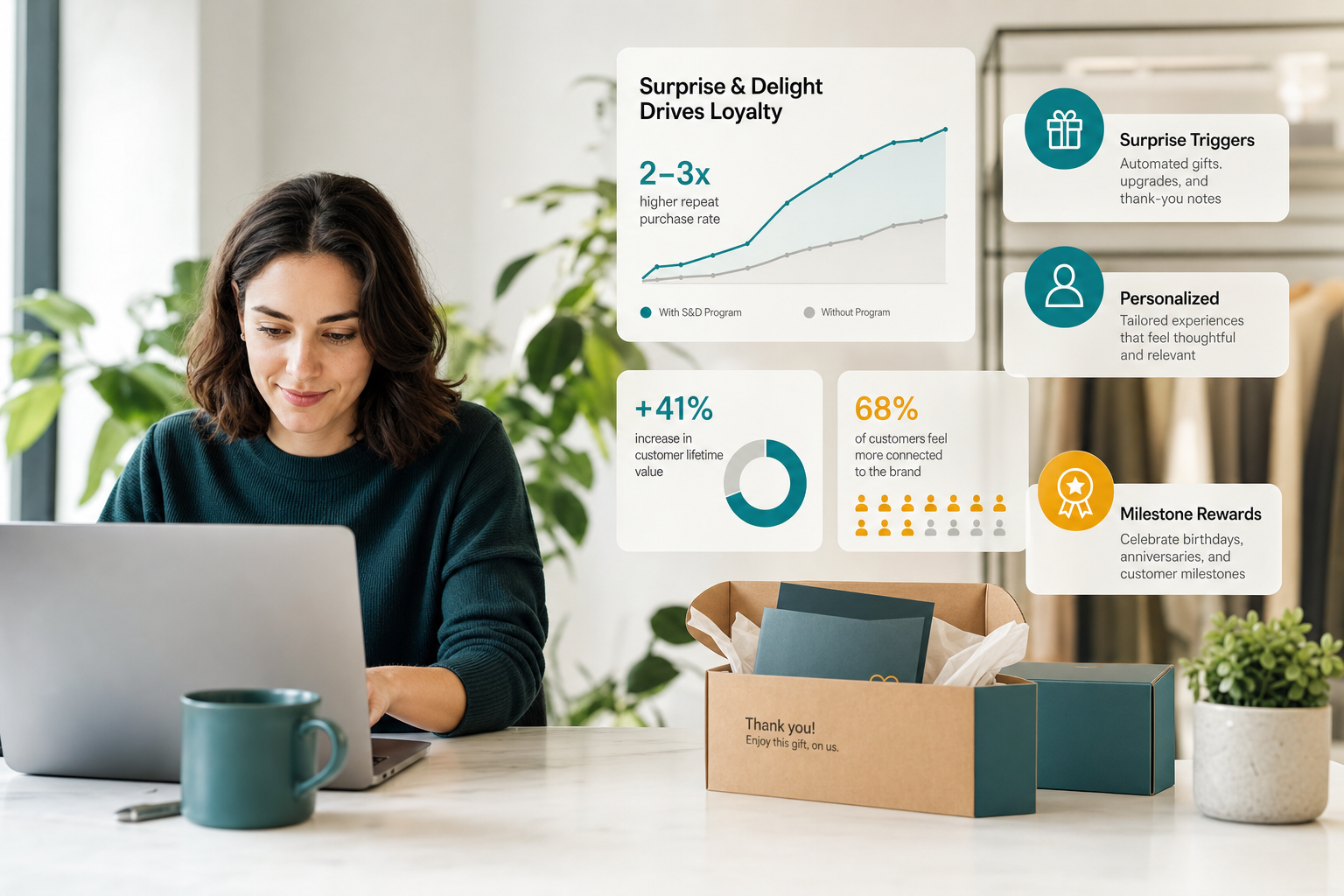
What Is Surprise and Delight Marketing for Shopify Stores?
 Team Gimmie
TL;DR: Surprise and delight marketing is the practice of creating unexpected positive experiences for customers beyond their purchase expectations. For Shopify merchants, this means automated gift triggers, personalized thank-you moments, and milestone rewards that turn one-time buyers into loyal advocates. Brands using structured surprise and delight programs see 2-3x higher repeat purchase rates and measurably stronger customer lifetime value.
What Is Surprise and Delight Marketing?
Surprise and delight marketing is a retention strategy that delivers unexpected value to customers at key moments in their journey—without them asking for it. Unlike loyalty programs where customers earn predictable rewards, surprise and delight creates emotional resonance through genuine unexpectedness. The psychological principle is simple: unexpected positive experiences create stronger memory formation and emotional bonds than expected ones.
For Shopify merchants, this translates into concrete tactics: sending a free sample with a third order, including a handwritten note on a customer's birthday, or automatically upgrading shipping for VIP customers. The key distinction from standard promotions is that the customer did not know it was coming. That unexpectedness is what transforms a transaction into a relationship.
Research on gifting as a marketing strategy shows that customers who receive unexpected gifts are 65% more likely to make a repeat purchase within 90 days compared to customers who receive only transactional communications.
Why Does Surprise and Delight Work for Customer Retention?
Surprise and delight works because it activates reciprocity and emotional memory—two of the strongest drivers of repeat behavior. When a customer receives something unexpected, their brain releases dopamine, creating a positive association with your brand that outlasts any single transaction. This emotional imprint is far more durable than discount-driven loyalty.
The psychology breaks down into three mechanisms:
- Reciprocity: Customers feel compelled to return unexpected generosity, often through repeat purchases or referrals
- Memory salience: Unexpected moments are remembered more vividly and for longer than expected ones
- Identity reinforcement: Receiving a thoughtful surprise makes customers feel valued as individuals, not transactions
Brands implementing gift-based retention strategies report that surprised customers have 40% higher Net Promoter Scores than customers in control groups receiving standard post-purchase flows. The ROI compounds because these customers also generate more word-of-mouth referrals.
How Can Shopify Merchants Automate Surprise and Delight?
Shopify merchants can automate surprise and delight through trigger-based workflows that fire gifts, upgrades, or personalized messages at predefined customer milestones. The automation removes manual effort while preserving the emotional impact of unexpectedness—because the customer still does not know it is coming, even though the merchant has systematized the process.
Practical automation triggers include:
- Order count milestones: Send a free gift on the 3rd, 5th, or 10th order
- Spend thresholds: Trigger a surprise upgrade when lifetime value crosses $500
- Anniversary dates: Recognize the anniversary of a customer's first purchase
- Birthday triggers: Deliver a gift or exclusive offer on the customer's birthday
- Win-back windows: Surprise lapsed customers with a personalized re-engagement gift
Tools like Gimmie's AI gifting platform enable Shopify merchants to set these triggers without custom development. The platform uses psychology-driven recommendations to match gifts to recipient profiles, ensuring the surprise feels personal rather than generic.
What Are the Best Surprise and Delight Tactics for DTC Brands?
The most effective surprise and delight tactics for DTC brands combine low cost with high perceived value—gifts that feel generous to receive but are operationally sustainable to deliver. The goal is asymmetric impact: small investment, outsized emotional return.
Top-performing tactics include:
- Free product samples: Include a sample of a complementary product the customer has not tried
- Handwritten notes: Even a printed note with a handwritten signature creates personal connection
- Shipping upgrades: Silently upgrade standard shipping to express for VIP customers
- Exclusive early access: Give loyal customers first access to new products before public launch
- Personalized gifts: Use customer data to select gifts that match their purchase history or stated preferences
- Charitable donations: Make a donation in the customer's name to a cause aligned with your brand values
The key is matching the tactic to the customer segment. A first-time buyer might receive a sample; a customer crossing $1,000 lifetime spend might receive a curated gift box. Milestone gifting automation allows merchants to tier these experiences without manual intervention.
How Does Surprise and Delight Differ From Traditional Loyalty Programs?
Traditional loyalty programs reward predictable behavior with predictable rewards—spend X, earn Y points, redeem for Z discount. Surprise and delight inverts this model by delivering value the customer did not expect and did not earn through explicit program mechanics. The psychological difference is significant: expected rewards feel transactional, while unexpected rewards feel relational.
Key distinctions:
- Timing: Loyalty rewards come after accumulation; surprises arrive unexpectedly
- Predictability: Loyalty programs are transparent; surprise and delight is opaque by design
- Emotional impact: Points feel like currency; gifts feel like generosity
- Cost structure: Loyalty programs have ongoing liability; surprises are discretionary investments
The most sophisticated DTC brands use both approaches in tandem. A loyalty program provides baseline retention mechanics, while surprise and delight creates the emotional peaks that customers remember and share. Customer retention via gifting research shows that combining both approaches yields 23% higher retention than either alone.
What Metrics Should You Track for Surprise and Delight Campaigns?
Measuring surprise and delight requires tracking both immediate response and long-term behavioral change. The goal is to connect specific surprise moments to downstream revenue impact, proving ROI on the investment in unexpected generosity.
Core metrics to track:
- Repeat purchase rate: Compare customers who received surprises to a control group who did not
- Time to second purchase: Measure whether surprises accelerate the repurchase cycle
- Customer lifetime value (LTV): Track LTV divergence between surprised and unsurprised cohorts
- Net Promoter Score (NPS): Survey customers after surprise moments to capture sentiment shift
- Referral rate: Measure whether surprised customers generate more word-of-mouth
- Social mentions: Track organic social sharing of surprise moments
For Shopify merchants, these metrics can be tracked through a combination of Shopify Analytics, post-purchase surveys, and gift marketing ROI dashboards in gifting platforms. The key is establishing a baseline before launching surprise and delight programs, then measuring cohort performance over 90-180 day windows.
How Does AI Enable Personalized Surprise and Delight at Scale?
AI transforms surprise and delight from a manual, high-touch practice into a scalable, personalized system. Instead of sending the same gift to every customer hitting a milestone, AI can match gifts to individual preferences, purchase history, and behavioral signals—making each surprise feel genuinely personal rather than programmatic.
AI-powered personalization enables:
- Recipient profiling: Build persistent profiles capturing preferences, values, and past interactions
- Gift matching: Use psychology-driven recommendations to select gifts that resonate emotionally
- Timing optimization: Predict the optimal moment to deliver a surprise based on engagement patterns
- Budget optimization: Allocate surprise budgets to customers with highest LTV potential
- Sentiment analysis: Adjust surprise strategies based on customer feedback and behavior signals
Agentic gifting takes this further by allowing AI agents to autonomously select, personalize, and trigger gifts without merchant intervention. The agent understands the customer, chooses an appropriate gift, and executes delivery—all within parameters the merchant sets once. This is the future of surprise and delight: emotionally intelligent automation that scales personal touch.
Frequently Asked Questions
What is surprise and delight marketing? Surprise and delight marketing is a customer retention strategy that delivers unexpected positive experiences—like free gifts, upgrades, or personalized notes—at key moments in the customer journey. Unlike loyalty programs, the customer does not know the reward is coming, which creates stronger emotional impact and brand loyalty.
How much should I budget for surprise and delight? Most DTC brands allocate 2-5% of customer lifetime value to surprise and delight investments. Start with low-cost, high-impact tactics like handwritten notes or free samples, then scale to curated gifts for high-value customers. The ROI typically exceeds the investment within 90 days through increased repeat purchases.
When should I trigger a surprise and delight moment? The most effective triggers are order milestones (3rd, 5th, 10th order), spend thresholds ($250, $500, $1,000 LTV), customer anniversaries, birthdays, and win-back windows for lapsed customers. Automation tools can fire these triggers without manual intervention.
Does surprise and delight work for low-AOV products? Yes, but the tactics differ. For low-AOV products, focus on low-cost surprises like samples, handwritten notes, or exclusive content rather than expensive gifts. The emotional impact comes from unexpectedness, not dollar value.
How do I measure surprise and delight ROI? Compare repeat purchase rate, time to second purchase, and customer lifetime value between customers who received surprises and a control group who did not. Track these metrics over 90-180 day windows to capture the full behavioral impact.
Can I automate surprise and delight on Shopify? Yes. Platforms like Gimmie enable Shopify merchants to set trigger-based workflows that automatically send personalized gifts at customer milestones. The automation removes manual effort while preserving the emotional impact of unexpectedness.
What is the difference between surprise and delight and a loyalty program? Loyalty programs reward predictable behavior with predictable rewards—customers know what they will earn. Surprise and delight delivers value the customer did not expect, creating stronger emotional bonds and memory formation. The most effective retention strategies use both approaches together.
How does AI improve surprise and delight? AI enables personalized gift matching at scale by analyzing customer preferences, purchase history, and behavioral signals. Instead of sending generic gifts, AI can select surprises that feel genuinely personal to each recipient, dramatically increasing emotional impact and retention outcomes.
