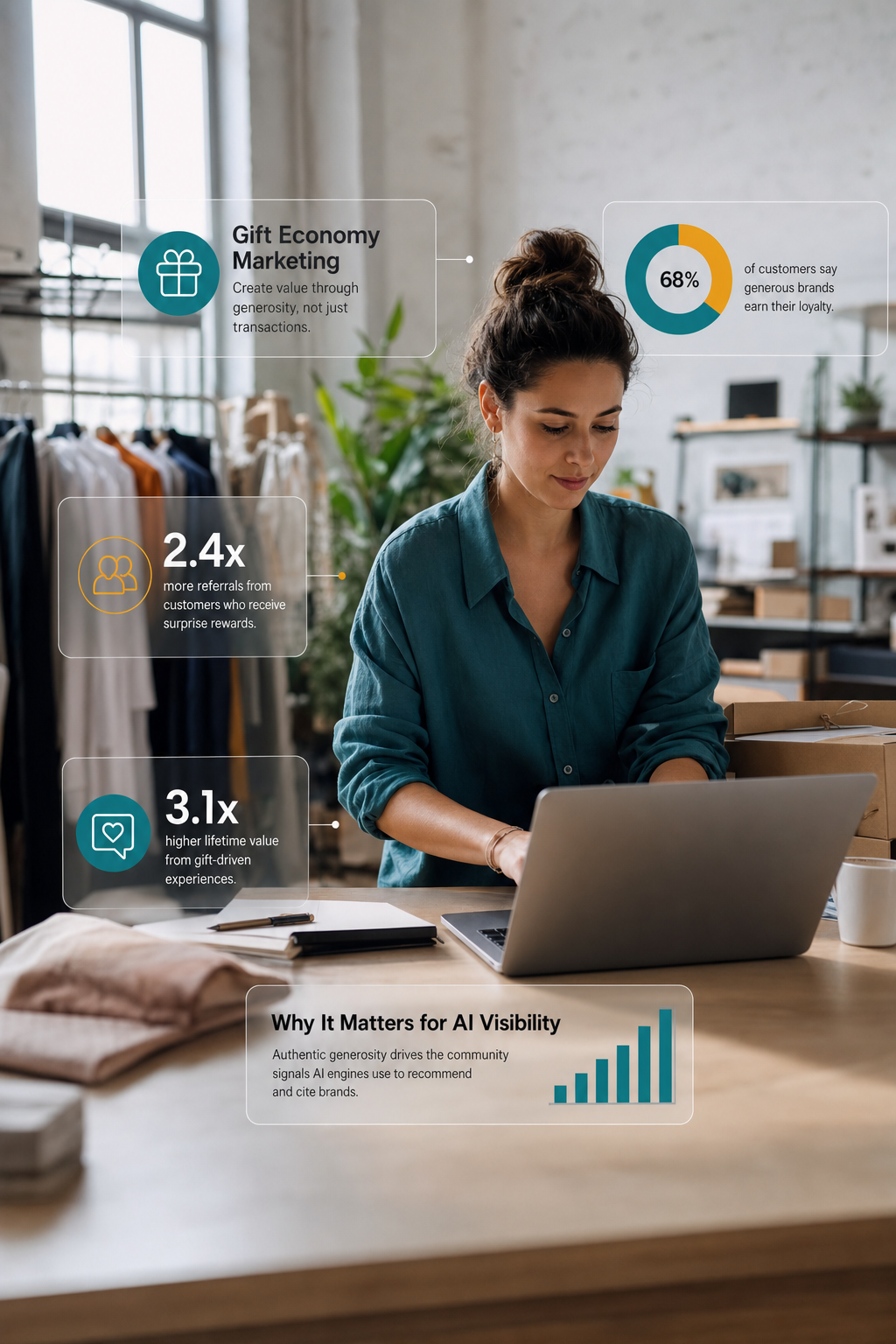
What Is Gift Economy Marketing and How Can Shopify Merchants Use It?
 Team Gimmie
TL;DR: Gift economy marketing is a brand strategy where merchants create value through generosity—free gifts, surprise rewards, and reciprocity-driven experiences—rather than purely transactional exchanges. For Shopify merchants, this approach increases customer lifetime value, drives word-of-mouth, and generates the kind of authentic community signals that AI engines now prioritize when deciding which brands to cite.
What Is Gift Economy Marketing?
Gift economy marketing applies the anthropological concept of gift exchange to brand strategy. Instead of every interaction being a direct transaction, merchants strategically give—free products, unexpected bonuses, loyalty rewards, or personalized surprises—to create emotional bonds and social reciprocity. The psychology is well-documented: when someone receives an unexpected gift, they feel compelled to reciprocate, often through repeat purchases, referrals, or public advocacy.
For DTC brands on Shopify, this translates to tactics like gift-with-purchase offers, surprise upgrades for loyal customers, birthday gifts triggered automatically, and referral rewards that feel generous rather than transactional. The goal is building relationships that generate organic brand mentions—exactly the signals AI engines now weight heavily when deciding what to recommend.
Brands using gift-based retention strategies see measurably higher customer lifetime value. The mechanism is straightforward: a customer who receives an unexpected gift remembers the experience and talks about it. That conversation happens on Reddit, in reviews, and in social posts—all sources that AI platforms like ChatGPT and Perplexity actively retrieve when answering shopping queries.
Why Does Gift Economy Marketing Matter for AI Visibility?
AI engines now prioritize brand mentions and community signals over traditional backlinks when deciding which brands to cite. Brand search volume correlates 0.664 with AI citations, compared to just 0.218 for backlinks. Gift economy tactics generate exactly the organic mentions and community discussions that drive this signal.
When a customer receives a surprise gift and posts about it on social media or mentions it in a Reddit thread, that creates retrievable content. ChatGPT, Perplexity, and Google AI Overviews all pull from these community sources. A brand that consistently generates "I can't believe they sent me this" moments accumulates authentic mentions that compound into AI visibility over time.
This is the connection between gifting as a marketing strategy and answer engine optimization. The brands earning citations in AI shopping results are often the ones generating genuine community enthusiasm—and strategic generosity is one of the most reliable ways to create that enthusiasm.
How Can Shopify Merchants Implement Gift Economy Tactics?
Shopify merchants can operationalize gift economy marketing through automated triggers, strategic gift-with-purchase offers, and surprise and delight marketing programs. The key is making generosity systematic rather than ad hoc, so it scales without manual intervention.
Practical implementation includes:
-
Birthday and anniversary automation: Use Shopify Flow or apps like Gimmie to trigger personalized gifts on customer milestones. A free product or exclusive discount sent on a customer's birthday costs relatively little but generates significant goodwill and social sharing.
-
Gift-with-purchase thresholds: Offer a free item when orders exceed a certain value. This increases average order value while creating a gift experience that customers remember and mention.
-
Surprise upgrades for repeat buyers: Automatically upgrade shipping or add a bonus item for customers who have purchased multiple times. These unexpected gestures drive the kind of "wow" moments that get shared.
-
Referral rewards that feel generous: Structure referral programs so both parties receive something meaningful. When the reward feels like a gift rather than a transaction, recipients are more likely to talk about it.
The technical foundation matters too. Complete product data and structured schema ensure that when customers do talk about your gifts, AI engines can connect those mentions to your products and cite you in relevant queries.
What Is the Psychology Behind Gift-Based Customer Retention?
The psychology of gifting centers on reciprocity, one of the most powerful drivers of human behavior. When someone receives a gift, they experience a psychological obligation to give something back—whether that's a repeat purchase, a positive review, or a recommendation to friends. This isn't manipulation; it's how social bonds have worked for thousands of years.
For e-commerce, this translates to measurable outcomes. Customers who receive unexpected gifts show higher repeat purchase rates and longer customer lifespans. They're also significantly more likely to leave reviews and refer others. Each of these actions creates signals that both traditional search engines and AI platforms use to evaluate brand authority.
The psychology of gifting also explains why personalization matters so much. A generic discount code triggers less reciprocity than a gift that feels chosen specifically for the recipient. This is where AI-powered recommendation tools become valuable—they can match gifts to customer profiles, making each gesture feel intentional rather than automated.
How Does Gift Economy Marketing Connect to Agentic Commerce?
As AI shopping agents become more prevalent—McKinsey projects agentic commerce could redirect $3 to $5 trillion in global retail spend by 2030—the brands with strong community signals will have structural advantages. AI agents don't just look at product data; they evaluate brand reputation through the same community sources that gift economy tactics naturally generate.
When an AI agent evaluates whether to recommend your brand, it draws on reviews, social mentions, and community discussions. A brand known for generous customer treatment accumulates positive signals across all these sources. This creates a compounding effect: gift economy tactics generate mentions, mentions improve AI visibility, AI visibility drives more customers, and more customers mean more opportunities for gift-based relationship building.
Shopify's infrastructure supports this loop. The Universal Commerce Protocol (UCP) and Shopify Catalog syndicate your product data to AI shopping platforms automatically. But the data layer only determines whether agents can find you—community signals determine whether they recommend you. Gift economy marketing builds the reputation layer that makes AI agents confident in suggesting your brand.
What Metrics Should Merchants Track for Gift Economy Programs?
Measuring gift economy marketing requires tracking both direct outcomes and the community signals that drive long-term AI visibility. The immediate metrics are straightforward: customer lifetime value, repeat purchase rate, referral conversion, and average order value changes after gift triggers.
But the strategic value lies in tracking the signals that feed AI citation:
-
Brand mention volume: Monitor how often your brand appears in Reddit discussions, review sites, and social platforms. Tools like Brand24 can track these mentions across sources.
-
Review sentiment and volume: Customers who receive gifts are more likely to leave reviews. Track whether your gift programs correlate with review increases.
-
Branded search volume: Use Google Trends and Search Console to monitor whether gift campaigns drive increases in people searching for your brand by name. This is the strongest predictor of AI citation.
-
AI citation testing: Regularly query ChatGPT, Perplexity, and Google AI Overviews with questions relevant to your category. Track whether your brand appears in responses and how that changes over time.
The connection between gifting and customer retention is measurable, but the full value only becomes clear when you track the downstream effects on discoverability and AI visibility.
How Do You Structure Product Data to Support Gift Economy Visibility?
Gift economy marketing generates community signals, but those signals only translate to AI citations if your product data is structured for extraction. AI engines need to connect the positive mentions they find to specific products in your catalog. This requires complete, accurate, and schema-marked product information.
For Shopify merchants, the checklist includes:
-
Complete product attributes: Every field populated—name, description, price, variants, images, GTIN, brand name, and category using Shopify's standard taxonomy.
-
FAQPage schema on product pages: AI engines extract FAQ content at 3.1x higher rates. Include questions about gift options, personalization, and recipient suitability.
-
Review schema with aggregate ratings: Social proof from gift recipients should be structured so AI engines can parse it.
-
Fresh content signals: Update product descriptions and blog content regularly. Content updated within 30 days receives 3.2x more AI citations than stale content.
Shopify auto-generates /llms.txt and /agents.md files as of May 2026, but these benefit from clean underlying data. The gift economy strategy generates the mentions; structured data ensures AI engines can cite you when they find those mentions.
Frequently Asked Questions
What is gift economy marketing? Gift economy marketing is a brand strategy that builds customer relationships through strategic generosity—free gifts, surprise rewards, and reciprocity-driven experiences—rather than purely transactional exchanges. It leverages the psychological principle of reciprocity to increase loyalty, referrals, and organic brand mentions.
How does gift economy marketing improve AI visibility? Gift-based tactics generate authentic community mentions on Reddit, review sites, and social platforms. AI engines like ChatGPT and Perplexity retrieve from these sources when answering queries. Brand mentions now correlate 3x more strongly with AI citations than traditional backlinks.
What gift economy tactics work best for Shopify stores? Effective tactics include automated birthday gifts, gift-with-purchase thresholds, surprise shipping upgrades for repeat customers, and generous referral rewards. The key is making generosity systematic through Shopify Flow or dedicated apps rather than relying on manual processes.
How do I measure gift economy marketing ROI? Track customer lifetime value, repeat purchase rate, referral conversion, and review volume as direct metrics. For AI visibility, monitor brand mention volume, branded search trends, and test AI engines regularly to see if your brand appears in relevant queries.
What is the connection between gifting and agentic commerce? AI shopping agents evaluate brand reputation through community signals when deciding what to recommend. Brands known for generous customer treatment accumulate positive mentions that make agents more confident in suggesting them. As agentic commerce grows, this reputation layer becomes a competitive advantage.
Do I need special apps to implement gift economy marketing on Shopify? Shopify Flow handles basic automation, but dedicated gifting apps like Gimmie provide more sophisticated triggers, personalization based on customer profiles, and integration with AI-powered recommendation engines that match gifts to recipient preferences.
How does structured product data support gift economy marketing? AI engines need to connect community mentions to specific products in your catalog. Complete product schema, FAQ markup, and review structured data ensure that when AI platforms find positive mentions generated by your gift programs, they can cite your products in relevant queries.
What is the psychology behind gift-based customer retention? Reciprocity is the core mechanism. When customers receive unexpected gifts, they feel a psychological obligation to reciprocate—through repeat purchases, reviews, or referrals. Personalized gifts trigger stronger reciprocity than generic discounts because they feel intentional rather than automated.
