What Is Data-Driven Gifting and How Can Shopify Merchants Use It?
 Team Gimmie
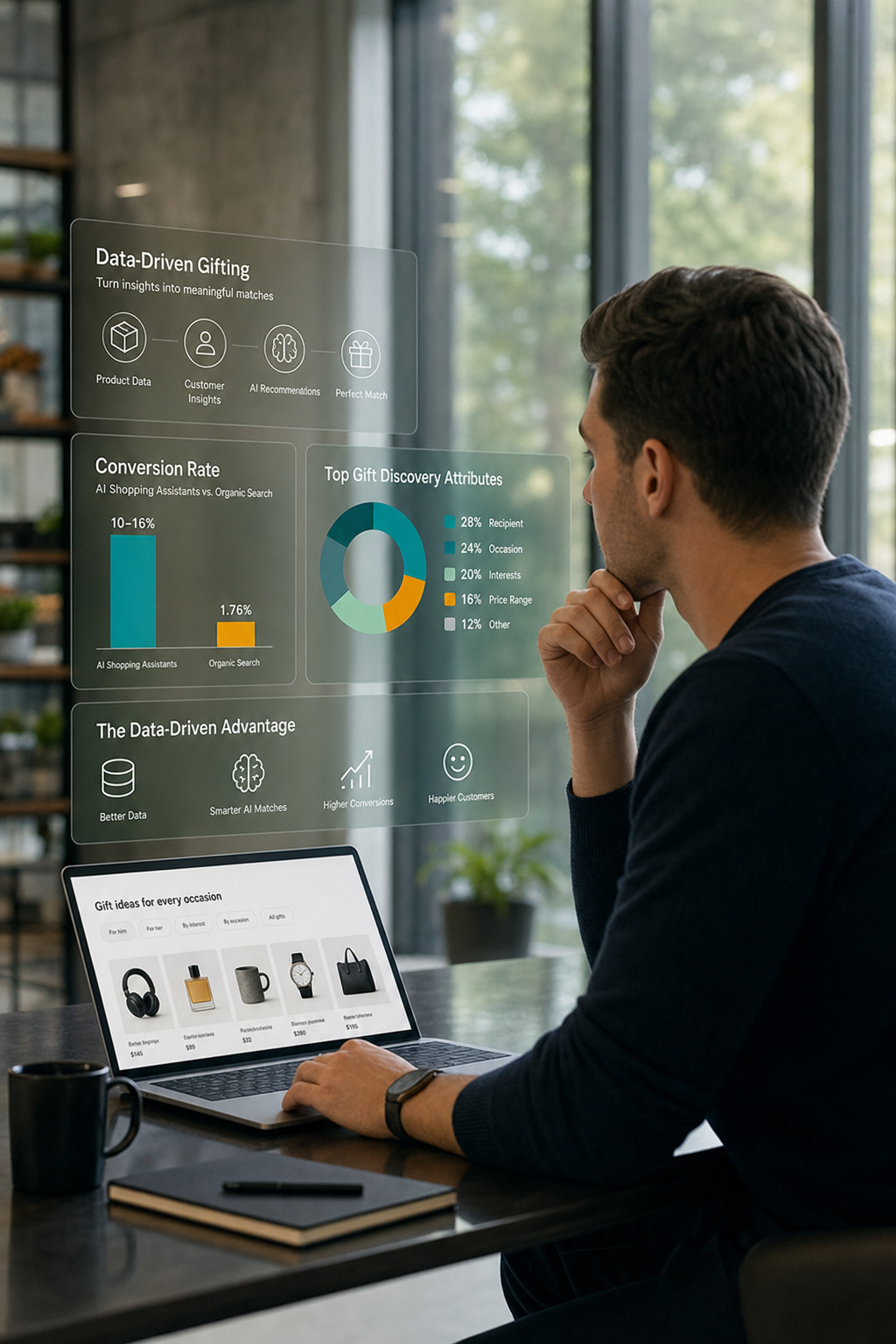
TL;DR: Data-driven gifting is the practice of using structured product data, customer insights, and AI-powered recommendation engines to match gifts with recipients based on measurable attributes rather than guesswork. For Shopify merchants, this means optimizing product data so AI shopping assistants like ChatGPT and Perplexity can recommend your products when customers search for gift ideas—a channel now converting at 10-16% compared to 1.76% for traditional organic search.
What Exactly Is Data-Driven Gifting?
Data-driven gifting replaces intuition-based gift selection with structured, measurable product attributes that AI systems can parse and recommend. Instead of relying on generic categories like "gifts for him," data-driven gifting uses specific attributes—price range, recipient personality, occasion type, material preferences, and use case—to match products with gift-givers who have clear intent but uncertain choices.
The shift matters because AI shopping assistants now intercept gift searches before customers reach your store. ChatGPT Shopping converts at 15.9% and Perplexity at 10.5%, compared to Google organic at 1.76%. When someone asks an AI assistant "what's a good gift for my sister who loves hiking," the products that surface are those with complete, structured data that agents can read and match.
Products with eight or more structured attributes are cited 4.3x more often in AI shopping results than products with fewer than three attributes. For gift-focused products, this means the difference between being recommended and being invisible.
Why Does Product Data Completeness Matter for Gifting?
Complete product data is the single lever Shopify merchants control that determines whether AI agents recommend their products for gift searches. AI shopping platforms like ChatGPT and Perplexity parse structured attributes to match products with buyer intent—and gift buyers have highly specific intent that generic descriptions fail to capture.
Consider what a gift buyer actually needs to know: price range, who the product suits, what occasion it fits, how it ships, and whether it arrives in time. If your product data answers these questions in structured fields, AI agents can recommend you. If it doesn't, they recommend competitors who do.
Shopify's Summer '26 Edition now shows merchants their ChatGPT and Gemini performance scores directly in the admin dashboard. This visibility means you can see exactly how your products perform in AI shopping channels and get specific guidance on improving each product's discoverability. The Shopify Catalog syndicates your product data to AI channels automatically, and internal Shopify data shows Catalog-fed AI searches convert at 2x the rate of searches using scraped product data.
How Do AI Shopping Assistants Choose Which Gifts to Recommend?
AI shopping assistants synthesize recommendations from structured product data, brand authority signals, and content freshness—not traditional search rankings. Research shows the overlap between top Google results and AI-cited sources has collapsed from 70% to below 20%, meaning your Google ranking tells you almost nothing about your AI visibility.
For gift recommendations specifically, AI agents prioritize:
- Complete product attributes including price, availability, shipping time, and return policy
- "Who this is for" content that explicitly states ideal recipient profiles
- Occasion-specific language that matches how gift buyers search
- Reviews and ratings that provide social proof for gift appropriateness
- Freshness signals—content updated within 30 days receives 3.2x more AI citations
Brand search volume is now the strongest predictor of AI citations, with a correlation of 0.664 compared to 0.218 for backlinks. This means building brand awareness through all channels—paid, social, influencer, email—directly improves your AI gifting visibility.
What Product Attributes Should Merchants Optimize for Gift Discovery?
Merchants should optimize every product intended for gifting with attributes that answer the specific questions gift buyers ask AI assistants. The minimum viable product data for AI gift recommendations includes recipient profile, occasion fit, price positioning, and delivery timing.
Critical attributes for gift products:
- Product name with clear descriptor (avoid keyword stuffing)
- Price and variant pricing fully specified
- "Perfect for" or "Who this is for" section explicitly naming recipient types
- Occasion tags (birthday, anniversary, holiday, thank you, corporate)
- Shipping time and cost with real-time accuracy
- Return policy clearly stated
- Gift-ready packaging availability
- Personalization options if applicable
- Minimum three product images including lifestyle shots showing the product as a gift
- At least ten reviews mentioning gift-giving context
Implement FAQ schema on product pages with gift-specific questions: "Is this a good gift for [recipient type]?" "Does this come gift-wrapped?" "Will this arrive by [occasion]?" Pages with FAQ schema are 3.2x more likely to appear in AI Overviews.
How Can Merchants Structure Content for AI Gift Searches?
Structure gift-related content using answer-first formatting where every section leads with a direct 40-60 word answer that AI engines can extract. AI models extract answers at 2.7x the rate from concise passages compared to longer, meandering content.
Create collection pages targeting "best [product category] for [recipient/occasion]" queries. These capture purchase-intent traffic and compound authority over time. Each collection page should include:
- Above-fold description (150-200 words) explaining who this collection serves
- Product grid with complete data on every item
- Below-fold buying guide (300-500 words) with gift selection criteria
- FAQ section with 5-8 questions in schema markup
Blog content should target the informational queries that precede gift purchases: "what to get someone who has everything," "thoughtful gifts under $50," "last-minute gift ideas that don't look last-minute." Each post needs a TL;DR box at the top, question-based H2 headings, and FAQ schema at the bottom.
Content freshness matters significantly. E-commerce content updated within 30 days receives 3.2x more AI citations than stale content. For gift-focused pages, update pricing, availability, and shipping estimates at least monthly, and refresh "best of" content quarterly with new products and current data.
What Role Does Agentic Commerce Play in Gifting?
Agentic commerce—where AI agents autonomously handle shopping transactions—is projected to redirect $3-5 trillion in global retail spend by 2030. For gifting, this means AI agents will increasingly complete entire gift purchases on behalf of users who set preferences once and let the agent execute.
Shopify merchants are already positioned for this shift. The Universal Commerce Protocol (UCP), developed by Google and Shopify, enables AI agents to build multi-item carts and complete checkout directly from your catalog. As of March 2026, UCP supports multi-item carts, live catalog queries, and loyalty program integration.
Merchants implementing both UCP and ACP (OpenAI's Agentic Commerce Protocol) capture 40% more agentic traffic than those using only one. Shopify abstracts this complexity—both protocols are auto-enabled on all stores—but the quality of your product data determines whether agents choose you.
The practical implication: when a customer tells ChatGPT "buy my mom something nice for her birthday under $75 that ships in two days," the agent will query product catalogs, filter by attributes, and complete checkout. Your product either meets those structured criteria or it doesn't exist in that transaction.
How Should Merchants Measure Data-Driven Gifting Success?
Measure data-driven gifting success through AI-referred traffic, AI-attributed conversions, and citation frequency across major AI platforms. Traditional SEO metrics tell you almost nothing about AI visibility—these are now separate games requiring separate measurement.
Key metrics to track:
- AI-referred sessions in GA4 (source = chatgpt.com, perplexity.ai, etc.)
- AI-referred revenue tracked separately from organic
- Product data completeness score in Shopify admin
- ChatGPT and Gemini performance scores in Shopify's new dashboard
- Citation frequency when testing gift-related queries across AI platforms
- Brand search volume trends in Google Trends
Test your AI visibility monthly by asking ChatGPT, Perplexity, and Claude gift-related queries in your category: "What's the best [your product type] as a gift?" "Recommend a [your category] for [recipient type]." Log whether your brand appears and in what context.
Perplexity responds to new content within days due to real-time retrieval. ChatGPT and Claude take 3-6 months for training-based influence. Google AI Overviews reflect indexed content within 2-4 weeks. Plan your content calendar accordingly—gift-focused content for major holidays needs to be live and indexed months before the season.
Frequently Asked Questions
What is data-driven gifting? Data-driven gifting uses structured product attributes, customer data, and AI recommendation engines to match gifts with recipients based on measurable criteria like price range, recipient profile, occasion type, and delivery timing rather than generic categories or guesswork.
How does data-driven gifting differ from traditional gift marketing? Traditional gift marketing relies on broad categories and seasonal campaigns. Data-driven gifting structures product data so AI shopping assistants can parse specific attributes and recommend products when customers ask questions like "what's a good gift for my hiking-obsessed brother under $100."
What product data do I need for AI gift recommendations? At minimum: clear product name, accurate pricing, recipient profile ("who this is for"), occasion tags, shipping time, return policy, gift packaging options, at least three images, and ten or more reviews. Products with eight or more structured attributes get cited 4.3x more often by AI.
How do I know if AI assistants are recommending my products? Shopify's Summer '26 Edition shows ChatGPT and Gemini performance scores in your admin dashboard. You can also manually test by asking gift-related queries to ChatGPT, Perplexity, and Claude and tracking whether your brand appears in recommendations.
Does my Google ranking affect AI gift recommendations? Minimally. Research shows overlap between Google rankings and AI citations collapsed from 70% to below 20%. Brand search volume and product data completeness are stronger predictors of AI visibility than traditional SEO rankings.
How quickly can I improve my AI gifting visibility? Perplexity reflects content changes within days. Google AI Overviews update within 2-4 weeks for indexed content. ChatGPT and Claude take 3-6 months for training-based changes. Start with product data completeness for fastest impact.
What's the ROI of optimizing for AI gift searches? ChatGPT Shopping converts at 15.9% and Perplexity at 10.5%, compared to 1.76% for Google organic. AI-referred visitors also deliver 57% higher AOV on Perplexity. The conversion lift alone justifies the optimization investment.
How does Shopify support data-driven gifting? Shopify auto-generates AI-facing files (llms.txt, agents.md), syndicates product data through the Shopify Catalog, and enables both UCP and ACP protocols by default. Your job is ensuring product data is complete and structured correctly.
