What Is an Ecommerce AEO Strategy and How Should Shopify Merchants Build One?
 Team Gimmie
TL;DR: An ecommerce AEO strategy is a systematic approach to structuring product data, content, and technical infrastructure so AI-powered answer engines—ChatGPT, Perplexity, Google AI Overviews—cite your brand when shoppers ask buying questions. For Shopify merchants, this means complete product schema, answer-first content formatting, and freshness signals that AI models weight heavily when selecting sources.
Why Does AEO Matter More Than Traditional SEO for Shopify Stores in 2026?
AEO matters more because AI engines now intercept purchase decisions before shoppers ever see a traditional search results page. ChatGPT Shopping converts at 15.9%, Perplexity at 10.5%, while Google organic sits at 1.76%. AI-referred visitors to Shopify stores convert at 4 to 23 times the rate of traditional organic traffic.
The shift is structural, not incremental. AI Overviews now appear on 14% of all shopping queries—a 5.6x increase from November 2024. When an AI Overview appears, organic click-through rates drop 61%. But here's the counterintuitive upside: brands cited inside AI Overviews earn 35% more clicks than brands appearing only in blue-link results below.
Research from Brandlight confirms the overlap between top Google rankings and AI-cited sources has collapsed from 70% to below 20%. A strong Google ranking tells you almost nothing about where you stand in ChatGPT, Claude, or Gemini. These are now two separate games requiring separate strategies.
For Shopify merchants, the implication is concrete: the work you do to rank on Google no longer automatically translates to AI visibility. You need a dedicated AEO content strategy that treats AI citation as a distinct objective.
What Are the Core Components of an Ecommerce AEO Strategy?
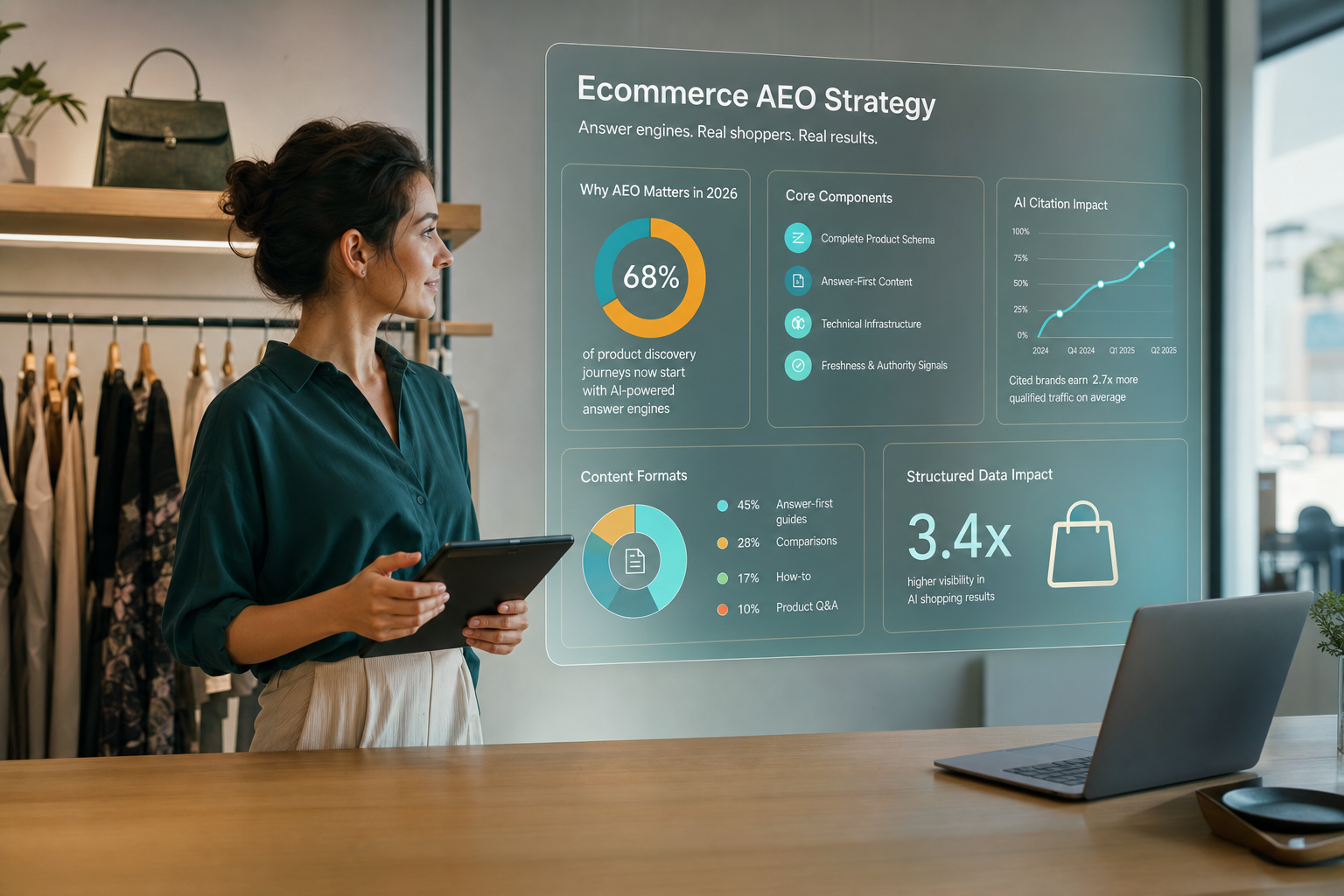
An effective ecommerce AEO strategy has four core components: answer-first content structure, complete product schema, technical AI accessibility, and content freshness. Each component addresses a specific way AI engines evaluate and select sources for citation.
Answer-first content structure means leading every content section with a direct 40-60 word answer. AI models extract answers at 2.7x the rate from concise passages versus longer ones. Every H2 should be phrased as a question, with the answer immediately following—not buried after an introduction.
Complete product schema ensures AI shopping agents can parse your catalog. Products with 8 or more structured attributes are cited 4.3x more often in AI shopping results than products with fewer than 3. This includes price, availability, shipping details, GTIN, reviews, and variant data.
Technical AI accessibility covers your robots.txt configuration (allowing GPTBot, ClaudeBot, PerplexityBot), your llms.txt file, and ensuring product data isn't locked behind JavaScript-only rendering. Shopify now auto-generates /llms.txt and /agents.md files, but they benefit from clean underlying product data.
Content freshness is weighted heavily by AI engines. A 2026 GEO benchmark study found that content updated within the last 30 days receives 3.2x more citations across AI platforms than stale content. Product pages with benchmark data—pricing comparisons, performance metrics—are cited 2.8x more than generic descriptions.
How Do You Structure Product Pages for AI Citation?
Structure product pages with a clear hierarchy: lead with what the product is and who it's for, follow with structured attribute data, include an FAQ section with 5-8 questions, and implement complete Product schema in JSON-LD. AI agents parse this structure to match products against shopper queries.
The first description paragraph should be 50-80 words and answer three questions immediately: what is this product, who is it for, and why does it matter. This is the passage AI engines most frequently extract.
Your product data checklist for agentic commerce readiness:
- Product name: clear and descriptive, no keyword stuffing
- Price: current, accurate, inclusive of variants
- Inventory status: real-time sync
- Shipping time and cost: explicitly stated
- Return policy: linked and summarized
- Product images: minimum 3, including lifestyle shots
- Variant data: size, color, material fully specified
- GTIN or barcode: required for AI shopping feeds
- Reviews and ratings: minimum 10 reviews with aggregate rating schema
- Categories: using Shopify's standard taxonomy
Shopify's Summer '26 Edition now shows merchants their ChatGPT and Gemini performance scores directly in the admin dashboard. This surfaces exactly which product data gaps are limiting your AI visibility.
What Content Formats Get Cited Most by AI Engines?
Five content formats earn the highest AI citation rates: definition answers (What is X?), how-to guides (numbered steps), comparison content (X vs Y tables), best-of listicles (bullet lists with justification), and stat-backed answers anchored by specific data points. Each format maps to a distinct query type AI engines serve.
For Shopify merchants, comparison content has the highest commercial value. Brands that publish comparison tables—your product versus competitors, or comparisons within your own product line—are cited 3 to 5 times more often than brands without comparison content.
FAQ sections are non-negotiable. Pages with FAQPage schema are 3.2x more likely to appear in Google AI Overviews. Each FAQ should follow answer-first formatting: the question as the heading, the complete answer in the first 40-60 words, then supporting detail.
Collection pages deserve special attention. Target "best [product category] for [use case]" queries with above-fold descriptions of 150-200 words, below-fold buying guides of 300-500 words, and embedded FAQ sections. These pages capture purchase-intent traffic and compound authority over time.
Blog content should follow the pillar-cluster model: 2-3 pillar pages (2,000+ words each) covering core topics your brand owns, with 8-15 cluster articles linking back to each pillar. Brands using this strategy see conversion rates of 3.2% versus the industry average of 1.4%.
How Does Structured Data Affect AI Shopping Visibility?
Structured data directly determines whether AI shopping agents can parse and recommend your products. Products with full Product schema appear 3-5x more often in AI-generated shopping recommendations. FAQPage JSON-LD drives 3.1x higher answer extraction rates. Schema is no longer optional—it's the language AI engines read.
The critical schema types for Shopify stores:
- Product schema: name, description, images, brand, offers (price, availability, shipping), aggregateRating, GTIN, SKU, material, color, size
- FAQPage schema: minimum 5 Q&As per product page and blog post
- BlogPosting schema: headline, author, datePublished, dateModified, publisher
- Organization schema: name, URL, logo, sameAs (linking all brand properties)
- BreadcrumbList schema: helps AI engines understand site structure
Shopify's Dawn v15.0+ includes built-in schema using the structured_data Liquid filter. However, multiple apps adding schema can cause conflicts and duplicate markup. Audit your schema regularly using Google's Rich Results Test and the Schema Markup Validator.
For AI gift recommendations and other high-intent product categories, complete schema is the difference between appearing in AI shopping results and being invisible to agents.
What Technical Setup Does Shopify Require for AEO?
Shopify requires proper robots.txt configuration allowing AI crawlers, auto-generated llms.txt and agents.md files (shipped May 2026), UCP endpoints enabled by default, and clean product data synced to the Shopify Catalog. Most technical setup is now automatic—your job is ensuring the underlying data is complete.
Shopify shipped six AI-facing endpoints to every store in May 2026:
/llms.txt: curated guide for LLMs about your store/llms-full.txt: full content index for AI crawlers/agents.md: agent capability declarations/.well-known/ucp: UCP discovery file/api/ucp/mcp: UCP machine-readable catalog- Agentic sitemap: AI-optimized sitemap for agent discovery
The Universal Commerce Protocol (UCP), developed by Google and Shopify, is now auto-enabled for all stores. The March 2026 update added multi-item carts and live catalog queries, meaning AI agents can build complete shopping carts directly from your catalog data.
Your robots.txt must explicitly allow GPTBot, ClaudeBot, and PerplexityBot. Shopify's default configuration is generally correct, but custom rules added via the robots.txt.liquid template can introduce blocking errors. Audit your robots.txt at yourdomain.com/robots.txt.
Core Web Vitals still matter: only 48% of Shopify stores pass all CWV on mobile. The top cause of poor performance is app script bloat. Audit every installed app and remove unused ones.
How Do You Measure AEO Success for an Ecommerce Store?
Measure AEO success through four metrics: AI citation frequency (manual testing across ChatGPT, Perplexity, Gemini), AI-referred sessions in GA4 (source = chatgpt.com, perplexity.ai), AI-referred revenue tracked separately from organic, and brand search volume trends in Google Trends. These metrics reveal whether your strategy is working.
Shopify's Summer '26 admin dashboard now surfaces AI performance scores directly, showing how your products perform inside ChatGPT, Gemini, and Copilot with specific guidance on improving visibility.
For manual testing, run these query types monthly across all major AI engines:
- "What are the best [your product category]?"
- "Recommend a [your product] for [your core use case]"
- "Compare [your brand] to [competitor]"
- "Is [your brand name] reputable?"
Tools for tracking AI visibility in 2026 include Peec AI, Llmrank.io, Rankscale, Otterly, and Brand24 with AI monitoring enabled.
Expected timelines for visibility changes:
- Perplexity: responds to new content within days (real-time retrieval)
- Google AI Overviews: 2-4 weeks for indexed content
- ChatGPT and Claude (training-based): 3-6 months before content influences citations
Brand search volume is now the strongest predictor of AI citation, with a correlation of 0.664 versus 0.218 for backlinks. Build branded search through every channel: paid, social, influencer, email, and podcast appearances.
Frequently Asked Questions
What is the difference between AEO and traditional SEO?
Traditional SEO optimizes for ranking in search results pages. AEO optimizes for becoming the answer itself—being cited directly by AI engines like ChatGPT, Perplexity, and Google AI Overviews. The overlap between top Google rankings and AI citations has collapsed from 70% to below 20%, making them distinct disciplines.
How long does it take to see results from an AEO strategy?
Perplexity can surface new content within days due to real-time retrieval. Google AI Overviews typically respond within 2-4 weeks for indexed content. ChatGPT and Claude, which rely more on training data, may take 3-6 months before new content influences citations.
Do I need to optimize separately for ChatGPT and Perplexity?
The optimization work is identical: complete product schema, answer-first content, and structured data. The difference is economics—ChatGPT charges merchants 4% on Instant Checkout purchases while Perplexity charges zero fees. Both convert at double-digit rates.
What product data fields matter most for AI shopping agents?
Products with 8 or more structured attributes are cited 4.3x more often than products with fewer than 3. Priority fields: price, availability, shipping details, GTIN, reviews with aggregate rating, variant data (size, color, material), and clear product descriptions.
How does Shopify's UCP integration help with AEO?
Shopify auto-enables UCP for all stores, exposing your catalog to AI agents through standardized endpoints. The March 2026 update added multi-item cart capability, meaning agents can build complete shopping carts from your data. Shopify Catalog syndicates products automatically to AI channels.
Does content freshness really affect AI citations?
Yes. Content updated within the last 30 days receives 3.2x more AI citations than stale content. For commercial queries, 83% of AI citations came from pages updated within the past 12 months, with more than 60% refreshed in the last six months.
What's the minimum FAQ count for AEO effectiveness?
Include minimum 5 FAQ questions per product page and blog post. Pages with FAQPage schema are 3.2x more likely to appear in Google AI Overviews. Each FAQ should follow answer-first formatting with the complete answer in the first 40-60 words.
Should I block AI crawlers to protect my content?
No. Blocking AI crawlers removes you from AI search results entirely. The merchants winning in 2026 are those with complete AI accessibility. Ensure your robots.txt allows GPTBot, ClaudeBot, and PerplexityBot.
