What Is Agentic Commerce SEO and How Should Shopify Merchants Prepare?
 Team Gimmie
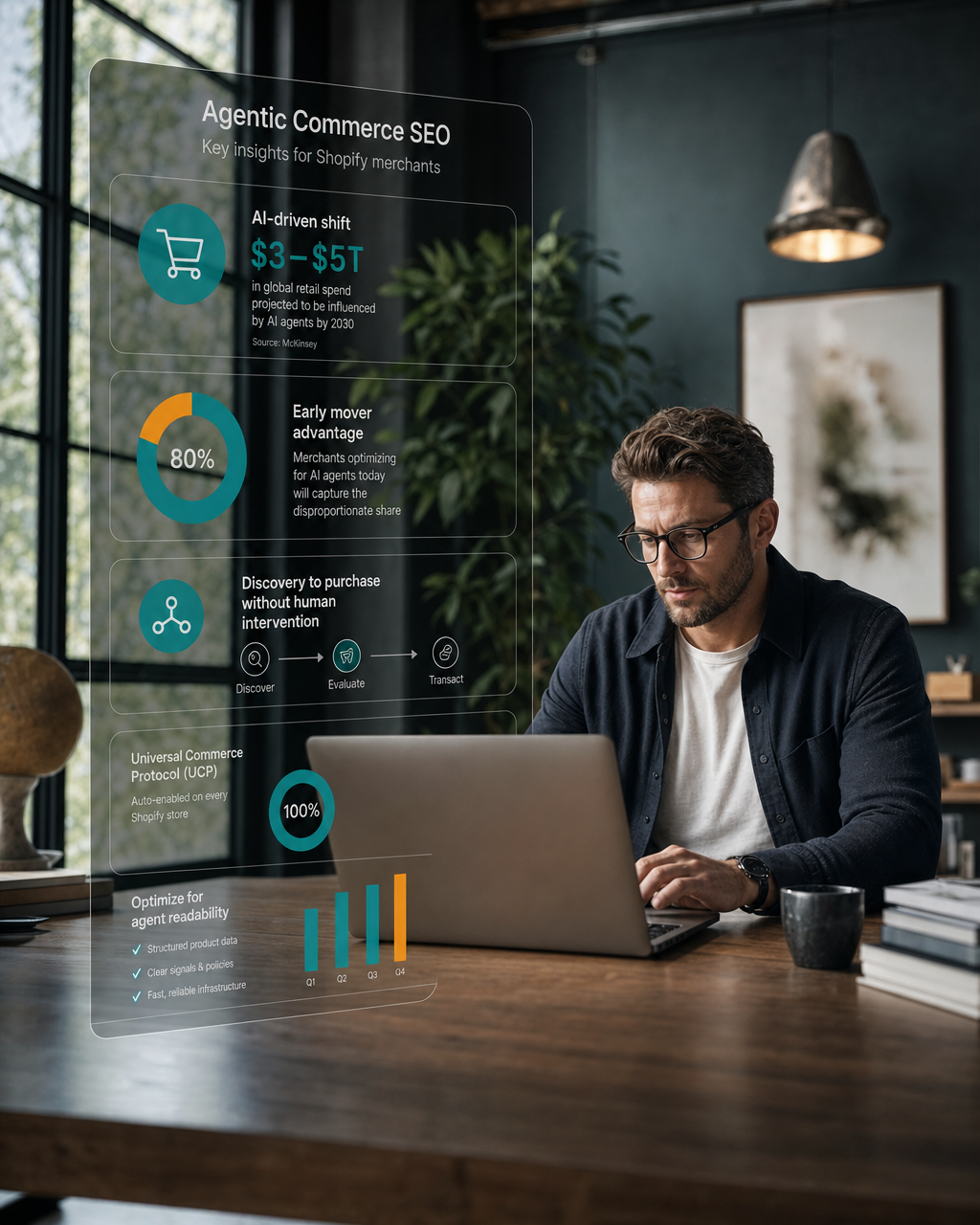
TL;DR: Agentic commerce SEO is the practice of optimizing your Shopify store so AI shopping agents can discover, evaluate, and transact on your products without human intervention. With McKinsey projecting $3 to $5 trillion in global retail spend redirected by AI agents by 2030, and Shopify already auto-enabling Universal Commerce Protocol on every store, the merchants who structure their product data for agent readability now will capture disproportionate share of this emerging channel.
What Is Agentic Commerce SEO?
Agentic commerce SEO combines traditional search optimization with the technical and content requirements that AI shopping agents need to autonomously complete purchases on behalf of consumers. Unlike conventional SEO that targets human searchers clicking through results, agentic commerce SEO targets machine agents that parse structured data, evaluate product attributes, and execute checkout flows without a human ever visiting your storefront.
The distinction matters because AI agents do not browse. They query. When a consumer tells ChatGPT or Google's Gemini to "find me a sustainable yoga mat under $80 with free shipping," the agent does not scroll through search results. It retrieves structured product data from stores that have made themselves agent-readable, compares attributes programmatically, and either recommends or purchases directly.
This shift is already measurable. AI-referred traffic to Shopify stores grew 8x year over year by Q1 2026, and AI-attributed orders grew 13x in the same window. ChatGPT Shopping converts at 15.9% compared to Google organic's 1.76%. The infrastructure is live. The question is whether your store is readable to it.
Why Does Agentic Commerce SEO Matter for Shopify Merchants Now?
The window for early-mover advantage in agentic commerce is open but narrowing. McKinsey estimates AI agents could redirect $3 to $5 trillion in global retail spend by 2030, yet only 13% of consumers have completed a purchase via AI referral so far. That gap between consumer comfort (70% are willing to let agents buy for them) and actual adoption represents the first-mover window.
Shopify has already built the infrastructure. Every Shopify store now has six AI-facing endpoints enabled by default, including /llms.txt, /.well-known/ucp, and an agentic sitemap. The Universal Commerce Protocol launched by Google and Shopify in January 2026 received a major update in March adding multi-item cart capabilities and live catalog queries.
The competitive dynamic is structural. Products with 8 or more structured attributes are cited 4.3x more often in AI shopping results than products with fewer than 3 attributes. Brands that complete their product data now build citation authority that compounds over time. Late movers will find the shelf already occupied.
How Do AI Shopping Agents Discover and Select Products?
AI shopping agents use a fundamentally different discovery mechanism than search engines. They retrieve structured data through standardized protocols, evaluate products against user-specified criteria, and make selection decisions based on attribute completeness and accuracy rather than page rank or backlink profiles.
Two protocols now govern this interaction. ACP (Agentic Commerce Protocol), developed by OpenAI and Stripe, handles checkout sessions and payment transmission, with ChatGPT charging merchants 4% on completed purchases. UCP (Universal Commerce Protocol), developed by Google and Shopify, covers the full journey from discovery through post-purchase support with no transaction fee.
For Shopify merchants, both protocols are abstracted away. Shopify handles the integration automatically. What remains in your control is whether your product data is complete enough for agents to select you over competitors. The checklist is specific: product name, price, real-time inventory status, shipping time and cost, return policy, minimum three product images, fully specified variant data, GTIN or barcode, brand name, AI-optimized description, reviews and ratings, and categories using Shopify's standard taxonomy.
What Technical Requirements Must Shopify Stores Meet for Agent Readability?
Agent readability requires technical foundations that go beyond traditional SEO. Your store must allow AI crawlers access, serve structured data in formats agents can parse, and maintain data consistency across your store, feeds, and the Shopify Catalog.
Start with your robots.txt file. Shopify's default configuration is generally well-configured, but custom rules can inadvertently block AI bots. Explicitly allow GPTBot, ClaudeBot, PerplexityBot, and GoogleBot unless you have a specific reason to block them. Verify your configuration at yourdomain.com/robots.txt.
Shopify auto-generates /llms.txt as of May 2026, but you can customize it to include your brand description, key pages, top products with prices, and brand voice guidelines. The /agents.md file declares your store's agent capabilities, and the /.well-known/ucp endpoint enables UCP discovery.
Structured data is non-negotiable. Products with full Product schema appear 3-5x more often in AI-generated shopping recommendations. Implement complete JSON-LD markup including offers, aggregate ratings, shipping details, and all product attributes. Dawn v15.0+ includes built-in schema support, but audit regularly for conflicts from multiple apps adding duplicate markup.
How Should Merchants Structure Product Data for AI Agents?
Product data structure determines whether agents can evaluate and select your products. The requirement is completeness: every attribute that could influence a purchase decision must be explicitly declared in a machine-readable format.
The minimum viable product listing for agentic commerce includes clear product names without keyword stuffing, current and accurate pricing inclusive of variants, real-time inventory status, shipping time and cost, return policy, at least three product images including lifestyle shots, fully specified variant data for size, color, and material, GTIN or barcode, brand name, description optimized for AI extraction, minimum 10 reviews with aggregate rating, and categories using Shopify's standard taxonomy.
Beyond the checklist, structure your product descriptions in answer-first format. Lead with what the product is, who it is for, and why it matters in the first 50-80 words. AI agents extract information from concise, structured passages at 2.7x the rate of longer unstructured content. Include a "Who this is for" section that explicitly states the ideal customer profile.
The Shopify Catalog syndicates your product data to AI channels automatically. Shopify's internal data shows Catalog-fed AI searches convert at 2x the rate of searches using scraped product data. Keeping your Catalog data complete and accurate is now a revenue driver, not just a hygiene task.
What Content Strategy Supports Agentic Commerce SEO?
Content strategy for agentic commerce extends answer engine optimization principles to support the full agent discovery journey. The goal is to be the source AI engines cite when consumers ask questions that lead to purchase decisions.
AI Overviews now appear on 14% of shopping queries, a 5.6x increase from November 2024. For informational queries like "best [product] for [use case]," AI Overview presence reaches 83%. These top-of-funnel queries are where agents form brand awareness and preference before transactional intent crystallizes.
Structure your content around question-based H2 headings with 40-60 word direct answers in the first paragraph of each section. Include FAQ sections with minimum 5 questions on every product page, collection page, and blog post. Implement FAQPage schema on all FAQ content. Pages with FAQ schema are 3.2x more likely to appear in AI Overviews.
Content freshness matters significantly. E-commerce content updated within the last 30 days receives 3.2x more AI citations than stale content. Product pages with benchmark data like pricing comparisons and performance metrics are cited 2.8x more than generic descriptions. Schedule quarterly audits of your top-performing content to add fresh data points and update statistics.
How Can Merchants Measure Agentic Commerce Performance?
Measurement for agentic commerce requires tracking AI-specific channels separately from traditional organic traffic. The metrics that matter are AI-referred sessions, AI-referred revenue, agent-originated orders, and product data completeness scores.
Shopify's Summer '26 Edition introduced a new admin section showing how products perform inside ChatGPT, Gemini, and Copilot with specific guidance on improving visibility in each. Check this dashboard regularly. If you are not monitoring it, your competitors are.
In Google Analytics 4, segment traffic by source to isolate visits from chatgpt.com, perplexity.ai, and other AI referrers. Track conversion rates for these segments separately. AI-referred visitors convert at 4-23x the rate of traditional organic visitors, so even small volumes can drive meaningful revenue.
For broader AI visibility, test 10 target queries monthly across ChatGPT, Perplexity, and Google AI Overviews. Log whether your brand is mentioned, in what context, and whether product details are accurate. Tools like Peec AI, Llmrank.io, and Otterly can automate this monitoring. Expected timelines for content to influence citations vary: Perplexity responds within days, Google AI Overviews within 2-4 weeks, and ChatGPT training-based citations within 3-6 months.
Frequently Asked Questions
What is the difference between agentic commerce SEO and traditional SEO?
Traditional SEO optimizes for human searchers who click through results and browse pages. Agentic commerce SEO optimizes for AI agents that programmatically query structured data, evaluate product attributes, and execute purchases without human page visits. The technical requirements overlap but the success metrics differ: agent readability and data completeness matter more than page rank.
Do I need to implement UCP and ACP separately on my Shopify store?
No. Shopify abstracts both protocols for merchants. UCP is auto-enabled on every Shopify store as of late March 2026, and ACP integration is native. Your work is ensuring your product data is complete enough for agents operating on either protocol to select your products.
How long does it take for product data improvements to affect AI visibility?
Timelines vary by platform. Perplexity uses real-time web retrieval and can respond to new content within days. Google AI Overviews typically reflect indexed content within 2-4 weeks. ChatGPT and Claude training-based citations take 3-6 months to reflect content changes.
What is the minimum product data required for agentic commerce?
The minimum includes product name, accurate price, real-time inventory status, shipping details, return policy, at least three images, fully specified variants, GTIN or barcode, brand name, AI-optimized description, reviews with aggregate rating, and standard taxonomy categories. Products with 8 or more structured attributes are cited 4.3x more often than those with fewer than 3.
Does Perplexity or ChatGPT convert better for e-commerce?
ChatGPT Shopping converts at 15.9% versus Perplexity at 10.5%, but Perplexity charges zero transaction fees while ChatGPT charges 4%. The optimization work is identical for both platforms, so prepare for both and let the economics play out based on your margins.
How do I check if my Shopify store is agent-readable?
Visit yourdomain.com/llms.txt, yourdomain.com/agents.md, and yourdomain.com/.well-known/ucp to verify these endpoints exist and contain accurate information. Check your robots.txt to confirm AI crawlers are allowed. Use Google's Rich Results Test to validate your Product schema implementation.
What is the ROI case for investing in agentic commerce SEO now?
AI-referred visitors convert at 4-23x traditional organic rates. AI-attributed orders on Shopify grew 13x year over year by Q1 2026. McKinsey projects $3-5 trillion in global retail spend redirected by AI agents by 2030. Early movers build citation authority that compounds, while late movers face an already-occupied shelf.
