What Is Agentic AI for Retailers and How Should Shopify Merchants Prepare?
 Team Gimmie
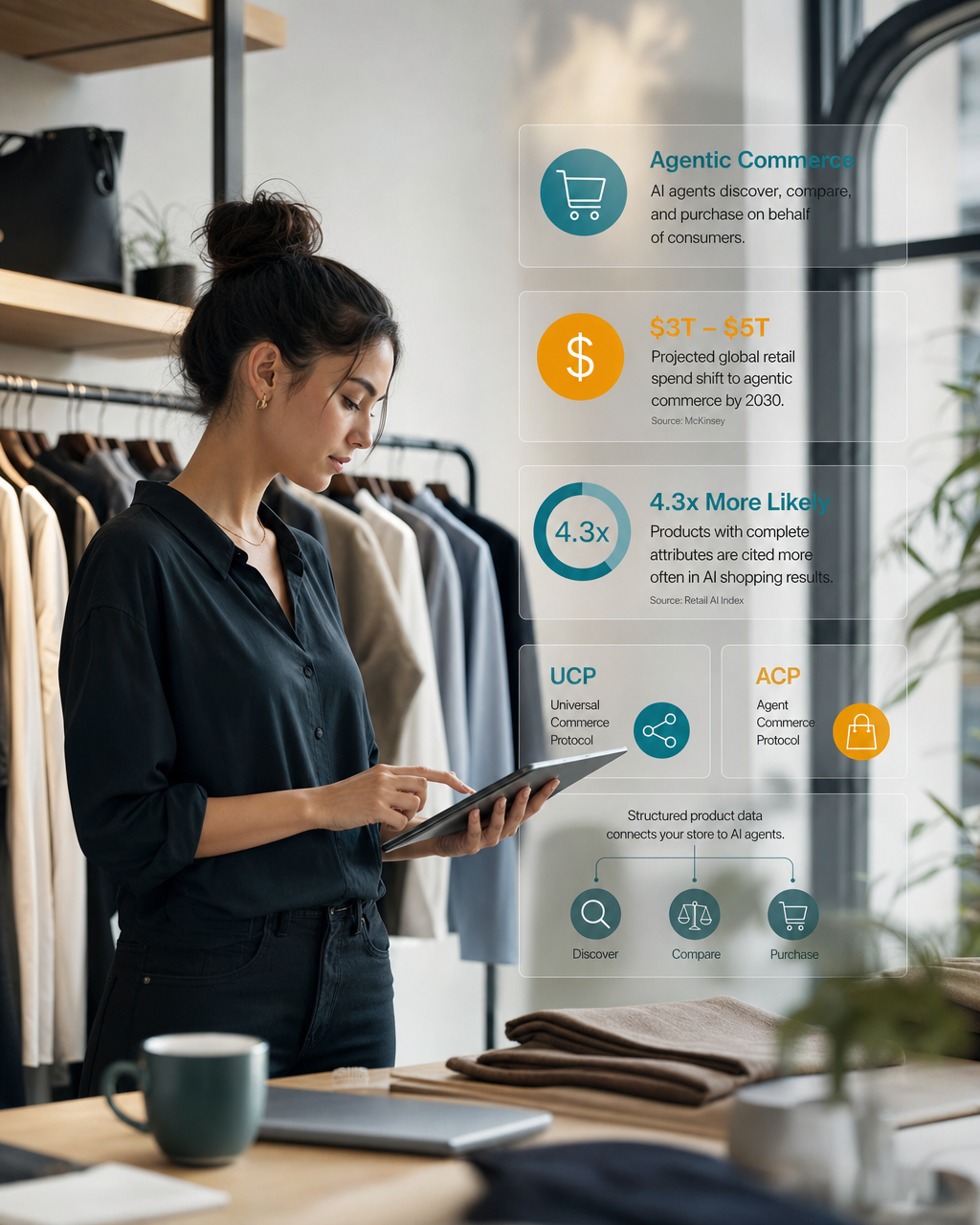
TL;DR: Agentic AI for retailers refers to autonomous AI systems that discover, compare, and purchase products on behalf of consumers. For Shopify merchants, preparation means ensuring product data is complete, structured, and accessible to AI agents operating on protocols like UCP and ACP. McKinsey projects agentic commerce could redirect $3 to $5 trillion in global retail spend by 2030, and brands with complete product attributes are already being cited 4.3x more often in AI shopping results.
What Is Agentic AI for Retailers?
Agentic AI for retailers describes AI systems that autonomously execute shopping tasks on behalf of consumers, from product discovery and comparison to checkout and post-purchase support. Unlike traditional recommendation engines that suggest products, agentic AI makes decisions and completes transactions. The consumer sets preferences once, and the agent handles the entire journey.
This shift is already underway. According to industry research, 73% of consumers now use AI somewhere in their shopping journey, and 70% are at least somewhat comfortable letting an AI agent buy on their behalf. AI platforms are expected to account for $20.9 billion in retail spending in 2026, quadrupling the 2025 figure. The implications for Shopify merchants are concrete: if an AI agent cannot read your product data, it cannot recommend your product.
The two dominant protocols governing agentic commerce are ACP (developed by OpenAI and Stripe) and UCP (developed by Google and Shopify). Both are now natively integrated into Shopify stores, meaning the technical infrastructure is handled for you. What remains in your control is whether your product data is complete enough for agents to choose you over a competitor.
Why Does Product Data Completeness Matter for Agentic AI?
Products with 8 or more structured attributes are cited 4.3x more often in AI shopping results than products with fewer than 3 attributes. AI agents parse structured data to understand what a product is, who it is for, and whether it meets the buyer's criteria. Incomplete data means invisibility.
For Shopify merchants, this translates to a specific checklist. Every product needs a clear name, accurate price, real-time inventory status, shipping time and cost, return policy, at least three images including lifestyle shots, fully specified variant data (size, color, material), GTIN or barcode, brand name, an AI-extractable description, minimum 10 reviews, and categories using Shopify's standard taxonomy.
Shopify's Catalog now syndicates product data to AI channels automatically. Internal Shopify data shows Catalog-fed AI searches convert at 2x the rate of searches using scraped product data. The gap between merchants with complete data and those without is widening every month.
How Do UCP and ACP Work Together for Shopify Stores?
UCP handles the full shopping journey from discovery through post-purchase support, while ACP focuses on checkout sessions and secure payment transmission. Merchants implementing both protocols capture 40% more agentic traffic than those using only one. Shopify abstracts this complexity entirely.
UCP, developed by Google and Shopify with over 20 endorsing companies including Visa, Mastercard, and Stripe, received a significant update in March 2026. The new Cart capability lets agents add multiple items per store in a single session rather than running separate checkout flows per item. The Catalog API enables agents to query live inventory, variants, and pricing directly from the merchant's server.
ACP, developed by OpenAI and Stripe, powers ChatGPT Instant Checkout. OpenAI charges merchants 4% on completed purchases. Perplexity's competing Instant Buy feature, built on PayPal, charges zero fees. Both platforms convert at double-digit rates—ChatGPT at 14-16%, Perplexity at 10.5%—and both require the same optimization work: complete product schema and structured attributes.
Shopify shipped six AI-facing endpoints to every store in May 2026: /llms.txt, /llms-full.txt, /agents.md, /.well-known/ucp, /api/ucp/mcp, and an agentic sitemap. These files exist by default, but they benefit from clean, complete product data in your store.
What Should Shopify Merchants Do This Week to Prepare?
Start with a product data audit. Check that every product has all required and recommended attributes populated. Verify prices, availability, and descriptions match what agents will report to users. Ensure variant data is fully specified and categories use Shopify's standard taxonomy.
The Summer '26 Edition added a new admin section showing how your products perform inside ChatGPT, Gemini, and Copilot. This score is now visible from your Shopify dashboard with specific guidance on improving visibility in each AI platform. If you have not checked it yet, your competitors likely have.
Content freshness also matters. A 2026 GEO benchmark study confirmed that e-commerce content updated within the last 30 days receives 3.2x more citations across AI platforms than stale content. Product pages with benchmark data—pricing comparisons, performance metrics—are cited 2.8x more than generic descriptions. The cheapest move you can make is refreshing your top product pages with current comparison data.
Finally, verify your robots.txt allows AI crawlers. Shopify's default configuration is generally sound, but custom rules can introduce blocking errors. Confirm GPTBot, PerplexityBot, and ClaudeBot are explicitly allowed.
How Does Agentic AI Change the Competitive Landscape for DTC Brands?
Agentic commerce may enable DTC brands to bypass Amazon entirely. When AI agents can route high-intent customers directly to your checkout, you reduce dependence on marketplace commissions. The first movers building agent-accessible product data now will have structural advantages as agentic commerce scales.
The math is straightforward. AI-referred visitors to Shopify stores convert at 4-23x the rate of traditional organic visitors. ChatGPT Shopping converts at 15.9%, Perplexity at 10.5%, Google organic at 1.76%. AI-attributed orders on Shopify grew 13x year over year by Q1 2026. The brands capturing this traffic are those whose product data agents can read and trust.
Brandlight research shows the overlap between top Google search results and AI-cited sources has collapsed from 70% to below 20%. A strong Google ranking tells you almost nothing about where you stand in ChatGPT, Claude, or Gemini. These are now two separate games requiring separate strategies. Traditional SEO optimizes for Google rankings. Answer engine optimization optimizes for AI citations.
What Metrics Should Merchants Track for Agentic Commerce?
Track agent-originated orders through Shopify Analytics channel attribution. Monitor ACP and UCP traffic through referral analysis. Audit product data completeness monthly, targeting 100% on all fields. Verify Catalog syndication status to ensure all products are eligible for AI discovery.
For AI visibility specifically, test 10 target queries across ChatGPT, Perplexity, and Google AI Overviews each month. Log brand mention frequency and context. Check AI-referred traffic in GA4 by filtering for sources like chatgpt.com and perplexity.ai. Monitor branded search volume trends in Google Trends—brand search volume is now the strongest predictor of AI citation, correlating at 0.664 versus 0.218 for backlinks.
Tools for tracking LLM visibility in 2026 include Peec AI, Llmrank.io, Rankscale, Otterly, Brand24 with AI monitoring, and Adobe LLM Optimizer. Expected timelines vary by platform: Perplexity responds to new content within days, ChatGPT and Claude take 3-6 months for training-based influence, and Google AI Overviews reflect indexed content within 2-4 weeks.
What Is the Timeline for Agentic Commerce Adoption?
McKinsey estimates agentic commerce could redirect $3 to $5 trillion in global retail spend by 2030. Morgan Stanley projects that nearly half of online shoppers will use AI shopping agents by 2030, accounting for roughly 25% of their total spending. The consumer comfort is there—73% already use AI in their shopping journey—but only 13% have completed a purchase via AI referral so far.
That gap is the first-mover window. The brands building agent-accessible product data now will be embedded in AI recommendation patterns before the mainstream adoption wave. Late movers will struggle to displace brands already cited in LLM training data.
For Shopify merchants, the infrastructure is already in place. UCP is enabled by default on every store. The Shopify Catalog syndicates your products automatically. The only variable left is whether your product data is complete, accurate, structured, consistent, and agent-accessible. That is the work that separates brands AI agents recommend from brands they ignore.
Frequently Asked Questions
What is agentic AI for retailers? Agentic AI for retailers refers to autonomous AI systems that handle shopping tasks on behalf of consumers, including product discovery, comparison, checkout, and post-purchase support. Unlike recommendation engines that suggest products, agentic AI makes decisions and completes transactions based on consumer preferences set once.
How do UCP and ACP differ for Shopify merchants? UCP (Universal Commerce Protocol), developed by Google and Shopify, handles the full shopping journey from discovery through post-purchase. ACP (Agentic Commerce Protocol), developed by OpenAI and Stripe, focuses on checkout sessions. Shopify integrates both natively, so merchants do not manage them directly—they just need complete product data.
What product data do AI agents require? AI agents need product name, accurate price, real-time inventory status, shipping details, return policy, minimum three images, fully specified variant data, GTIN or barcode, brand name, AI-extractable description, minimum 10 reviews, and categories using Shopify's standard taxonomy.
How much does ChatGPT Shopping charge merchants? OpenAI charges merchants 4% on completed Instant Checkout purchases through ChatGPT Shopping. Perplexity's competing Instant Buy feature charges zero listing fees, zero commissions, and zero transaction fees. Both platforms convert at double-digit rates.
How can I check my AI visibility score on Shopify? Shopify's Summer '26 Edition added a new admin section showing how your products perform inside ChatGPT, Gemini, and Copilot. Access it from your Shopify dashboard to see specific guidance on improving visibility in each AI platform.
Why does product data completeness matter for AI citations? Products with 8 or more structured attributes are cited 4.3x more often in AI shopping results than products with fewer than 3 attributes. AI agents parse structured data to understand products and match them to buyer criteria. Incomplete data means invisibility.
What is the projected market size for agentic commerce? McKinsey estimates agentic commerce could redirect $3 to $5 trillion in global retail spend by 2030. AI platforms are expected to account for $20.9 billion in retail spending in 2026, quadrupling the 2025 figure.
How quickly do AI platforms reflect new product content? Perplexity responds to new content within days due to real-time retrieval. Google AI Overviews reflect indexed content within 2-4 weeks. ChatGPT and Claude take 3-6 months for content to influence training-based citations.
