What Is AEO for Shopify and How Do Merchants Optimize for AI Search?
 Team Gimmie
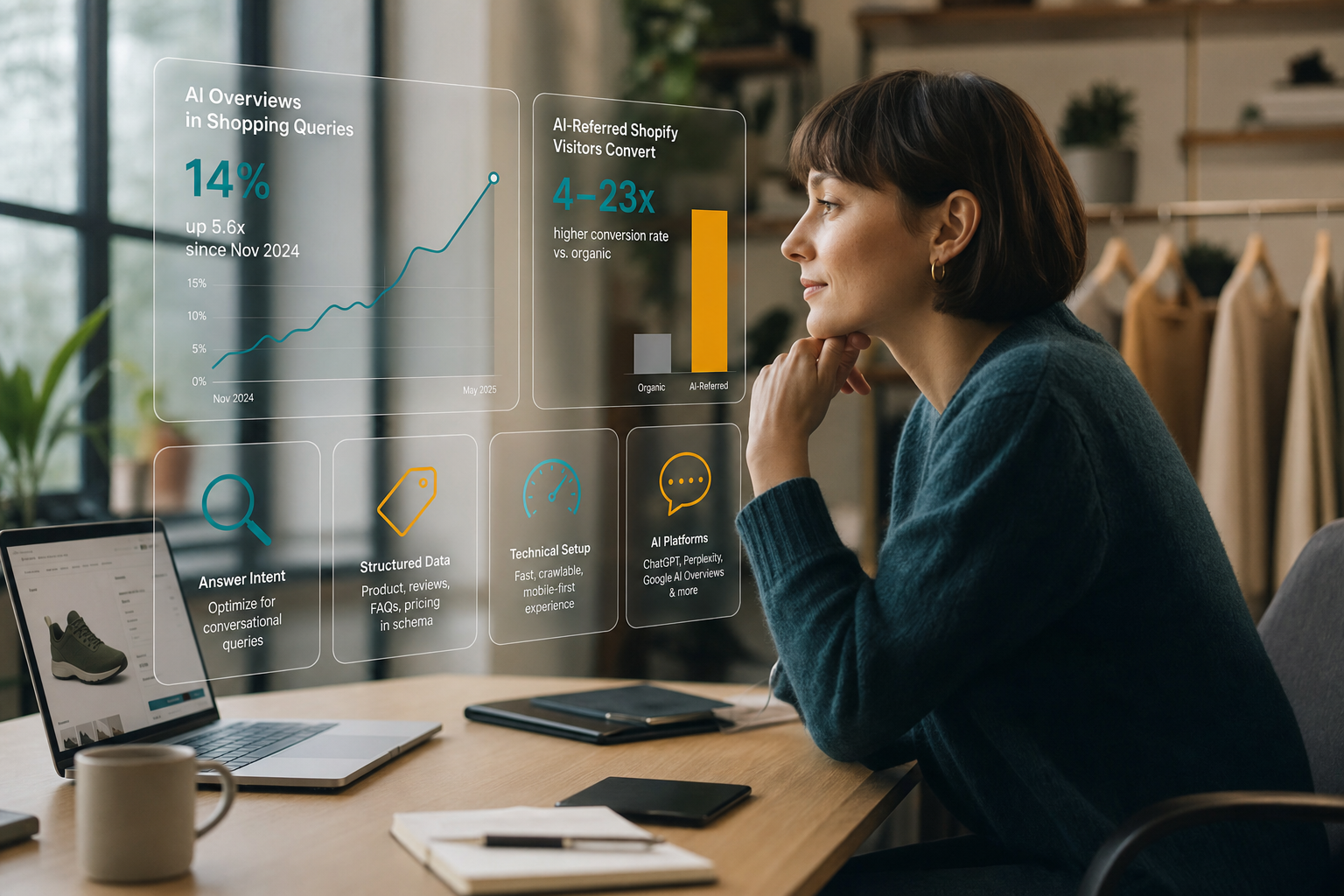
TL;DR: AEO (Answer Engine Optimization) for Shopify is the practice of formatting your store's content, product data, and technical setup so AI-powered search engines—ChatGPT, Perplexity, Google AI Overviews—extract and cite your brand as the direct answer to shopper queries. With AI Overviews now appearing on 14% of shopping queries (up 5.6x since November 2024) and AI-referred Shopify visitors converting at 4–23x the rate of traditional organic traffic, AEO is no longer optional. It's the new front door to product discovery.
Why Does AEO Matter for Shopify Merchants in 2026?
AEO matters because AI engines are intercepting purchase decisions before shoppers ever reach your store. ChatGPT handles over 2 billion queries daily, and AI-referred traffic to Shopify stores grew 8x year over year by Q1 2026. Brands cited inside AI Overviews earn 35% more organic clicks than brands appearing only in traditional blue-link results below.
The structural shift is unmistakable. When an AI Overview appears, organic CTR drops 61%. Yet 93% of Google AI Mode sessions end without a click to any website. The implication: if you're not inside the AI answer, you're invisible to a growing share of high-intent shoppers.
Here's what makes this urgent for Shopify merchants specifically:
- ChatGPT Shopping converts at 15.9%, Perplexity at 10.5%, versus Google organic at 1.76%
- AI-attributed orders on Shopify grew 13x in the same window as the 8x traffic increase
- Perplexity shoppers deliver 57% higher AOV than traditional visitors
- Products with 8+ structured attributes are cited 4.3x more often than products with fewer than 3
The brands winning now built their AI visibility infrastructure 12–18 months ago. The window for first-mover advantage is narrowing—HubSpot just built AEO directly into its marketing platform, signaling that this is becoming table stakes, not an edge tactic.
What Makes AEO Different From Traditional SEO?
AEO differs from traditional SEO because AI engines synthesize answers rather than rank pages. Traditional SEO optimizes for position in a list of links. AEO optimizes to become the answer itself—the source that ChatGPT, Perplexity, or Google AI Overviews cite when a shopper asks a question.
Research from Brandlight shows the overlap between top Google search results and AI-cited sources has collapsed from 70% to below 20%. A brand can rank first on Google for a query and be completely absent from ChatGPT's answer to the same question. These are now two separate games requiring separate strategies.
The key differences:
- Backlinks vs. brand mentions: Brand mentions correlate 3x more strongly with AI visibility than backlinks (0.664 vs. 0.218 correlation)
- Page ranking vs. passage extraction: AI engines cite individual sections, not whole pages—each H2 must stand alone as a complete answer
- Keyword density vs. answer completeness: AI models extract answers at 2.7x the rate from concise 40–60 word passages versus longer content
- Domain authority vs. content freshness: E-commerce content updated within the last 30 days receives 3.2x more AI citations than stale content
For Shopify merchants, this means your product pages, collection descriptions, and blog content all need to be restructured around the questions shoppers actually ask AI assistants.
How Do You Structure Shopify Content for AI Citation?
Structure every piece of content with a direct answer in the first 40–60 words of each section, followed by supporting evidence. AI engines extract answers from concise, self-contained passages—not from content that builds up to a conclusion. Lead with the answer, then explain.
The AEO content framework for Shopify:
- Question-based H2s: Every major section heading should be phrased as a question or directly answer one
- 40–60 word answer blocks: The first one to two sentences of each section must provide a complete, standalone answer
- Self-contained chunks: Each H2 or H3 section must function independently—AI engines frequently cite individual sections, not whole pages
- FAQ sections: Include 5–8 Q&As at the bottom of every article and product page, implemented with FAQPage schema
For product pages specifically:
- Open descriptions with "what it is, who it's for, why it matters" in the first 50–80 words
- Add a "Who this is for" section explicitly stating the ideal customer profile
- Include comparison sections (vs. competitors or within your own product line)
- Build FAQ sections with the actual questions shoppers ask ChatGPT about your category
Pages with FAQ schema are 3.2x more likely to appear in Google AI Overviews. Products with full Product schema appear 3–5x more often in AI-generated shopping recommendations.
What Technical Setup Does Shopify Require for AEO?
Shopify now auto-generates the core AI-facing infrastructure every store needs, but merchants must ensure their product data is complete enough for AI agents to select them. As of May 2026, Shopify ships six AI-facing endpoints to every store automatically: /llms.txt, /llms-full.txt, /agents.md, /.well-known/ucp, /api/ucp/mcp, and an agentic sitemap.
The technical checklist for AEO-ready Shopify stores:
- robots.txt: Verify AI crawlers (GPTBot, ClaudeBot, PerplexityBot) are allowed—Shopify's default is generally correct, but custom rules can break this
- JSON-LD schema: Implement complete Product schema on all product pages, FAQPage schema on content pages, and Organization schema site-wide
- Core Web Vitals: Only 48% of Shopify stores pass all CWV on mobile—this is a competitive opportunity since AI engines favor fast-loading, well-structured pages
- Canonical tags: Shopify generates duplicate URLs by default—ensure canonicals point to
/products/[product-name], not collection-prefixed URLs
The Shopify Catalog syndicates your product data to AI shopping agents automatically. Shopify's internal data shows Catalog-fed AI searches convert at 2x the rate of searches using scraped product data. But this only works if your product data is complete.
Product data completeness checklist:
- Product name (clear, descriptive, no keyword stuffing)
- Price and inventory status (real-time accurate)
- Variant data (size, color, material) fully specified
- GTIN/barcode
- Minimum 3 product images including lifestyle shots
- Reviews and ratings (minimum 10 reviews)
- Shipping time, cost, and return policy
Which AI Platforms Should Shopify Merchants Prioritize?
Prioritize Perplexity and ChatGPT Shopping first—both convert at double-digit rates and the optimization work is identical for each. Perplexity charges zero fees on merchant transactions while ChatGPT charges 4%, making Perplexity the better net margin channel, but both require the same structured product data and answer-first content.
Platform-specific notes for Shopify merchants:
- Perplexity: Real-time web retrieval means new content can influence citations within days. Perplexity Shopping converts at 10.5% with 57% higher AOV than traditional visitors. Zero merchant fees via PayPal integration.
- ChatGPT: Uses Google's index for real-time search, so Google indexing is prerequisite. Converts at 15.9%. Brand search volume is a stronger predictor of citation than backlinks. 4% transaction fee on Instant Checkout.
- Google AI Overviews: Triggered on 48% of all queries and 14% of shopping queries specifically. Pages with FAQ schema are 3.2x more likely to appear. Featured snippet candidates have the highest correlation with AI Overview inclusion.
The Summer '26 Shopify Edition added a dashboard showing how your products perform inside ChatGPT, Gemini, and Copilot, with specific guidance on improving visibility in each. Check your Shopify admin for this new AI performance section.
Merchants implementing both UCP (Google/Shopify) and ACP (OpenAI/Stripe) protocols capture 40% more agentic traffic than those using only one. Shopify abstracts this complexity—both protocols are auto-enabled for all stores.
How Do You Measure AEO Success for a Shopify Store?
Measure AEO success by tracking AI-referred traffic in GA4, testing brand citation frequency across ChatGPT, Perplexity, and Google AI Overviews, and monitoring your Shopify admin's new AI performance dashboard. Traditional SEO metrics like keyword rankings tell you almost nothing about AI visibility—the overlap between Google rankings and AI citations has collapsed to below 20%.
Key AEO metrics for Shopify merchants:
- AI-referred sessions: In GA4, filter by source containing chatgpt.com, perplexity.ai, or similar AI referrers
- AI-referred revenue: Track separately from organic—AI visitors convert at 4–23x the rate of traditional organic
- Citation frequency: Manually test 10 target queries monthly across ChatGPT, Perplexity, and Google AI Overviews; log whether your brand is mentioned and in what context
- Brand search volume: Monitor in Google Trends and Search Console—this is now the strongest predictor of AI citation (0.664 correlation)
- Product data completeness: Audit monthly; products with 8+ structured attributes are cited 4.3x more often
Tools for tracking AI visibility in 2026 include Peec AI, Llmrank.io, Rankscale, Otterly, and Brand24 with AI monitoring enabled.
Expected timelines for seeing results:
- Perplexity responds to new content within days (real-time retrieval)
- Google AI Overviews: 2–4 weeks for indexed content
- ChatGPT and Claude (training-based): 3–6 months before content influences citations
What's the Fastest AEO Win for a Shopify Merchant This Week?
The fastest AEO win is updating your top 10 product pages with complete structured data and adding FAQ sections with 5–8 questions each. Content updated within the last 30 days receives 3.2x more AI citations, and products with complete schema appear 3–5x more often in AI shopping recommendations. This is a 2–3 hour project that moves the needle immediately.
The 20-minute product page refresh:
- Add a "Who this is for" paragraph in the first 80 words of the description
- Fill all variant attributes (size, color, material, weight)
- Add GTIN/barcode if missing
- Write 5 FAQ Q&As using questions from ChatGPT's "People also ask" for your category
- Verify Product schema includes aggregateRating, brand, offers, and shippingDetails
For blog content, audit your top 5 performing posts:
- Add a TL;DR box at the top with a 2–3 sentence direct answer
- Restructure H2s as questions
- Ensure each H2 section opens with a 40–60 word answer block
- Add or update the FAQ section with FAQPage schema
- Update the "Last modified" date
The AEO content strategy that works is not complicated—it's about restructuring existing content around how AI engines extract answers, then keeping it fresh.
Frequently Asked Questions
What is AEO for Shopify? AEO (Answer Engine Optimization) for Shopify is the practice of structuring your store's content, product data, and technical setup so AI-powered search engines like ChatGPT, Perplexity, and Google AI Overviews extract and cite your brand as the direct answer to shopper queries.
How is AEO different from SEO? Traditional SEO optimizes for ranking position in a list of links. AEO optimizes to become the answer itself—the source AI engines cite. The overlap between top Google results and AI-cited sources has collapsed from 70% to below 20%, meaning these are now separate disciplines.
Does Shopify support AEO automatically?
Shopify auto-generates core AI-facing files (/llms.txt, /agents.md, UCP endpoints) as of May 2026. However, AI agents only select your products if your product data is complete—name, price, variants, GTIN, images, reviews, and shipping details all populated.
Which AI platforms should I optimize for first? Prioritize Perplexity (zero merchant fees, 10.5% conversion rate) and ChatGPT Shopping (4% fee, 15.9% conversion rate). The optimization work is identical for both: complete product schema and answer-first content.
How long does AEO take to show results? Perplexity responds to new content within days. Google AI Overviews take 2–4 weeks for indexed content. ChatGPT and Claude (training-based models) take 3–6 months before new content influences citations.
What's the most important AEO metric? Brand search volume is now the strongest predictor of AI citation (0.664 correlation vs. 0.218 for backlinks). Track it in Google Trends and Search Console alongside AI-referred traffic in GA4.
Do I need to block or allow AI crawlers? Allow them. Verify your robots.txt permits GPTBot, ClaudeBot, and PerplexityBot. Shopify's default configuration is generally correct, but custom rules can accidentally block AI crawlers.
What product data fields matter most for AI visibility? Products with 8+ structured attributes are cited 4.3x more often than products with fewer than 3. Prioritize: product name, price, inventory status, variant data, GTIN, images (minimum 3), reviews, and shipping details.
