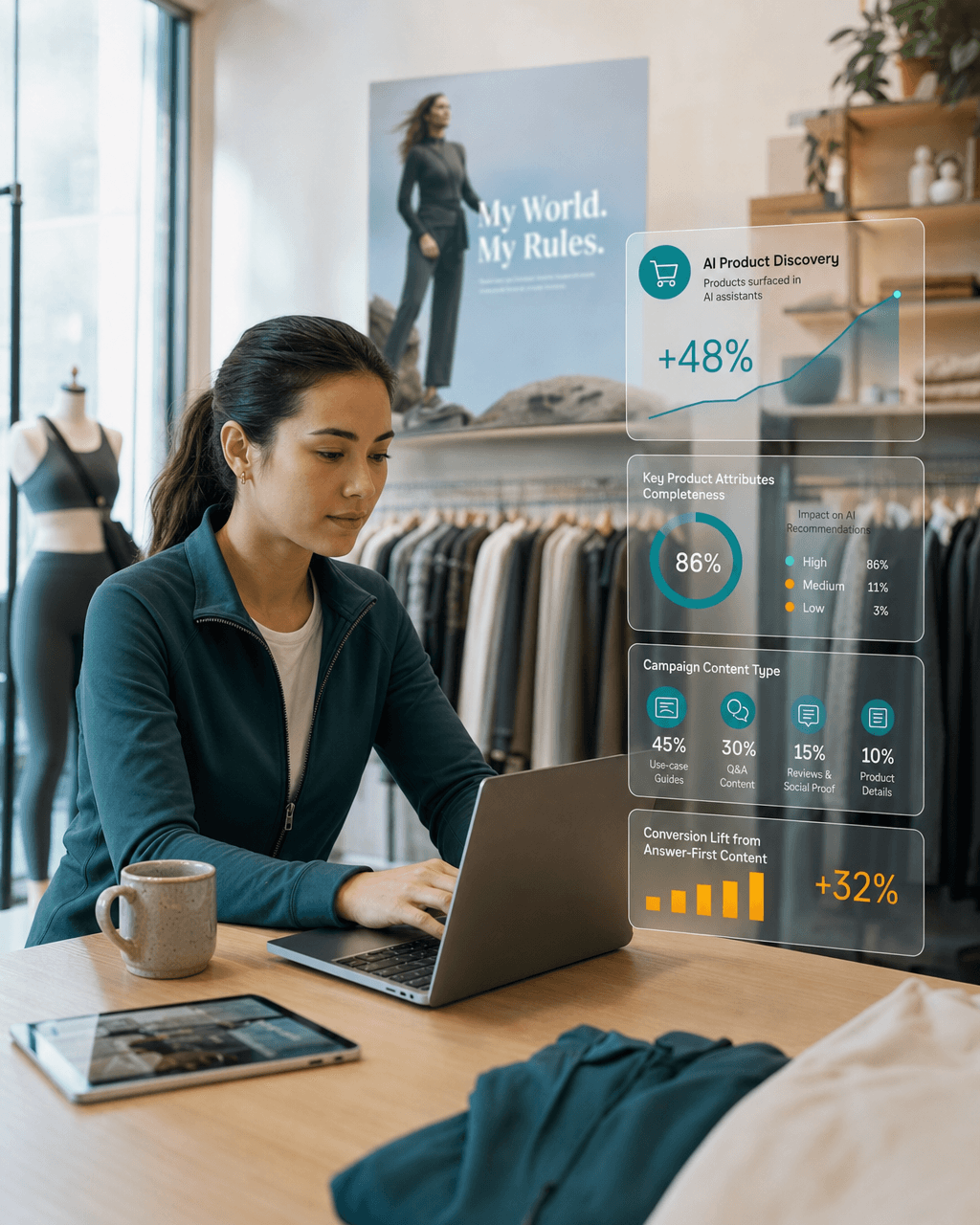
Athleta's new fall campaign is a reminder that brand storytelling now has to be readable by both people and AI shopping systems. For Shopify merchants, the practical takeaway is not to copy the campaign. It is to connect seasonal narratives, complete product data, answer-first content, and agentic commerce readiness before demand arrives.
TL;DR: Athleta's "My World. My Rules." campaign gives DTC operators a timely lesson in how brand moments travel across search, social, AI answers, and product discovery. If your Shopify catalog lacks structured attributes, schema, clear use cases, reviews, shipping details, and answer-first buying content, AI assistants may not understand when to recommend you.
Why does Athleta's fall campaign matter for Shopify merchants?
Athleta's campaign matters because it connects a cultural story to product discovery, not just brand awareness. The campaign highlights women breaking barriers, promotes performance and lifestyle apparel, and extends into an experiential wellness activation, according to Fibre2Fashion. That blend creates multiple AI-readable signals if the underlying content and product data are structured well.
For DTC brands, a campaign is no longer only a paid media asset. It is a source of entity signals, product context, community mentions, and fresh content that AI systems may retrieve when shoppers ask questions like "best performance leggings for travel," "women's workout apparel for strength training," or "gift ideas for active women."
The Shopify merchant lesson is simple: if your campaign creates demand, your catalog must explain what each product is, who it is for, what problem it solves, and why it fits the moment. That requires more than strong visuals.
A strong campaign should feed:
- Product pages with specific use cases, materials, sizes, colors, and fit details.
- Collection pages built around shopper intent, such as best apparel for Pilates, commuting, or cold weather runs.
- Blog content that answers the questions shoppers ask before they buy.
- FAQ schema and Product schema that help AI systems extract answers.
- Social and PR mentions that build brand search volume and citation authority.
If you are planning seasonal campaigns, connect the creative brief to your AEO for Shopify strategy before launch, not after traffic has already peaked.
How should DTC brands turn campaign storytelling into AI-readable product context?
DTC brands should translate campaign themes into specific product attributes, customer use cases, and answer-first content blocks. AI systems can understand "high-rise black compression leggings for strength training" more reliably than broad lifestyle language. The story creates attention, but structured product context helps assistants decide whether to recommend the item.
Start by mapping every campaign claim to a catalog field or page section. If the campaign says "strength," define what that means at the product level. Is the product built for squat-proof coverage, sweat management, compression, stretch recovery, cold weather layering, or all-day comfort?
For each hero product, add:
- A 50 to 80 word opening description that states what it is, who it is for, and why it matters.
- Variant completeness for size, color, fit, inseam, material, and care.
- At least three images, including lifestyle or in-use images.
- Review and rating data when available.
- Shipping time, return policy, inventory status, SKU, and GTIN where applicable.
- A "who this is for" section tied to real shopper needs.
This is also where gifting brands can apply the same logic. If a merchant uses an AI gifting app or personalized gifting AI, the product data must carry emotional and practical context. "Best for a sister who runs half marathons" is more useful to an AI gift assistant than "premium activewear."
Gimmie's approach to Agentic Gifting and Emotionally Intelligent Gifting depends on this distinction. Psychology-Driven Recommendations work better when product pages describe the recipient profile, occasion, values, and likely use case in language that both shoppers and AI agents can parse.
What product data should Shopify merchants fix before a seasonal campaign launches?
Shopify merchants should fix product names, variant attributes, pricing, inventory, shipping, returns, images, GTINs, reviews, and schema before a campaign goes live. AI shopping platforms and agents rely on complete, accurate, structured data to compare products, build recommendations, and route shoppers toward purchase-ready pages.
Use this pre-launch audit for every campaign collection:
- Product name: Clear, descriptive, and specific without keyword stuffing.
- Price: Current, accurate, and consistent across Shopify, feeds, and apps.
- Availability: Real-time inventory status for each variant.
- Shipping: Cost, handling time, and delivery range.
- Returns: Plain language policy linked from product and footer.
- Variants: Size, color, material, fit, weight, scent, bundle, or other category-specific fields.
- Images: Multiple product and lifestyle images with descriptive alt text.
- Reviews: Aggregate rating and review count where available.
- Identifiers: SKU and GTIN or barcode when relevant.
- Taxonomy: Products assigned to Shopify's standard categories.
The knowledge base is clear on the core issue: clean, complete, structured product data is the lever merchants control across AI Overviews, ChatGPT Shopping, Perplexity Shopping, Shopify Catalog, and agentic commerce protocols.
Section 9 notes that products with full Product schema appear 3 to 5 times more often in AI-generated shopping recommendations. Section 0 also highlights that products with eight or more structured attributes are cited far more often than thin product listings. The exact fields vary by category, but the principle is consistent: agents cannot choose what they cannot understand.
If your store also sells giftable products, connect product attributes to gifting context. A Shopify gifting strategy should tag products by recipient, occasion, personality fit, price range, shipping cutoff, and emotional intent.
How does AEO change campaign content for Shopify stores?
AEO changes campaign content by making every page answer a specific shopper question in a concise, extractable format. Instead of publishing only campaign copy, merchants should create supporting pages that answer comparison, use case, gifting, material, fit, care, and purchase decision questions in 40 to 60 word blocks.
This matters because answer engines frequently cite sections, not whole pages. If a section cannot stand alone, it is less useful for AI extraction.
For a Shopify campaign, build a content cluster around the launch:
- Awareness: "What should women look for in fall workout apparel?"
- Consideration: "Compression leggings vs soft lifestyle leggings: which is better for daily wear?"
- Decision: "Best fall activewear pieces for strength training and errands."
- Gifting: "Best gifts for runners, gym friends, and wellness-focused women."
- Post-purchase: "How to care for performance apparel so it lasts longer."
Each article should start with a direct answer and a TL;DR box. Each H2 should be a question. Each section should answer first, then support the answer with examples, bullets, citations, and internal links.
This is not just formatting preference. Section 2 states that concise passages are extracted at much higher rates than long, buried explanations. Section 7 recommends using pillar and cluster content to build topical authority, then linking back to collections and product pages.
For merchants using Gimmie, campaign content can also support gift buying confidence. A guide like "best wellness gifts for women who lift" can connect informational search to Agentic Gifting, recipient profiles, and product recommendations that reduce Decision Paralysis.
Why is agentic commerce readiness part of campaign planning now?
Agentic commerce readiness belongs in campaign planning because AI agents are starting to handle product discovery, comparison, cart building, and checkout. Shopify abstracts much of the protocol layer, but merchants still control the product data, schema, crawlability, policies, and content that agents use to evaluate products.
The market signal is large enough to take seriously. The knowledge base cites estimates that agentic commerce could redirect $3 to $5 trillion in global retail spend by 2030, while 73% of consumers already use AI somewhere in their shopping journey. That does not mean every sale becomes autonomous tomorrow. It means the infrastructure is being built now.
For Shopify merchants, the protocol details are less important than the preparation work. Shopify has AI-facing files and endpoints, Shopify Catalog syndication, and support for agentic discovery. Merchants should focus on the parts they can improve:
- Do not block important product, collection, or blog pages from GoogleBot, GPTBot, ClaudeBot, or PerplexityBot unless there is a specific legal or business reason.
- Keep the sitemap current and submitted.
- Use canonical URLs correctly for products that appear in multiple collections.
- Make key product facts visible in HTML, not hidden behind JavaScript-only experiences.
- Validate Product, FAQPage, BreadcrumbList, and Organization schema.
- Keep shipping, returns, and availability accurate.
This is especially important for Shopify merchants building gift programs. Agentic Gifting depends on matching a shopper's intent to a recipient profile, then finding products that fit that profile. If your catalog cannot express "good for a last minute birthday gift under $75 with two day shipping," an AI gift buying agent has fewer reasons to recommend you.
What should merchants measure after a campaign goes live?
Merchants should measure AI visibility, AI-referred sessions, AI-referred revenue, product data completeness, brand search demand, and campaign page performance. Traditional traffic still matters, but it no longer tells the full story because shoppers increasingly research through AI assistants, social search, and zero-click answers before visiting a store.
Track these metrics weekly during the campaign and monthly after it ends:
- AI citations: Test priority prompts in ChatGPT, Perplexity, Gemini, Claude, and Google AI Overviews.
- AI referral traffic: Segment sources such as chatgpt.com, perplexity.ai, and related referrals in GA4.
- AI-attributed revenue: Compare conversion rate and AOV against traditional organic traffic.
- Shopify product data completeness: Audit campaign products against required and recommended fields.
- Collection performance: Monitor impressions, clicks, add-to-cart rate, and conversion rate.
- Brand search volume: Watch branded and campaign-related queries in Google Search Console.
- Community mentions: Track Reddit, TikTok, YouTube, Instagram, and review discussions.
- Schema validity: Re-test campaign pages after theme or app changes.
Section 13 recommends measuring AI citation frequency, AI-referred sessions, AI-referred revenue, featured snippet ownership, brand search volume, and agent-originated orders. The point is not to replace SEO reporting. It is to add an AEO layer that shows whether AI systems are recognizing your brand as a useful answer.
If your campaign includes gifting, also measure gift-specific behavior: recipient profiles created, recommendation clicks, gift conversion rate, gift AOV, repeat purchase rate, and post-purchase gift trigger performance. That connects campaign reach to retention and Customer Retention via Gifting.
What is the practical 7 day action plan for Shopify merchants?
The fastest action plan is to audit the campaign collection, complete missing product attributes, add answer-first page content, validate schema, check crawlability, publish supporting FAQ content, and measure AI citations. This work improves traditional SEO, AEO visibility, and agentic commerce readiness without requiring a full site rebuild.
Use this sequence:
- Day 1: Pick one campaign collection and export its product data.
- Day 2: Fill missing variant fields, including size, color, material, fit, SKU, and GTIN where available.
- Day 3: Rewrite the top 10 product descriptions with a direct "what it is, who it is for, why it matters" opening.
- Day 4: Add or improve FAQs on product and collection pages.
- Day 5: Validate Product schema, FAQPage schema, BreadcrumbList schema, and Organization schema.
- Day 6: Check robots.txt, sitemap, canonical tags, and whether important content is visible without relying on app scripts.
- Day 7: Publish one AEO-style buying guide tied to the campaign and internally link it to the collection.
For a Gimmie-connected merchant, add one more step: map products to gifting use cases. Define which items fit birthdays, milestones, thank-you moments, wellness goals, customer anniversaries, or win-back triggers. That gives an AI gift assistant better inputs and helps shoppers make confident choices.
Athleta's campaign is a useful prompt because it shows how seasonal storytelling can create demand across culture, apparel, and wellness. The Shopify opportunity is more operational: make sure every campaign product, collection, and guide is structured enough for AI systems to cite, compare, and recommend.
Frequently Asked Questions
What is AEO for Shopify merchants?
AEO for Shopify is the practice of structuring product pages, collection pages, blog posts, FAQs, schema, and brand signals so AI answer engines can cite and recommend the store. It supports visibility in ChatGPT, Perplexity, Gemini, Google AI Overviews, and AI shopping interfaces.
Does a strong brand campaign automatically improve AI visibility?
No. A strong campaign can increase awareness and mentions, but AI visibility depends on whether the campaign is supported by crawlable pages, complete product data, structured schema, answer-first content, and third-party signals. Creative alone is not enough for AI shopping systems to understand product fit.
Which Shopify pages should merchants optimize first for AI shopping?
Start with best sellers, campaign hero products, high-margin products, and high-intent collections. These pages should have complete Product schema, descriptive attributes, reviews, shipping details, return policy information, FAQs, and internal links from supporting buying guides.
How do structured product attributes affect agentic commerce?
Structured attributes help AI agents compare products accurately. Fields such as size, color, material, price, inventory, shipping time, returns, GTIN, reviews, and use case signals give agents the data needed to decide whether a product matches a shopper's stated preferences.
How can gifting merchants use campaign content for retention?
Gifting merchants can turn campaign themes into automated gift triggers for birthdays, customer anniversaries, milestones, win-back flows, and VIP thank-you moments. With recipient profiles and Psychology-Driven Recommendations, the campaign can support repeat purchases instead of ending after the launch window.
How often should Shopify merchants refresh AEO content?
Refresh priority product pages, collection pages, and buying guides at least quarterly, and update campaign pages before each seasonal push. Fresh pricing, availability, reviews, comparisons, images, and FAQs help both shoppers and AI systems trust that the content is current.
Sources