
What Does Stable Cotton Yarn Pricing Mean for Shopify Brands Preparing for AI Commerce?
North India cotton yarn is stable while demand stays cautious. Learn how Shopify brands can improve product data, AEO visibility, and AI readiness now.
North India cotton yarn is stable while demand stays cautious. Learn how Shopify brands can improve product data, AEO visibility, and AI readiness now.

By Team Gimmie
Updated September 10, 2026
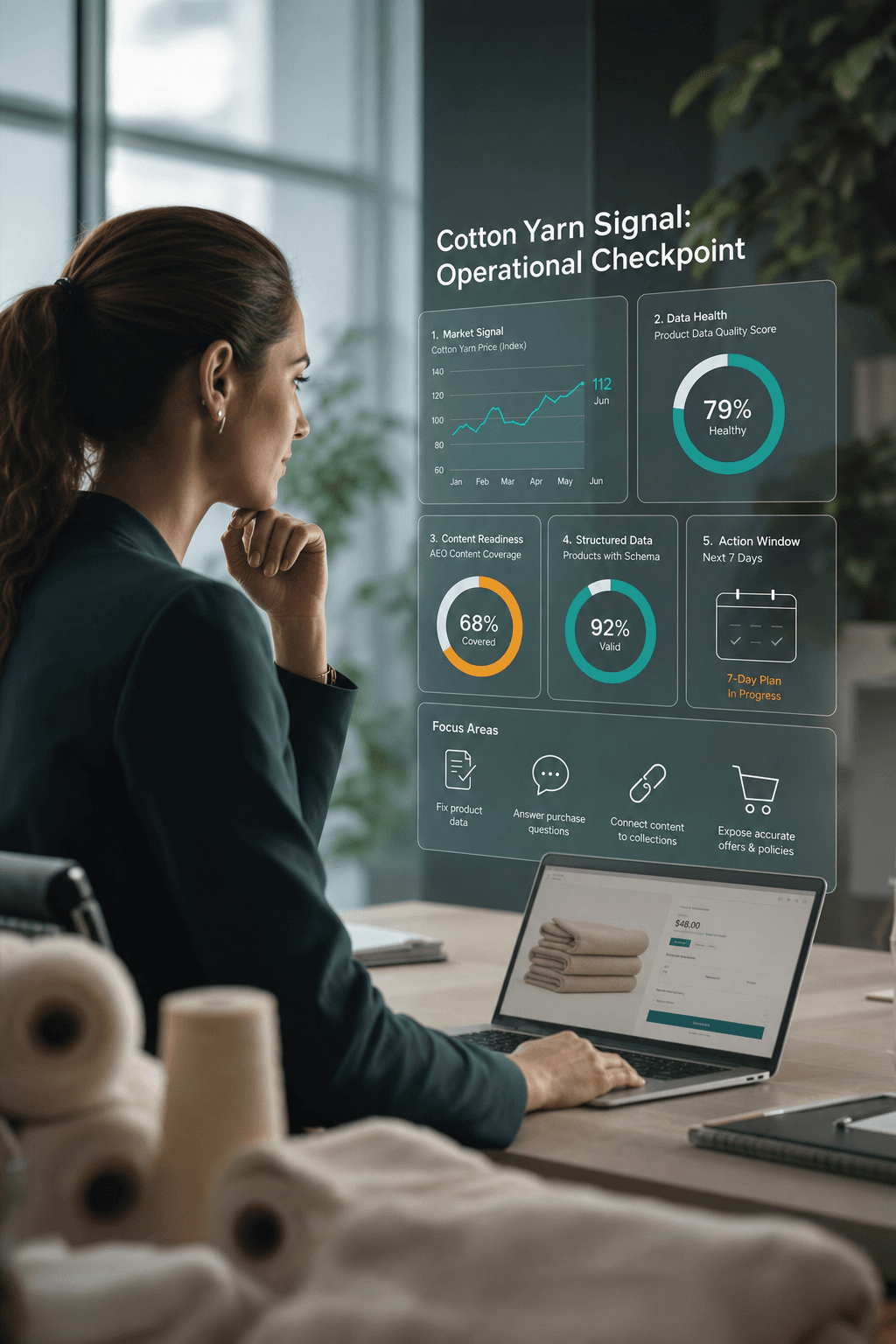
Stable cotton yarn pricing amid cautious demand gives apparel and home goods merchants time to improve product information before the next cost or demand shift. The practical move is not a blanket price change. It is a catalog audit that makes material, variant, availability, shipping, and value claims clear to shoppers, search engines, and AI agents.
TL;DR: Use the current cotton yarn signal as an operational checkpoint. Verify every cotton product's facts, publish concise answers to purchase questions, connect educational content to collections, and confirm that Shopify exposes accurate offers and policies. Better data supports AEO visibility and agentic commerce readiness even if market conditions change.
The September 10 Fibre2Fashion headline reports stable North India cotton yarn while demand remains cautious. That is a useful news peg for cotton dependent brands, but it is not a guarantee about future input costs, retail demand, or margins. Merchants should apply it as a prompt for disciplined catalog work.
The headline is useful because stable input pricing and cautious demand create a narrow planning window. Shopify brands can use that window to improve catalog facts, answer customer questions, and test merchandising without assuming that cotton costs or consumer demand will remain unchanged. Treat the news as an operational prompt, not a forecast.
For a cotton apparel, bedding, accessories, or gifting brand, cautious demand puts more pressure on product clarity. A shopper comparing two similar items may want to know fiber composition, fabric weight, softness, care requirements, durability, origin, delivery timing, and return terms. An AI shopping assistant may evaluate many of the same facts before recommending an item.
Do not translate a stable upstream quote directly into a retail price decision. Your landed cost can still move because of exchange rates, freight, duties, finishing, packaging, minimum order quantities, and supplier terms. Instead, ask three questions:
This reframes market news from commentary into a manageable merchant task. It also supports an AEO for Shopify strategy because direct, verifiable product facts are easier to extract and cite than broad marketing language.
Start with the facts that determine eligibility, comparison, and purchase confidence: product name, brand, price, availability, variant size, color, material, GTIN, images, shipping terms, and returns. Cotton brands should also document fiber percentages, fabric construction, weight, care, certifications, and origin when those claims are accurate and supported.
Prioritize fields in this order:
Use Shopify metafields for details that do not fit standard variant options, then surface important facts in visible page copy. Product structured data should reflect the same price, inventory, material, color, size, rating, and offer information shown to customers. Schema.org's Product documentation provides the common vocabulary, while Google's Rich Results Test can identify invalid or missing markup.
Audit duplicate schema as well. Shopify themes and apps can both emit Product markup, creating conflicting prices or availability. One accurate representation is more useful than several inconsistent ones. See the practical guide to optimizing product pages for AI for a page level workflow.
Cautious demand increases the importance of answering comparison and value questions before asking for the sale. Build content around specific shopper concerns, such as cotton blends, fabric weight, care, durability, gifting suitability, and total value. Each section should begin with a concise answer, then provide evidence and link to the relevant collection or product.
For cotton products, useful question led topics include:
Map these questions across the Shopify content hierarchy. A broad cotton buying guide can act as pillar content. Focused articles can answer material and use case questions. Collection pages can target commercial needs, such as lightweight cotton clothing for travel. Product pages should close the final information gap with concise descriptions, specifications, reviews, policies, and FAQs.
This structure follows the self-contained chunk principle. An answer engine can retrieve a useful section without needing the entire article, while a human can continue to a collection with clear context. It also protects against thin trend content. The yarn headline may be timely, but the underlying questions about composition, comfort, care, value, and delivery remain useful after the market changes.
Google AI Overviews now appear on about 14% of shopping queries, according to ALM Corp's shopping query analysis. That makes informational and comparison content a practical discovery surface, not just a blog traffic play. Measure whether those pages assist product views, collection visits, email signups, and orders.
Structured data gives shopping systems explicit facts they can compare, while Shopify's catalog and protocol infrastructure can make those facts available across AI channels. Merchants generally do not need to build commerce protocols themselves. They do need complete, accurate, consistent, and crawlable product records that match the storefront and checkout experience.
Agentic commerce means an AI system may help with discovery, comparison, cart building, or purchase execution. A request such as “find a navy cotton robe under $100 that arrives by Friday” depends on several independent fields. If color appears only in a photo, material is vague, or delivery timing is absent, the product may not satisfy the request with enough confidence.
Shopify abstracts much of the protocol layer, including support associated with UCP and other agentic storefront capabilities. Google's overview of Universal Commerce Protocol explains how standardized commerce interactions can connect discovery and transaction steps. Merchant responsibility remains centered on the catalog.
Check these technical foundations:
Read the Shopify agentic commerce guide before considering custom protocol work. For most merchants, cleaning the source catalog is the higher priority.
Run a focused audit on the products most exposed to cotton costs or most important to revenue. Fix data before producing more promotional content, then publish one answer led guide and measure discovery quality. A seven day sprint should leave the catalog more accurate, the content more useful, and reporting ready for AI referrals.
A practical schedule is:
Repeat the audit monthly for high velocity products and whenever supplier specifications, pricing, inventory, or policies change. Track AI citation frequency separately from conventional ranking because visibility in an answer engine is not identical to a Google position. The goal is not more impressions at any cost. It is accurate discovery that produces qualified visits and viable orders.
Merchants usually want to know whether market news requires immediate repricing, which attributes AI systems need, and whether schema alone can create visibility. The answers are operational: verify economics before changing price, make decisive product facts explicit, pair structured data with useful content, and measure AI discovery separately from traditional organic search.
Q: Should stable cotton yarn prices lead to lower retail prices?
A: Not automatically. Yarn is only one component of landed cost. Freight, duties, labor, finishing, packaging, exchange rates, discounts, and returns can change independently. Review contribution margin and replacement cost by SKU before changing price. Market stability can support planning, but it does not prove that a retail price reduction is viable.
Q: Which cotton attributes matter most for AI shopping recommendations?
A: Start with exact fiber composition, material, color, size, price, availability, GTIN, images, shipping timing, and return terms. Add fabric construction, weight, care instructions, origin, and supported certifications where relevant. Keep these facts consistent across visible copy, Shopify fields, feeds, and Product structured data.
Q: Is Product schema enough to get recommended by AI assistants?
A: No. Product schema improves machine readability, but recommendation also depends on crawlability, data accuracy, useful content, reviews, brand authority, and fit with the shopper's request. Schema cannot compensate for missing inventory, vague descriptions, unsupported claims, or conflicting information across the storefront and catalog.
Q: How should a cotton product description be written for AEO?
A: Open with what the product is, who it is for, and why the cotton specification matters. Follow with scannable facts about composition, construction, weight, care, fit, use case, shipping, and returns. Add direct answers to real customer questions rather than repeating promotional phrases from the opening paragraph.
Q: Do Shopify merchants need to implement UCP themselves?
A: Most Shopify merchants should not begin with custom protocol development. Shopify handles much of the infrastructure associated with agentic storefronts and catalog distribution. The merchant's priority is accurate source data, crawlable pages, current policies, valid structured data, and consistent product information that an agent can evaluate confidently.
Q: How should AI visibility be measured after the audit?
A: Track AI referred sessions and revenue, agent originated orders where available, product data completeness, catalog eligibility, and citation frequency for a fixed set of prompts. Also monitor assisted collection visits, product views, conversion rate, and returns. Compare results with a dated baseline instead of relying on isolated chatbot checks.
The news article supplies the timely market signal, while the supporting references explain shopping query changes, product vocabulary, structured data validation, and commerce protocol design. These sources should be reviewed alongside your own supplier contracts, Shopify catalog records, analytics, and legal requirements before changing product claims, prices, or crawler policies.

A small team of friends and colleagues working together to produce useful content to help you...gift better.