
What Does Macy’s American Designers Collection Teach Shopify Brands About AI Discovery?
Macy’s American designers collection shows Shopify brands how structured product data, AEO content, and agent-ready catalogs support discovery and sales.
Macy’s American designers collection shows Shopify brands how structured product data, AEO content, and agent-ready catalogs support discovery and sales.

By Team Gimmie
Updated September 9, 2026
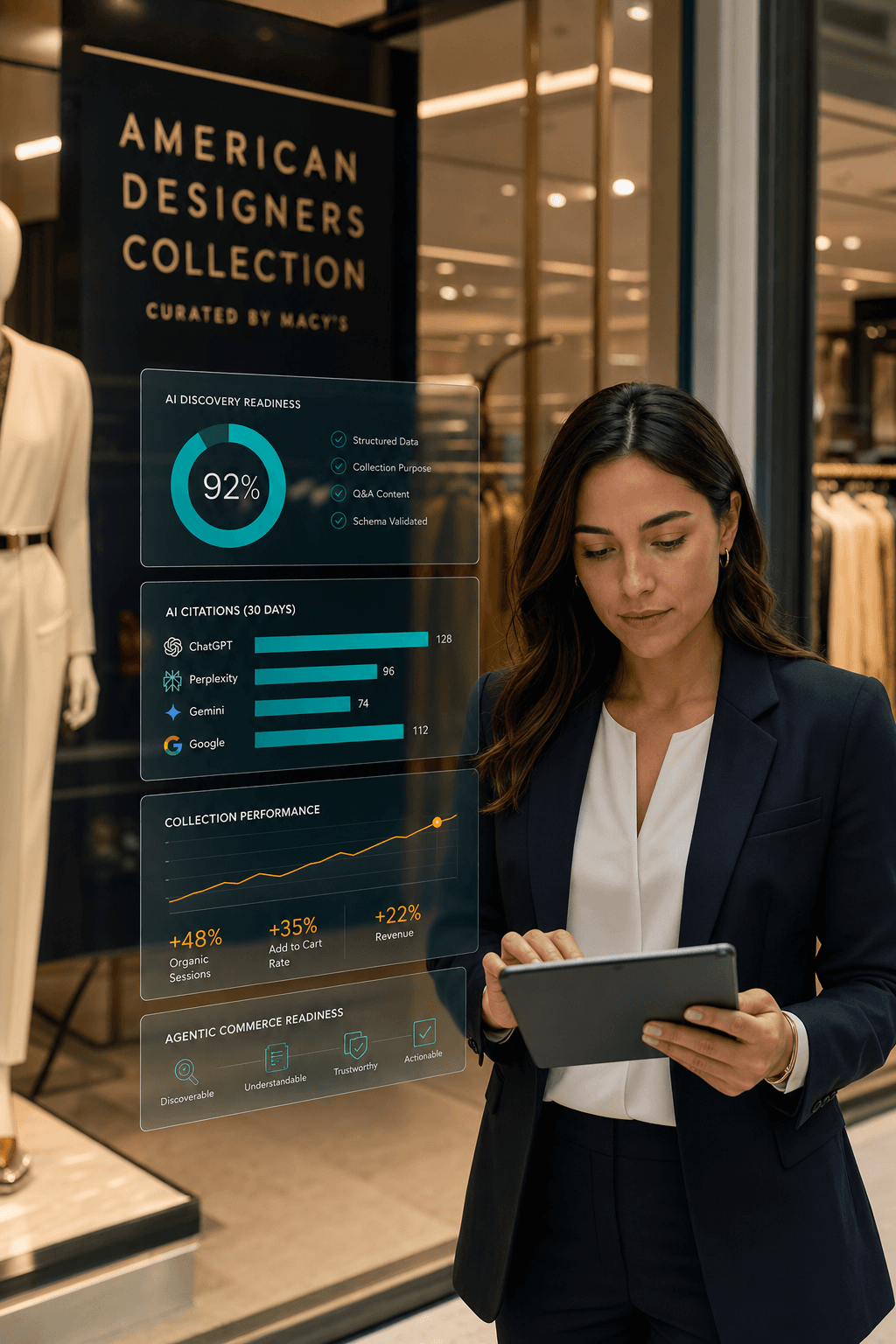
Macy’s launch of an exclusive Celebrate American Designers collection offers Shopify merchants a useful lesson: a collection is now both a customer-facing story and a data set for AI discovery. Brands should connect campaign creative with complete product attributes, answer-first content, structured data, and accurate commerce policies.
TL;DR: Treat every themed collection as an AI-readable merchandising hub. Complete the underlying product data, explain who the collection serves, publish answers to likely shopping questions, validate schema, and measure whether ChatGPT, Perplexity, Gemini, and Google cite or send buyers to the collection.
The Fibre2Fashion report provides the timely hook. The practical opportunity for a DTC operator is not to copy a department store campaign. It is to make each launch understandable to people, search engines, and AI shopping agents at the same time.
Macy’s collection is a reminder that a launch is not only a merchandising event. For Shopify brands, every collection should also be a machine-readable product set with clear designer or brand attribution, variant details, availability, shipping, returns, and editorial context that answer engines and shopping agents can interpret.
A campaign can generate attention through its theme, participants, imagery, and press coverage. That attention becomes more durable when the collection page answers the questions shoppers ask after encountering the campaign. Examples include who made each item, where it was produced, what materials it uses, which sizes are available, how quickly it ships, and whether it can be returned.
This is where traditional merchandising and Answer Engine Optimization meet. AEO is the practice of formatting information so an answer engine can extract and present a direct response. It does not replace brand storytelling. It gives the story a clear factual layer that can be retrieved, cited, compared, and checked.
For an independent label, the useful strategic pattern is:
Structured product data tells search engines and AI systems exactly what an item is, who makes it, what it costs, whether it is available, and which variants exist. Without those facts, a visually strong Shopify launch can remain difficult for an answer engine to compare, recommend, or place in an agent-built cart.
The Gimmie knowledge base treats comprehensive Product schema as a critical visibility layer. It reports that products with full Product schema appear three to five times more often in AI-generated shopping recommendations. Merchants should treat that figure as a directional benchmark, then validate performance against their own catalog and referral data.
Prioritize these fields on every product in the collection:
Visible page copy and schema must agree. If a product page says an item ships in two days while the structured offer says five days, the inconsistency reduces trust and can produce a poor customer experience. Use Google’s product structured data documentation to review required and recommended properties, then test the rendered page rather than only inspecting a theme template.
A strong collection page combines a concise description, a useful product grid, purchasing guidance, and customer questions. Each product page then supplies complete transactional facts. This hierarchy helps a shopper understand the campaign while giving search and AI systems self-contained passages that connect broad intent to specific products and variants.
Start the collection page with 150 to 200 words explaining what the collection contains, who it is for, and what distinguishes it. Below the product grid, add a 300 to 500 word buying guide that explains selection criteria without repeating product descriptions. Include links to the most relevant product pages and supporting articles.
For each product, lead with 50 to 80 words covering what it is, who it suits, and why its distinguishing feature matters. Follow with scannable facts, a “Who this is for” section, care or usage instructions, shipping and return details, reviews, and five or more customer questions.
Use one canonical product URL. Shopify products can appear through both product and collection paths, so confirm that alternate paths point to the primary product URL. Also check that filters do not create thousands of indexable near-duplicates.
The content hierarchy should move logically from a topic guide to related articles, then to the commercial collection and individual products. The AEO for Shopify guide can support the editorial layer, while each internal link should use descriptive anchor text that explains the destination.
AEO extends a campaign by answering the specific questions buyers ask before purchasing. Instead of publishing one launch announcement, a Shopify brand can create a connected set of answer-first resources about materials, fit, origin, use cases, gifting occasions, care, comparisons, shipping, and returns, with each resource linked to the relevant collection.
Every major section should begin with a direct 40 to 60 word answer. The remaining copy can add evidence, examples, limitations, and next steps. This structure helps readers scan and gives retrieval systems a self-contained passage that can be quoted without losing its meaning.
A practical content cluster for a designer-led collection might include:
Add FAQPage structured data only for questions and answers that are visible on the page. Do not use schema to hide extra keywords or claims from shoppers. For campaign coverage, include BlogPosting markup and connect the article to the collection with a clear internal link.
For gifting-focused launches, a Shopify gifting strategy can organize content around recipient, occasion, budget, and delivery timing. Those are explicit forms of shopper intent that both human buyers and an AI gift assistant can use.
An agent-ready catalog is complete, accurate, structured, consistent, and accessible. Shopify may handle much of the protocol layer, but the merchant still controls the facts an agent uses to select a product. Missing variants, stale inventory, vague shipping terms, or blocked pages can remove an otherwise relevant item from consideration.
Agentic commerce describes AI systems handling part or all of discovery, comparison, checkout, and post-purchase support. For a themed collection, that could mean an agent receives a request such as “Find an American designer gift under $150 that arrives by Friday,” filters eligible products, and builds a cart from catalog facts.
That request requires more than keywords. The agent needs reliable price, brand, category, inventory, delivery, material, variant, and policy data. The Google Developers overview of UCP explains how a common commerce layer can support discovery and transactions across participating systems.
Shopify merchants should also inspect their AI-facing and crawler-facing setup. Confirm that product, collection, and blog paths are not blocked in robots.txt. Review Shopify-generated catalog surfaces and verify that important information is present in rendered HTML, not available only after unsupported client-side interactions. See the agentic commerce guide for a broader readiness framework.
Start with the highest-revenue collection and audit its top 20 products. Fix missing operational data before writing more content. Then improve the collection’s answer-first copy, validate its schema, confirm crawl access, and establish a baseline for AI citations, referrals, and revenue so future changes can be evaluated against evidence.
Use this seven-day sprint:
Repeat the audit monthly. Track product data completeness and agent-originated orders alongside rankings. A launch is successful when it creates qualified discovery and profitable sales, not merely a short traffic spike.
Shopify teams usually ask whether schema alone is enough, which fields matter most, and how quickly results appear. The practical answers are consistent: pair structured data with useful visible copy, keep operational facts synchronized, allow crawlers to reach key pages, and measure citations and agent-originated revenue rather than rankings alone.
No. Product schema improves machine readability, but recommendation also depends on relevance, data accuracy, crawlability, content quality, reviews, brand authority, and third-party validation. Treat schema as required infrastructure, not a guaranteed placement mechanism.
Start with product name, brand, price, currency, availability, variants, category, material, color, size, images, shipping, returns, SKU, and GTIN. Prioritize fields that help an agent determine eligibility for a buyer’s budget, use case, delivery deadline, and preferences.
Create a dedicated collection page when the campaign represents a stable group of purchasable products and a distinct search intent. Use a canonical page, explain the selection logic, keep inventory current, and redirect or update the page when the campaign ends rather than leaving a thin orphan page.
Traditional SEO focuses largely on ranking pages in search results. AEO focuses on making a page’s answers easy for AI systems to extract and cite. Shopify merchants need both because organic listings, AI answers, product cards, and shopping agents are separate but connected discovery surfaces.
Track citation frequency for repeatable prompts, AI referral sessions, cited landing pages, agent-originated orders, assisted conversions, product data completeness, and the accuracy of generated product descriptions. Record a baseline before making changes and compare results monthly.
Yes, for specific questions where the brand provides clearer expertise, better product facts, stronger first-hand evidence, and a closer match to shopper intent. A small brand should target narrow use cases and category questions rather than trying to match a national retailer’s catalog breadth.
The Macy’s announcement is the timely news peg. The implementation guidance is grounded in Shopify and Google documentation on product data, structured markup, and agent access, plus the Gimmie knowledge base framework for AEO content, Shopify catalog readiness, and measurement. Review these references before changing theme code or feed logic.

A small team of friends and colleagues working together to produce useful content to help you...gift better.