
What Can Shopify Brands Learn From Old Navy Sport About AI Shopping Visibility?
Old Navy Sport shows Shopify brands how distinct categories, complete product data, and answer-first content can improve AI shopping visibility in 2026.
Old Navy Sport shows Shopify brands how distinct categories, complete product data, and answer-first content can improve AI shopping visibility in 2026.

By Team Gimmie
Updated September 16, 2026
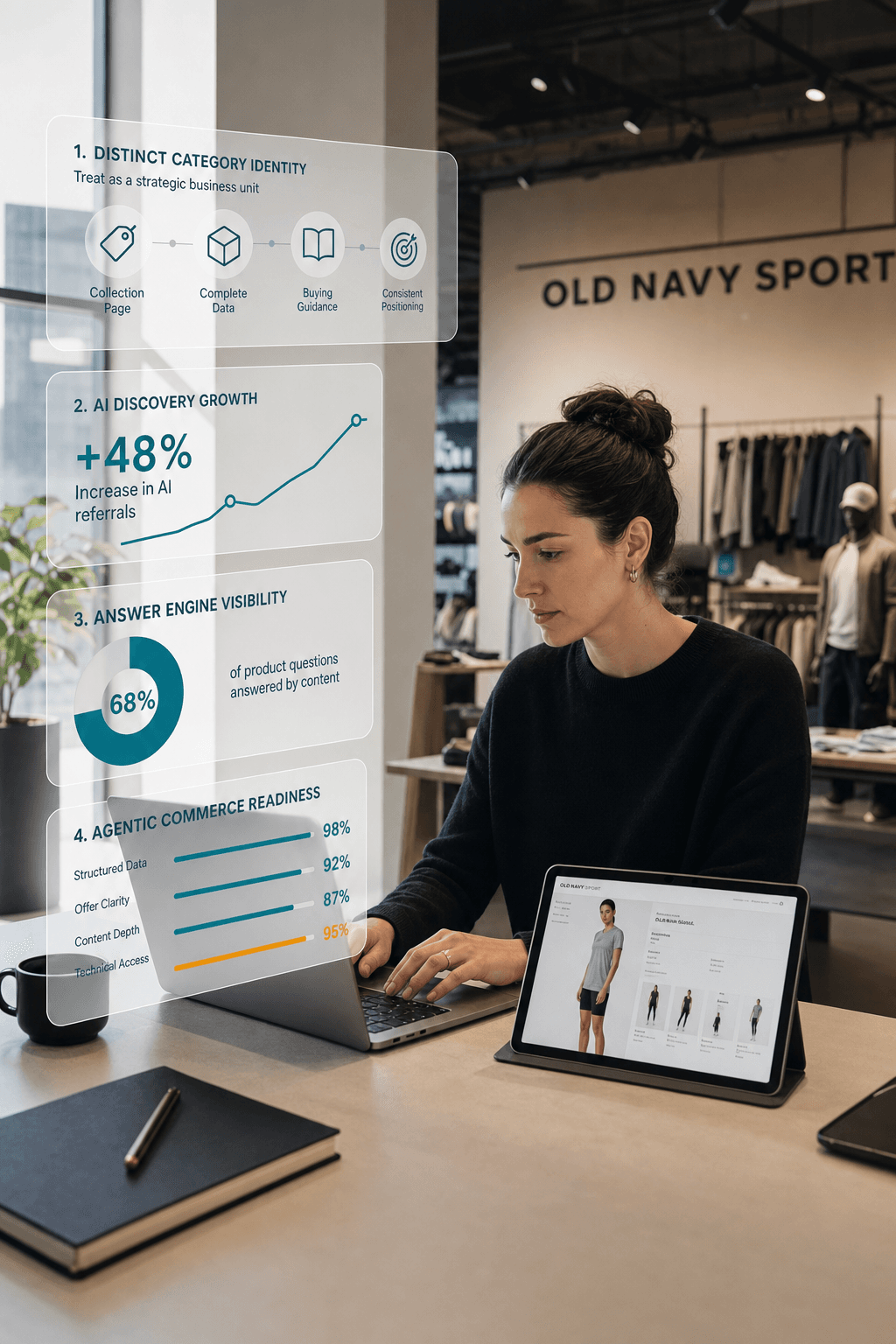
Old Navy Sport illustrates a practical growth principle for Shopify brands: a category becomes easier to discover when it has a clear identity, dedicated merchandising, and consistent product information across every customer touchpoint. The same principle applies when AI assistants evaluate which products to cite, compare, and recommend.
TL;DR: Treat a strategic category as a machine-readable business unit, not just a navigation label. Give it a distinct collection page, complete variant and offer data, answer-first buying guidance, and consistent positioning across your store, feeds, content, and external coverage.
The Old Navy Sport announcement says the retailer is giving activewear a distinct identity centered on style, performance, and value. The sub-brand will appear across its website, app, and stores, with 42 locations receiving dedicated shop-in-shop spaces. For DTC operators, the useful lesson is not simply to create more sub-brands. It is to make important categories unmistakable to both people and machines.
Old Navy Sport matters because it turns an existing product category into a more explicit discovery surface. Its name, positioning, digital placement, and physical presentation all reinforce the same category signal. Shopify merchants can apply that logic with dedicated collections, consistent attributes, focused content, and clear use-case language.
The report also says Old Navy already ranks fifth in the US activewear market. That context matters. The company is not inventing demand from zero. It is organizing an established assortment so shoppers can recognize the category faster and the business can market it more directly.
A Shopify brand should consider a similar approach when one category has distinct customers, use cases, or buying criteria. A dedicated identity may be useful when:
A new category name alone will not improve discovery. The operational value comes from connecting positioning to catalog structure, product data, content, and measurement.
A distinct category identity gives answer engines a stable concept to understand and cite. The collection name, introductory copy, product descriptions, FAQs, internal links, and external mentions should describe the same audience, use cases, features, and value proposition without relying on vague campaign language or keyword repetition.
Answer Engine Optimization is the practice of formatting information so AI systems can extract a direct response. For a collection, that means answering questions such as who the products are for, what activities they support, how the materials perform, and how shoppers should choose between variants.
Build the category into a content hierarchy:
This structure helps shoppers move from research to purchase while giving search and answer engines connected, self-contained passages to retrieve. Our AEO for Shopify guide explains how answer-first blocks and question-led sections support this process.
Shopify brands should populate every material product field, then verify that storefront content, structured data, feeds, and Shopify Catalog records agree. Priority fields include product name, brand, price, availability, variant size, color, material, GTIN, shipping details, return terms, images, ratings, and standardized category assignments.
Complete data reduces ambiguity. An AI shopping assistant cannot confidently recommend a training legging for a specific size, fabric preference, budget, and delivery deadline when those facts are missing or conflict across systems.
For each product, audit:
The knowledge base reports that products with full Product schema appear three to five times more often in AI-generated shopping recommendations. Merchants should treat that as a directional benchmark, not a guaranteed outcome. Use Google's Rich Results Test and Schema.org's validator to check implementation, and remove duplicate schema created by overlapping Shopify apps.
Category content improves visibility when it answers a narrow shopping question better than a generic product grid. Use a concise collection introduction, a practical buying guide, comparisons, specific use cases, and five to eight FAQs. Each section should begin with a direct answer that remains useful when quoted without surrounding context.
For an activewear collection, useful questions might include:
Avoid copying the same paragraph across every product. Collection copy should explain category-level choices, while product copy should document individual specifications and fit. Publish supporting guides for informational searches, then point qualified readers toward the relevant collection.
This follows the answer-first framework in our AEO content strategy guide: question-based headings, 40 to 60 word direct answers, supporting evidence, and a readable FAQ. It also supports topical authority by connecting pillar content, cluster articles, collections, and products.
An agent-ready catalog is complete, accurate, structured, consistent, and accessible to approved crawlers. Shopify handles much of the protocol layer, but merchants still control the facts agents use to compare products. Missing variants, stale inventory, hidden shipping terms, or conflicting prices can remove an otherwise relevant item from consideration.
Agentic commerce lets AI systems assist with discovery, comparison, cart building, checkout, and support. Shopify's infrastructure can expose catalog data through its AI-facing systems, including Universal Commerce Protocol capabilities. Merchants generally should not build a custom protocol integration before fixing basic catalog quality.
Start with four controls:
For a deeper implementation sequence, see our agentic commerce readiness checklist. The goal is not to optimize for one assistant. It is to maintain reliable product facts that any supported discovery surface can interpret.
In the next 30 days, choose one strategically important category and improve it end to end. Establish a baseline, repair its product records, strengthen its collection page, publish supporting answers, validate technical access, and measure citations and revenue. A focused pilot is more useful than a catalog-wide rewrite without controls.
Use this operating plan:
Track category conversion rate alongside AI citation frequency and AI-referred revenue. Visibility is useful only when it helps qualified shoppers choose the right product.
Merchants usually want to know whether they need a formal sub-brand, which data fields matter first, and how quickly results may appear. The practical answer is to begin with one category, improve the underlying catalog and content, then measure platform-specific visibility instead of assuming conventional rankings represent AI performance.
Do I need a sub-brand to improve AI shopping visibility?
No. A sub-brand can clarify positioning, but AI visibility depends more directly on consistent category language, complete product attributes, useful answers, structured data, and third-party trust signals. Many Shopify merchants can gain the same operational benefit by building a strong collection identity without creating a separate legal or visual brand.
Which product fields should I fix first?
Start with product name, brand, price, availability, variant size, color, material, GTIN, category, shipping information, return terms, images, and descriptions. These fields help an assistant determine relevance and purchase feasibility. Fix inaccurate data before adding more descriptive content, because confident recommendations require reliable facts.
Should collection pages or product pages come first?
Fix product data first, then improve the collection page. Product records supply the facts needed for comparison and checkout, while the collection page explains category-level choices and captures broader intent. The strongest system connects both through internal links, consistent terminology, buying guidance, and accurate structured data.
How is AEO different from traditional Shopify SEO?
Traditional SEO seeks ranked listings and clicks. AEO seeks extraction and citation inside generated answers. They share technical foundations, but AEO puts greater emphasis on concise answer blocks, self-contained sections, entity consistency, product attributes, FAQs, and citation monitoring across multiple assistants rather than Google rankings alone.
How should a merchant measure AI shopping visibility?
Track a repeatable set of prompts across major assistants, the frequency and accuracy of brand mentions, cited URLs, AI-referred sessions, assisted conversions, agent-originated orders, and revenue. Also monitor product data completeness and catalog eligibility. Use the same prompts monthly so changes can be compared against a stable baseline.
Can structured data guarantee an AI recommendation?
No. Structured data helps machines interpret products, but it does not guarantee selection. Recommendation systems also consider query relevance, availability, price, delivery, reviews, authority, and platform-specific rules. Treat schema as required infrastructure, then strengthen content quality, product competitiveness, customer evidence, and consistent brand signals across the web.
This analysis uses the Old Navy Sport report as its timely news peg, then applies Shopify-focused guidance on answer-first content, structured product information, schema validation, and agentic commerce. The external links below provide the announcement, protocol context, platform guidance, and validation tools merchants can use during implementation.

A small team of friends and colleagues working together to produce useful content to help you...gift better.