
What Can Shopify Brands Learn From Karl Mayer's 90-Year Textile Innovation Program?
Karl Mayer's 90-year program shows Shopify brands how structured product data, AEO content, and agent-ready catalogs can strengthen AI discovery.
Karl Mayer's 90-year program shows Shopify brands how structured product data, AEO content, and agent-ready catalogs can strengthen AI discovery.

By Team Gimmie
Updated September 25, 2026
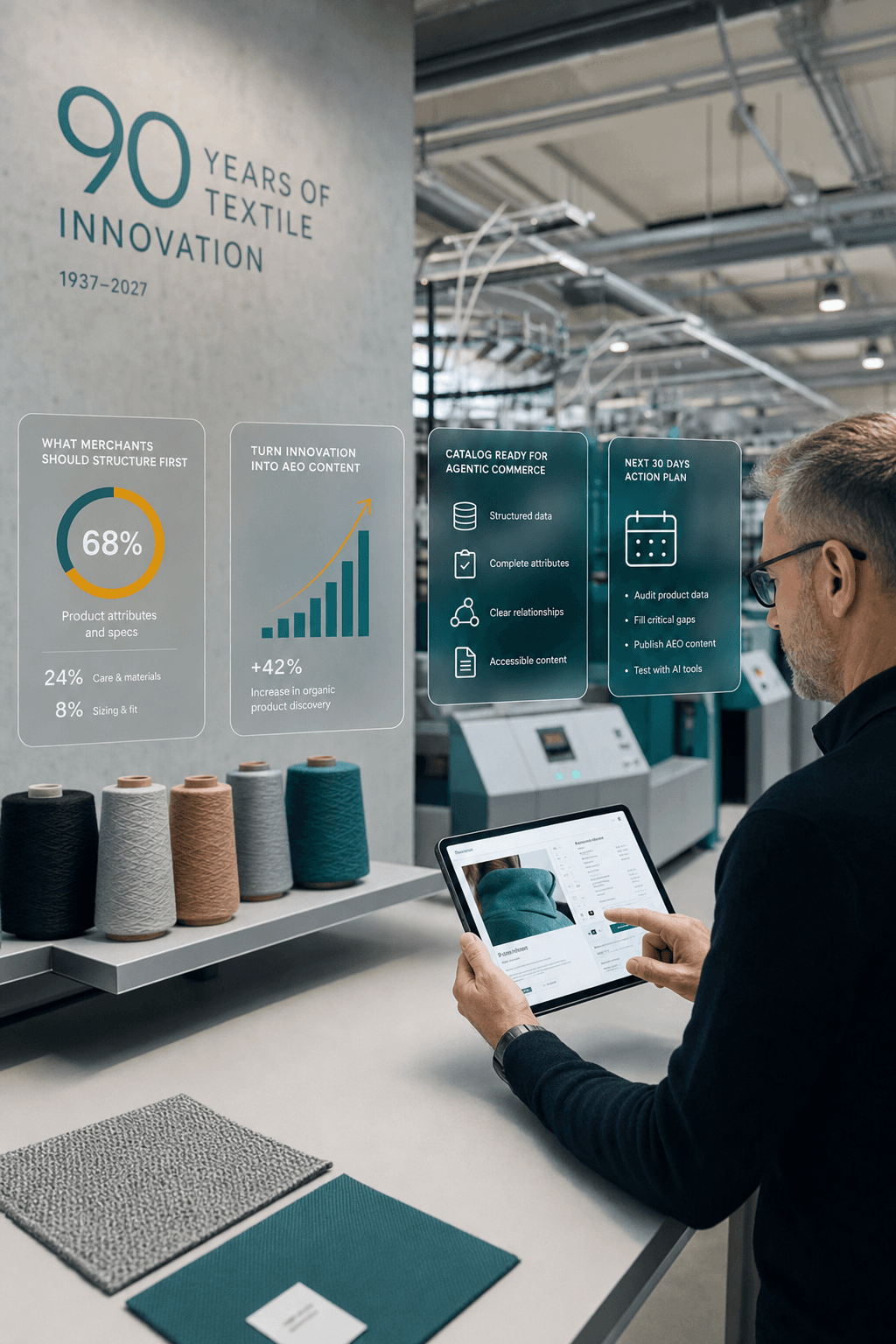
The practical lesson for Shopify merchants is simple: product innovation creates commercial value only when shoppers, search engines, and AI agents can understand it. Turn every new material, design, use case, and production claim into complete product data, answer-first content, and verifiable proof.
TL;DR: Karl Mayer plans to mark its 90th anniversary with a global textile innovation program in 2027. Shopify brands can apply the same demonstration mindset online by documenting product attributes, answering buyer questions, and making catalog information accessible to AI shopping systems.
A Fibre2Fashion report says Karl Mayer will prioritize an anniversary program at its Obertshausen headquarters over ITMA 2027. The planned event will use 5,000 square meters to present machinery, textile applications, and production solutions, following new developments shown at ITMA ASIA 2026.
For Shopify merchants, the relevant idea is not the size of the event. It is the decision to make innovation concrete, organized, and easy to evaluate. A new fabric, finish, ingredient, component, or production method should not remain buried in internal documents or vague marketing copy. It should become machine-readable catalog data and useful customer education.
Karl Mayer's program illustrates a wider commerce principle: buyers need more than a claim that something is innovative. They need clear applications, specifications, comparisons, and evidence. Shopify brands should present product innovation in the same structured way, especially as AI assistants increasingly summarize options before shoppers visit a store.
This matters beyond apparel. Beauty brands have ingredients and concentrations. Food brands have dietary attributes and sourcing details. Home goods brands have dimensions, materials, care requirements, and room use cases. Jewelry brands have metal, stone, size, and maintenance data.
The online equivalent of an innovation showroom is a connected set of assets:
This is the foundation of AEO for Shopify. Answer Engine Optimization helps an AI system extract a useful response, while structured product data helps shopping systems determine whether an item fits the shopper's constraints.
Start with fields that affect eligibility and purchase confidence: product name, brand, category, price, availability, variants, material, color, size, GTIN, images, shipping, returns, ratings, and reviews. Keep each field accurate across the storefront, product schema, sales feeds, and Shopify Catalog rather than treating schema as separate copy.
For textile and apparel merchants, add attributes that answer practical selection questions:
Do not insert unsupported sustainability, performance, or health claims merely to fill fields. Trust depends on consistency between the structured data, visible page, packaging, and supporting documentation.
Google's product structured data documentation explains how product markup can communicate offers, ratings, shipping, and return information. After implementation, test representative pages with the Rich Results Test and check that only one app or theme component controls each schema type.
Translate each innovation into the questions a shopper would ask before buying. Create one self-contained answer for each question, then connect those answers to the relevant collection and product pages. This turns technical knowledge into searchable guidance without reducing the product story to repetitive keywords or unsupported superlatives.
A textile brand introducing a new moisture-management fabric could build a focused content cluster around questions such as:
Each section should begin with a direct answer of roughly 40 to 60 words, then provide evidence, examples, and limitations. Link the guide to a commercial collection and link product pages back to the guide when shoppers need more context.
That structure follows the content hierarchy in the knowledge base: pillar content supports focused articles, which support collection pages and product pages. It also gives AI systems discrete passages they can retrieve. For more implementation detail, use this guide to writing AEO content.
An agent-ready catalog is complete, current, consistent, and accessible without relying on visual interpretation. An AI commerce agent must be able to confirm the exact variant, live price, inventory status, delivery terms, and return policy before recommending or purchasing an item on a shopper's behalf.
Agentic commerce differs from ordinary search because the system may move from discovery to comparison and checkout. The Universal Commerce Protocol is designed to support commerce interactions between agents and businesses. Shopify handles much of the protocol layer, but merchants still control the quality of the underlying catalog.
Review these operational requirements:
Protocol support cannot compensate for missing attributes. The merchant task is data quality, not choosing a single AI shopping platform. Our agentic commerce guide explains how discovery, comparison, and transaction systems fit together.
Use a four-week catalog sprint rather than attempting a full store rewrite. Audit the highest-revenue products first, repair missing attributes second, improve answer-first content third, and validate technical access last. This sequence directs limited resources toward pages most likely to influence revenue and exposes repeatable fixes for the rest of the catalog.
Week 1: Establish a baseline
Week 2: Repair product records
Week 3: Build answer assets
Week 4: Validate and monitor
If gifting is a meaningful use case, apply the same data discipline to recipient, occasion, budget, and delivery constraints through a documented Shopify gifting strategy.
Measure catalog quality, AI visibility, and commercial outcomes separately. A merchant should track product data completeness, valid structured data, indexing, AI citations, AI-referred sessions, and agent-originated orders. Compare changes against a saved baseline, because rankings alone cannot show whether an assistant mentioned the brand or influenced a later purchase.
Use a compact monthly scorecard:
AI Overviews appear on about 14 percent of shopping queries, according to ALM Corp's analysis, but their presence varies sharply by intent. That makes query-level monitoring more useful than a single sitewide visibility number.
Keep prompt wording, location, date, and platform consistent when testing. AI responses vary, so one result is not a trend. Review at least monthly, investigate changes, and refresh important guides when product specifications, evidence, or policies change.
Merchants usually want to know whether schema alone is enough, which pages deserve priority, and how quickly results should appear. The short answer is that technical markup, visible content, catalog accuracy, and third-party trust signals work together. No single field or article guarantees placement in an AI-generated answer.
No. Product schema makes information easier to parse, but recommendation systems can also consider relevance, availability, price, reviews, merchant trust, content quality, and outside references. Treat schema as a required foundation, not a placement guarantee.
No. Important schema values should match the visible product page and current offer. Hidden or conflicting claims can create validation problems and weaken trust. Update storefront content, Shopify fields, feeds, and markup together.
Start with high-revenue products, best-selling collections, and guides that answer common pre-purchase questions. These pages combine existing demand with commercial relevance. Fix technical access and data conflicts before expanding lower-priority content.
Complete every applicable required and recommended field, rather than targeting an arbitrary count. At minimum, cover identity, price, availability, variants, material, dimensions or size, images, shipping, returns, identifiers, ratings, and category. Relevance matters more than adding empty or invented attributes.
Traditional SEO seeks visibility in ranked search results. AEO structures content so an answer system can extract and cite a direct response. Merchants need both because product discovery now happens through search results, generated answers, shopping assistants, and agent-led transactions.
Yes, particularly on specific use cases where the brand has better product detail, first-hand expertise, clear policies, and credible proof. Small brands should target narrow buyer questions and maintain accurate catalog data instead of trying to outpublish broad marketplaces.
These recommendations combine the Karl Mayer announcement with official documentation and current commerce research. The news report supplies the timely innovation-program hook, while Google and Shopify resources explain structured product data and AI shopping preparation. Independent analysis provides context on how often generated shopping results now appear.

A small team of friends and colleagues working together to produce useful content to help you...gift better.