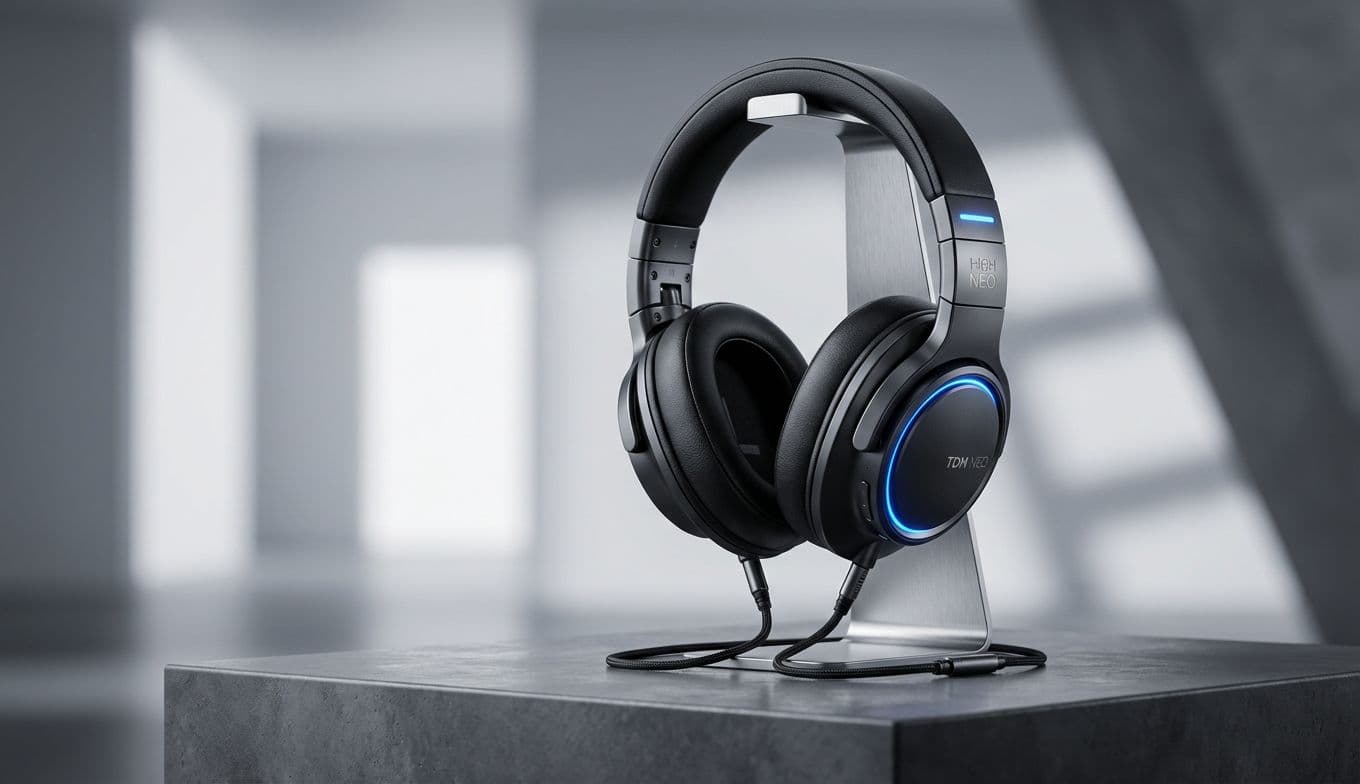
TDM Neo Headphones Analysis: A High-Risk Hybrid for $249?
Team Gimmie
1/30/2026

WHY THE HEDGEHOG HEADPHONES ARE A HIGH-RISK GIFT FOR 2026
Imagine a pair of premium headphones that, with a quick flick of the wrist, curls into a tight, dense ball like a startled hedgehog. It is a tactile, slightly bizarre transformation that turns a personal listening device into a compact Bluetooth speaker. This is the Neo, the flagship product from Tomorrow Doesn't Matter (TDM), and it was easily the most talked-about piece of "weird tech" at this year’s Consumer Electronics Show.
But as we approach the rescheduled February 10th Kickstarter launch, the excitement is being met with a healthy dose of editorial skepticism. While the design is undeniably clever, the Neo represents a significant gamble for consumers. At a projected retail price of $249, you aren’t just buying a pair of headphones; you are buying into an unproven concept with a delivery date that is, at best, a hopeful estimate. If you are looking at these as a gift—or a treat for yourself—it is time to look past the "cool factor" and evaluate the reality of what $250 actually buys you in today’s market.
THE PHYSICS OF THE TRANSFORMER: HEADPHONES VS. SPEAKERS
The primary draw of the Neo is its dual-purpose nature. TDM claims these headphones are perfect for the transition from solo listening to a shared party atmosphere. However, from an acoustic engineering standpoint, this is a massive mountain to climb.
Acoustic drivers are usually optimized for a specific environment. Professional-grade headphones are designed to move a tiny amount of air within a sealed chamber—your ear canal. To produce rich, deep bass and crisp highs in that space, the driver needs precision and isolation. Conversely, a Bluetooth speaker needs to move a room’s worth of air.
This creates a technical "identity crisis" for the Neo. If the drivers are tuned to be loud enough to fill a room in "hedgehog mode," they risk being harsh or overwhelming when pressed against your ears. Furthermore, the driver orientation is a puzzle. If the speakers face outward to function as a boombox, they are essentially operating as open-back headphones when you wear them. This means you’ll have zero noise isolation, and everyone on the bus will hear your music just as clearly as you do. For $249, consumers usually expect high-end Active Noise Cancellation (ANC), something the Neo’s transformable spine might not be able to accommodate.

THE $250 PRICE TAG: NOVELTY VS. THE GOLD STANDARDS
We need to talk about the competition. The $250 to $350 range is the most fiercely contested space in personal audio. When you spend this kind of money, you are usually looking for a "forever" pair of headphones.
Consider the Sony WH-1000XM5. While its retail price is higher, it is frequently on sale near the Neo’s $249 target. With the Sony, you get industry-leading noise cancellation, forty hours of battery life, and a refined app ecosystem. Then there is the Bose QuietComfort series, which remains the gold standard for long-haul comfort and reliable connectivity.
When you choose the TDM Neo, you are consciously sacrificing the guaranteed audio fidelity and world-class ANC of brands like Sony, Bose, or Sennheiser in exchange for a rolling mechanism. You have to ask yourself: how often do I actually need my headphones to become a mediocre speaker? Most of us already own a dedicated portable speaker that likely sounds better than a folded-up pair of headphones ever could.
THE KICKSTARTER GIFTING GAMBLE: PROMISES DON'T FIT UNDER A TREE
The Neo was originally supposed to launch its crowdfunding campaign this month. That has already been pushed to February 10th. While a few weeks might not seem like much, in the world of hardware startups, it is often a harbinger of the "Kickstarter Slide."
Gifting a crowdfunding project is a unique psychological exercise. You aren't actually giving a product; you are giving a "promise" and a receipt. TDM estimates a July 2026 shipping date, but seasoned backers know that manufacturing hurdles, shipping bottlenecks, and software bugs can easily push that into 2027.
If you are buying this as a birthday or graduation gift, you are essentially telling the recipient, "I bought you something cool, but you can't have it for six months—maybe longer." There is also the inherent risk that the company fails to move from prototype to mass production. In that scenario, your $249 gift becomes an expensive lesson in the volatility of tech startups. For a gift-giver, that is a high-stress position to be in.
BETTER BETS FOR RIGHT NOW
If you need a high-quality audio gift today—or if you want the functionality of the Neo without the Kickstarter risk—there are better ways to spend $250. You can provide a superior experience by "bundling" established products that actually exist and ship within 24 hours.
For the Commuter: Pair the Soundcore Space Q45 headphones with a JBL Go 4 speaker. This combo usually costs less than $200 total. The recipient gets headphones with 50-hour battery life and legitimate noise canceling, plus a rugged, waterproof speaker they can actually take to the pool—something the Neo definitely isn't designed for.
For the Audiophile: Look at the Sennheiser Accentum Plus. It delivers incredible sound and 50 hours of playback for around $230. It doesn't roll into a ball, but it will sound significantly better in your ears than a dual-purpose hybrid.
For the Tech Enthusiast: If they truly crave novelty, look into the EarFun Air Pro 4 or the Nothing Ear headphones. These brands offer unique, transparent designs and cutting-edge features for half the price of the Neo, leaving you with enough room in the budget to buy a dedicated Bose SoundLink Micro for their speaker needs.
THE VERDICT: WAIT FOR THE WAREHOUSE, NOT THE CAMPAIGN
The TDM Neo is a fascinating piece of industrial design. It’s the kind of "what if" thinking that makes CES exciting every year. However, there is a wide chasm between a cool prototype on a showroom floor and a reliable piece of consumer electronics that lives in your backpack.
Between the technical hurdles of driver orientation, the lack of established ANC, and the inherent risks of a delayed Kickstarter launch, the Neo is a "wait and see" product. If TDM delivers in July and the reviews confirm that it actually sounds good in both modes, then it might be worth the premium.
Until then, don't let the hedgehog charm fool you. If you need a reliable, high-performance audio solution today, stick with the brands that have already mastered the art of the earcup. A promise of a cool gadget in July isn't nearly as satisfying as a great pair of headphones on your ears right now.