Product copy that AI gift assistants choose: a Shopify guide

Product copy that AI gift assistants choose: a Shopify guide

Team GimmieTeam Gimmie
Published on August 4, 2026

TL;DR — What this guide does

Product copy that AI gift assistants choose is product copy written to signal who a gift is for, how it feels, and why it solves an emotional problem. AI Overviews and shopping agents (ChatGPT, Perplexity, Gemini, UCP/ACP-enabled agents) now favor concise, personality-rich signals; brands that add these signals see immediate improvements in agentic discovery and conversion.

Quick answer (50 words): Write product copy that names the recipient (e.g., "for the busy new parent"), states the emotional outcome (comfort, pride, delight), uses one-of-eight personality cues (Gimmie’s 8-Color), and exposes explicit machine-readable attributes (giftability, occasion, who-this-is-for) via Product schema and llms.txt so AI agents pick your item first.

What is personality-optimized product copy for AI gift assistants?

Personality-optimized product copy is copy that encodes human personality cues and gift intent into short, machine- and human-readable signals so AI assistants can match items to recipient archetypes. It blends Gimmie’s 8-Color psychology with transactional product facts and clear occasion tags.

Product pages historically list specs, features, and price. Agentic commerce requires three new signals: recipient intent (who it’s for), emotional outcome (what the gift makes them feel), and personality cue (e.g., Explorer vs. Guardian). These are the attributes agents search for when building carts through UCP and ACP.

Why do AI gift assistants prefer personality signals?

AI gift assistants prefer personality signals because agents synthesize limited context; personality lets them generalize from a single preference to a set of high-fit products. In 2026, UCP-enabled agents use structured attributes to create multi-item carts; personality attributes reduce false positives and increase conversion.

Practical result: when a user asks ChatGPT or a UCP agent for “a thoughtful graduation gift for a creative aunt who loves plants,” agents favor pages that explicitly state "for creative plant-lovers" and showcase emotional outcomes like "joy of tending an indoor garden." That clarity increases selection probability and reduces returns.

How do I structure a Shopify product page for agentic gifting?

Structure product pages with four visible blocks: (1) one-line who-this-is-for, (2) 30–50-word emotional outcome, (3) features in bullets, and (4) a personality tag + short social-proof example. Expose these same values in JSON-LD Product schema and llms.txt.

Checklist for Shopify merchants:

  • H1: Product name + primary differentiator (e.g., "Koban Ceramic Planter — Self-Watering, 5" pot")
  • Immediately below H1: Who this is for (one line): "For the creative aunt who loves low-maintenance houseplants."
  • 30–50 word outcome paragraph: emotional benefit + usage context.
  • Bulleted features with explicit specs (size, material, GTIN).
  • Short UGC quote (one-liner) showing fit for a personality.
  • Add an occasions list: "Birthday, Housewarming, Graduation, Thank-you" as visible badges.
  • Add a product tag: giftable:true, gift_personality:creator in Shopify metafields.

What copy elements map to Gimmie’s 8-Color archetypes?

Each 8-Color archetype prefers specific language: use a single dominant cue per product to avoid signal conflict. Below are example archetypes and the exact tonal cues agents look for.

  • Creator — Primary cue to include: "aesthetic, crafted, limited edition"; Example one-line copy: "Hand-glazed planter for the design-minded aunt."
  • Explorer — Primary cue to include: "novelty, discovery, compact adventure"; Example one-line copy: "A desktop terrarium—tiny, wild, endlessly curious."
  • Guardian — Primary cue to include: "practical, durable, useful"; Example one-line copy: "Self-watering planter for busy plant parents—no fuss."
  • Connector — Primary cue to include: "social, gift-ready, shareable"; Example one-line copy: "Perfect for hosting: conversation-starting planter."

Sample product snippets (choose one tone per product):

  • Creator: "Hand-glazed ceramic with a matte finish—designed to elevate a shelf and invite compliments."
  • Guardian: "Robust, self-watering base and refill indicator so plants thrive during busy weeks."
  • Connector: "Gift-ready with a gold-trimmed box and a pre-written card option—shareable joy, no wrapping needed."

How do I expose these signals to AI agents (schema, llms.txt, metafields)?

Expose personality and gift intent via three channels: Shopify metafields, JSON-LD Product schema, and your store’s llms.txt/agents.md files. Agents prioritize structured data (UCP) and llms.txt excerpts when available.

Implementation steps:

  1. Add Shopify metafields: giftable:boolean, gift_personality:string (slug of 8-Color archetype), gift_occasions:array.
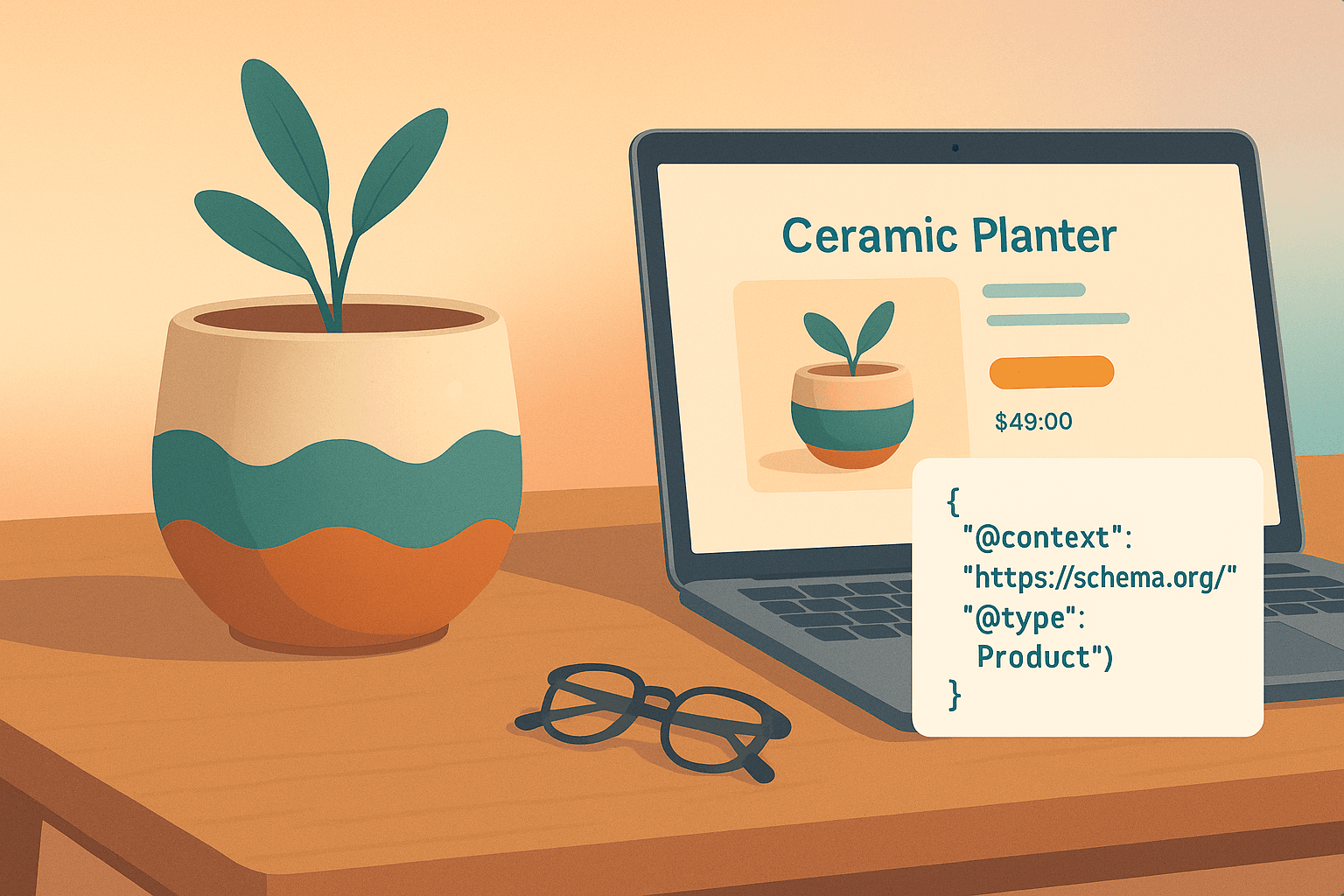
  2. JSON-LD Product schema: include audience/whoThisIsFor and an additionalProperty block for gift_personality and occasion. Example:
"additionalProperty": [
  {"name": "gift_personality", "value": "creator"},
  {"name": "gift_occasions", "value": "birthday,housewarming"}
]
  1. llms.txt: add a short excerpt with 10–20 top products and a one-line personality hook per product.
  2. Agents.md or /.well-known/ucp: ensure agent capability declarations allow cart addition and gifting flows.

How should I test and measure agentic gifting performance?

Measure agentic outcomes with four KPIs: agentic discovery (agent referrals), agentic conversion (orders attributed to ChatGPT/Perplexity/UCP), gift-success metrics (returns rate on gift purchases), and gift-attributed LTV increase. Use Shopify’s new ChatGPT/Gemini performance score and UTM tagging for agentic sources.

Practical A/B tests:

  • Variant A: standard product copy. Variant B: personality-optimized copy + metafields. Run 30-day test with identical paid distribution to isolate agentic effects.
  • Track: agentic impressions, add-to-cart rate from AI channels, conversion rate, AOV, 90-day repeat purchase rate for recipients.

What common mistakes stop agents from choosing your product?

The three common failures are missing structured fields, mixed personality signals, and vague "giftable" claims. Each reduces an agent’s confidence and removes your item from multi-item carts.

Avoid:

  • Multiple competing personality cues on one product (e.g., "luxury" + "budget")
  • Hiding key data behind tabs or JS that agents can’t parse
  • Lacking GTIN/variant data—agents prefer items with full commerce metadata

How do I scale this across a catalog of 500+ SKUs?

Scale by tagging product clusters, templating copy snippets per archetype, and batch populating metafields via CSV or Shopify API. Start with your top 100 SKUs that drive 80% of AOV.

Scaling playbook:

  1. Run a 2-week audit to map SKUs to primary archetype.
  2. Create 8 copy templates (one per archetype) and a short outcomes library.
  3. Bulk-write 50–100 product descriptions using templates and human edits.
  4. Push metafields via Shopify API and validate JSON-LD on 10 sample product pages.

The bottom line

Personality-optimized product copy is the bridge between emotional gifting and agentic commerce. When Shopify merchants combine Gimmie’s 8-Color cues with explicit schema and llms.txt signals, AI gift assistants choose their products more often, conversion rises, and returns fall. Start by optimizing 10–20 top SKUs with clear "who this is for" lines and measurable metafields—then scale.

Ready to try it? Test one archetype on your best-selling SKU this week and watch the ChatGPT/Gemini product score in your Shopify admin for early movement.

Product copy that AI gift assistants choose: a Shopify guide | Gimmie