
Laurie Spiegel The Expanding Universe Review: An Ambient Masterpiece
Discover why Laurie Spiegel's 'The Expanding Universe' is a timeless ambient masterpiece. Explore its history, the GROOVE system, and why it's the perfect gift for creatives.

By Team Gimmie
Updated September 2, 2026
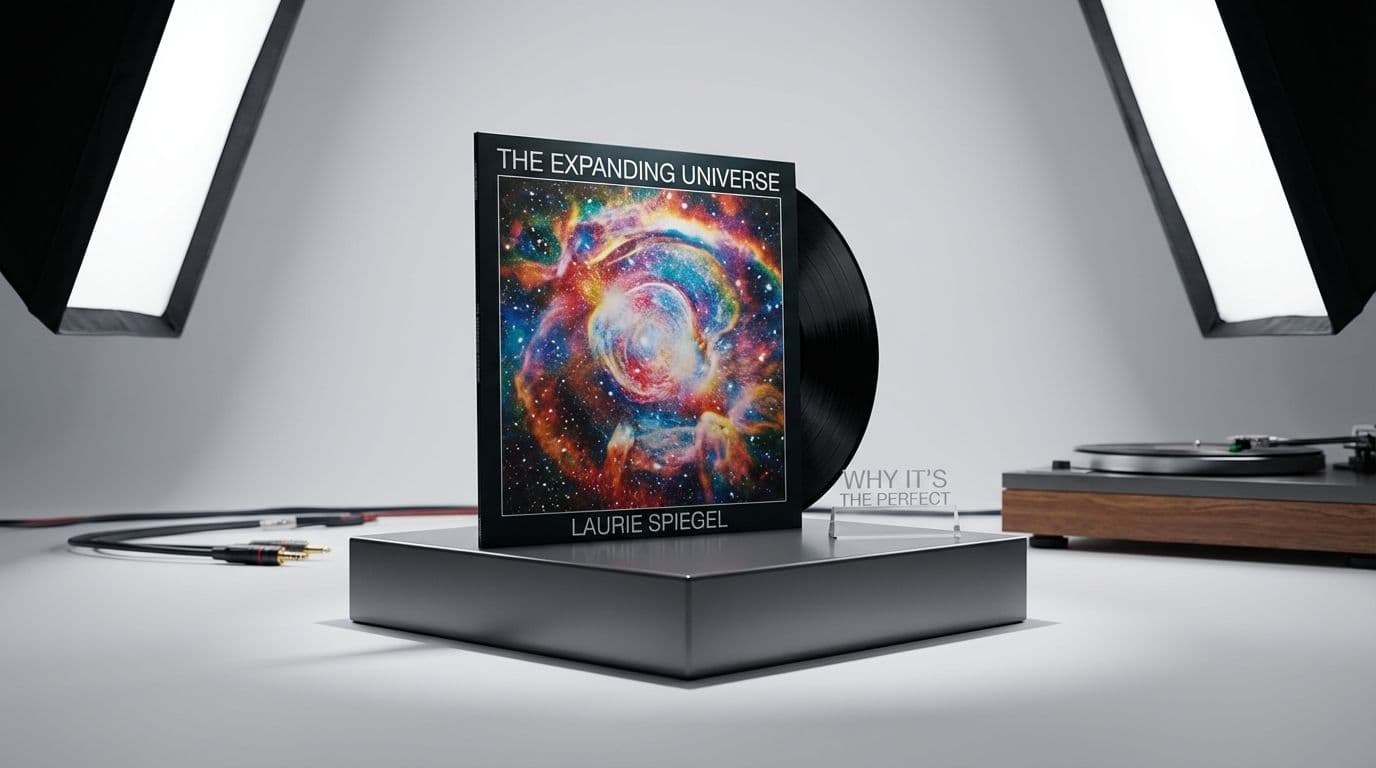
REDISCOVERING THE ALGORITHM: WHY LAURIE SPIEGEL STILL MATTERS
While preparing for a recent interview with Laurie Spiegel, I found myself tethered to my desk, headphones clamped tight, losing track of time inside her 1980 landmark, The Expanding Universe. It is a rare experience to sit with a record that is over four decades old and realize it feels more technologically prophetic than half the electronic music currently topping the charts.
As I sifted through my interview notes and revisited her discography, I realized that Spiegel’s work is not just a collection of songs. It is the result of a pioneer wrestling with the very idea of how humans and machines communicate. For any auditory explorer or tech historian, this album is less of a vintage relic and more of a primary source for the digital world we now inhabit. Re-listening to it through the lens of my conversation with her changed how I view the entire genre of ambient music. It is not just about relaxation; it is about the elegant intersection of mathematics and emotion.
BEYOND THE SYNTH: THE TECHNICAL SOUL OF THE EXPANDING UNIVERSE
To understand why The Expanding Universe is a necessary gift for the modern music lover, you have to look past the generic labels of electronic or ambient. Spiegel’s approach in the late 1970s was deeply rooted in her work at Bell Labs, where she utilized the GROOVE system—an acronym for Generated Real-time Output Operations on Voltage-controlled Equipment.
Unlike the plug-and-play digital workstations of today, Spiegel was essentially a composer-programmer. She wrote the code that defined the logic of the music, allowing the computer to generate variations while she manipulated the parameters in real-time. This algorithmic composition is what gives tracks like Patchwork and A Folk Study their distinctive character. They feature bouncy, recursive arpeggios that might remind a casual listener of the synth textures in The Who’s Baba O’Riley, but the complexity here is far more granular. These pieces aren't just looping; they are evolving according to mathematical rules that Spiegel set in motion.
In contrast, longer works like Old Wave and East River Dawn move away from rhythmic precision and into a state of suspension. This is where Spiegel laid the groundwork for what we now call ambient music. By stripping away traditional song structures, she created a space where sound could simply exist. It is a remarkable feat of engineering and artistry that managed to make a massive, room-filling computer sound intimate, human, and deeply contemplative.
