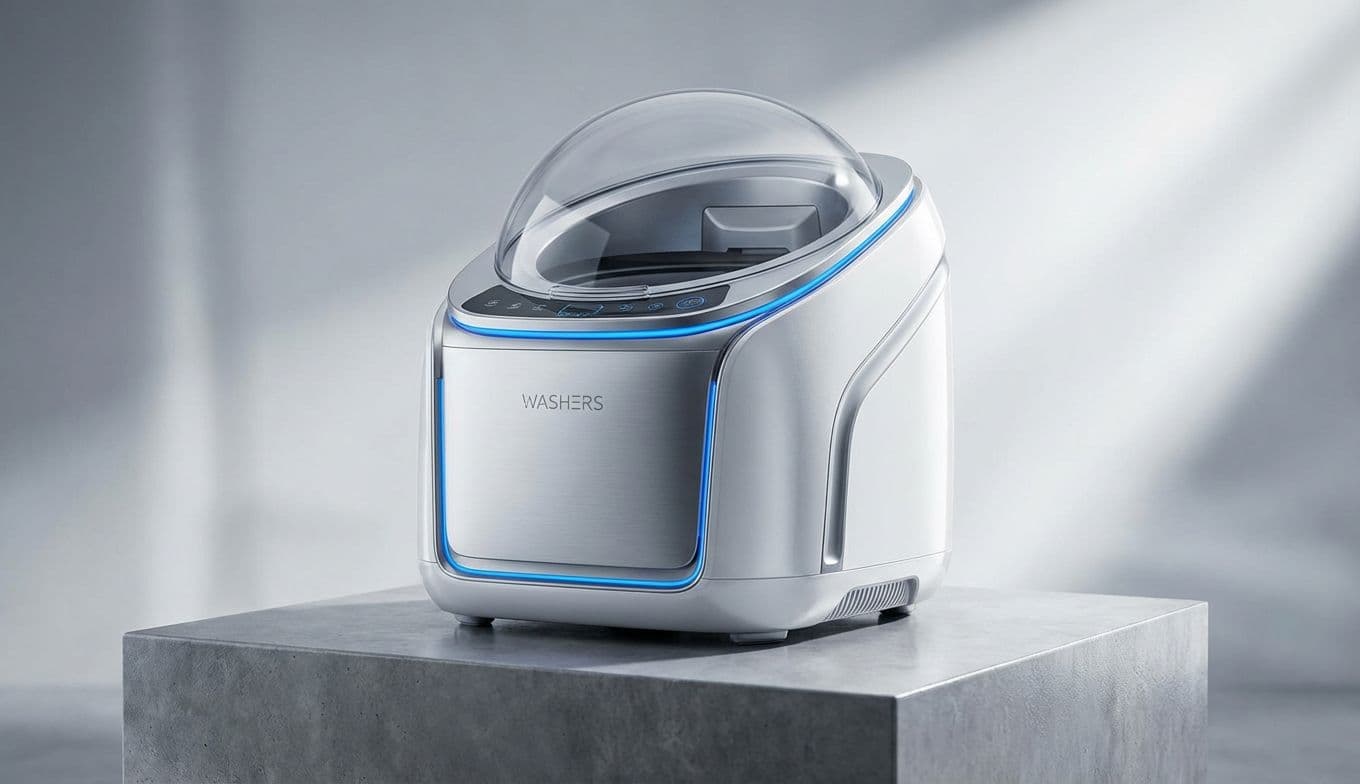
Laundry Robots vs. AI Washers: The 2026 Reality Check
Team Gimmie
1/11/2026

The Silicon Valley Laundry Dream
It is the ultimate domestic fantasy. You come home to find a sleek, metallic assistant gliding through your hallway. It doesn’t just move; it navigates. It enters the laundry room, identifies a pile of mixed fabrics, and begins sorting whites from colors with the precision of a diamond cutter. By the time you’ve poured a glass of wine, your t-shirts are folded into crisp, retail-grade squares.
At this year’s Consumer Electronics Show, that carrot was dangled more enticingly than ever. We saw LG’s CLOiD and SwitchBot’s Onero H1 making bold claims about household autonomy. We watched high-frame-rate videos of humanoid limbs from Boston Dynamics and various startups performing delicate tasks. The tech world is buzzing with a singular question: Are we finally at the finish line of the most hated chore in history?
As a product reviewer who has spent years debunking gadgets that promise the moon but deliver a flickering candle, I have a simple message for you: keep your hamper. While the leap in AI-driven motor control is staggering, the distance between a trade-show floor and your mudroom is still measured in miles, not inches.
Why Your T-Shirt is a Robot’s Worst Nightmare
To understand why we aren’t there yet, you have to understand the difference between a floor and a fabric. We’ve had robot vacuums for decades because a floor is a predictable, two-dimensional plane. A Roomba doesn’t need to understand the soul of a carpet; it just needs to not fall down the stairs.
Laundry is different. It is what researchers call an unstructured environment. A crumpled pair of jeans is a topographical disaster. To a robot’s sensors, a pile of clothes is a chaotic mass of shifting shadows, overlapping layers, and varying textures. A robot needs to figure out where a sleeve ends and a pant leg begins, all while dealing with materials that are floppy, translucent, or heavy.
While LG’s CLOiD was showcased loading a washing machine, notice the fine print: the clothes were often pre-positioned or the environment was surgically controlled. Handling a single, pre-folded towel in a lab is one thing; reaching into a tangled ball of damp leggings, lace, and denim is the Everest of domestic robotics. Manipulating fabric requires a level of tactile sensing—knowing exactly how much pressure to apply so you don’t tear a silk blouse while still gripping a heavy wet towel—that consumer-grade robotics simply hasn’t mastered.

A Quick Reality Check: Is This For You?
Before you start clearing a space in the garage for a humanoid butler, let’s talk about the current market tiers.
The Tech Elite and Research Labs: If you have a six-figure disposable income and a desire to live in a beta-test environment, the current crop of humanoids is a fascinating toy. They are for people who want to own a piece of the future and don’t mind if that future occasionally drops a plate or gets stuck on a rug.
The Average Gimmie AI Reader: If you are looking for a gift that actually reduces the time you spend staring at a dryer, these humanoid robots are not for you. They are expensive, temperamental, and currently lack the multi-step autonomy required to be truly useful. Buying a CLOiD today for its laundry skills would be like buying a Ferrari to use as a lawnmower—expensive, flashy, and fundamentally the wrong tool for the job.
The Robots You Should Actually Buy Today
If the goal is to stop doing laundry, don’t look for a machine with legs. Look for the machines that have integrated the brains of these robots into the appliances themselves. The real innovation in 2026 isn't a walking butler; it is the "all-in-one" revolution.
The GE Profile UltraFast Combo is a prime example of what actual, usable laundry automation looks like. It doesn’t walk, but it eliminates the most annoying part of the process: the transfer. You put dirty clothes in, and a few hours later, they are dry. It uses a high-efficiency heat pump and AI-driven sensors to determine exactly when the load is finished. It’s a "robot" that lives in a box, and it’s infinitely more useful than a humanoid arm trying to grip a sock.
Similarly, the Samsung Bespoke AI Laundry Hub uses computer vision and sensors to detect fabric softness and soil levels. It then adjusts detergent levels and cycle times automatically. These machines solve the "decision-making" part of laundry—the sorting, the measuring, the timing—which is where most of our mental energy goes anyway. If you want to gift someone "the gift of time," these are the machines that deliver.
Navigating the Hype: A Buyer’s North Star
It is easy to get swept up in the viral videos of robots doing backflips or making lattes. But as a discerning consumer, you need to apply a different lens to these innovations. Instead of asking if a robot is cool, ask if it is reliable in the "chaos of the real."
When you see a demo for a new household assistant, look at the environment. Is it a brightly lit, perfectly clean stage? If so, assume the robot will struggle in your dimly lit basement. Is the robot performing a single, repetitive motion? If so, realize it likely lacks the "chain of thought" required to move from the washer to the dryer to the folding table.
The value proposition for a 20,000 dollar humanoid that might fold three shirts an hour simply isn’t there yet. However, the value of a 2,500 dollar smart appliance that handles the washing and drying in one go is immense. One is a conversation piece; the other is a life-changer.
The Long Road to the Automated Hamper
The research being done by Boston Dynamics and SwitchBot is vital. They are solving the hard problems of spatial awareness and fine motor control that will, one day, give us the "Rosey the Robot" we were promised in the 1960s. We should admire the engineering and follow the progress with genuine excitement.
But for the 2026 holiday season, and likely for the next several years, the "laundry robot" is already here—it just doesn't have a face. It’s the smart, high-efficiency, all-in-one machine sitting in your utility room.
The dream of the humanoid assistant is beautiful, but the reality of a machine that lets you go to bed with dirty clothes and wake up with dry ones is much more satisfying. Invest in the technology that works today, and leave the prototypes to the research labs. Your t-shirts will thank you.