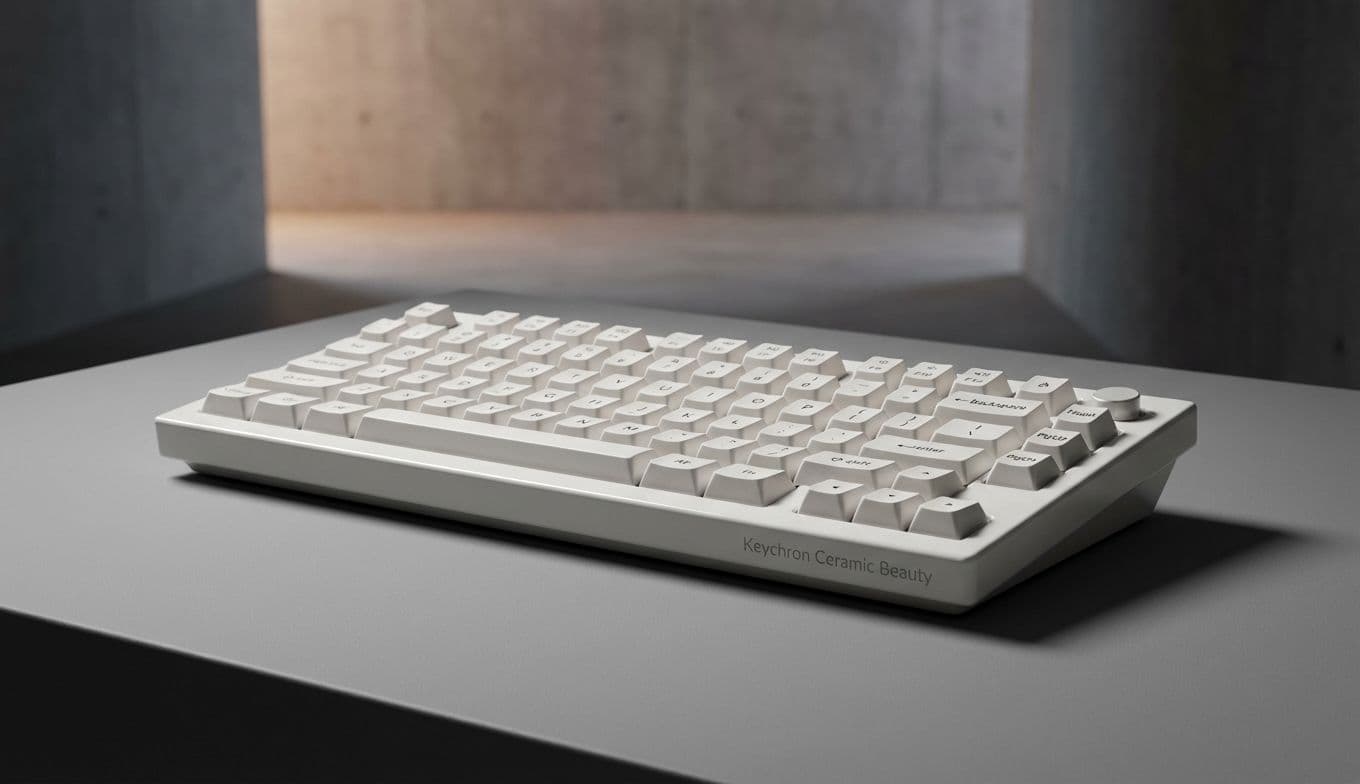
Keychron Q16 HE 8K Review: Ceramic Beauty vs. Fragile Risk
Team Gimmie
1/30/2026

THE CERAMIC GAMBLE: WHY THE KEYCHRON Q16 HE 8K IS A BRILLIANT HEADACHE
Imagine unboxing a keyboard that feels less like a computer peripheral and more like a piece of high-end dinnerware. It is cold to the touch, surprisingly heavy, and possesses a polished, vitreous sheen that makes your standard plastic or aluminum decks look like toys. This is the Keychron Q16 HE 8K, a device that attempts to marry the bleeding edge of gaming technology with a material usually reserved for fine vases and dental implants.
On paper, this keyboard is a masterpiece. It features the latest Hall Effect magnetic switches and a blistering 8K polling rate. But in practice, Keychron has created a polarizing paradox. While the internal technology is some of the best the company has ever produced, the ceramic housing turns a high-performance tool into a fragile liability. As someone who has tested dozens of mechanical boards, I can tell you that while this is a fascinating experiment, it is a risky bet for most users and an even riskier gift.
THE MAGNETIC REVOLUTION: WHY HE TECHNOLOGY MATTERS
Before we get into the controversial shell, we have to talk about the HE in the name. HE stands for Hall Effect, and it represents the biggest shift in keyboard technology in a decade. Unlike traditional mechanical switches that rely on two pieces of metal touching to register a keystroke, Hall Effect switches use magnets.
As you press a key, a sensor measures the proximity of a magnet. This allows for a feature called adjustable actuation. With a few clicks in Keychron’s software, you can decide exactly how deep you want to press the key before it registers. You can set it to a hair-trigger 0.1mm for lightning-fast gaming reflexes or a deep 4.0mm to prevent typos while you are writing an email.
The real magic for gamers, however, is Rapid Trigger. In games like Valorant or Counter-Strike, movement is everything. With traditional switches, you have to let the key rise back up past a specific point before you can press it again. With Rapid Trigger, the key resets the instant your finger begins to lift. This removes the physical delay of the switch, making your character feel like an extension of your nervous system. Pair that with an 8K polling rate—which sends data to your PC 8,000 times per second rather than the standard 1,000—and you have arguably the most responsive input device on the market.

A SENSORY EXPERIENCE: THE WEIGHT AND THE THOCK
The ceramic casing is the headline feature, and it is a total departure from the aluminum frames we have grown used to. The first thing you will notice is the weight. Ceramic is dense—significantly heavier than aluminum—meaning this keyboard stays exactly where you put it. There is zero deck flex; it feels like a solid slab of stone.
Then there is the temperature. On a cold morning, the Q16 HE 8K feels icy. As you type, it slowly absorbs your body heat, eventually reaching a comfortable, neutral temperature. It is a tactile experience that plastic simply cannot replicate.
But for keyboard enthusiasts, the most important sensory detail is the sound profile, or the thock. Ceramic produces a unique acoustic signature. Because the material is so dense and non-porous, it does not have the hollow, metallic ring found in some aluminum boards. Instead, it offers a clean, marbly clack. Every keystroke sounds deliberate and high-end. It is a sophisticated sound that makes the $219 MSRP feel, at least momentarily, justified.
THE FRAGILITY FACTOR: A PORCELAIN PROBLEM
Here is where the dream starts to crack—potentially literally. While Keychron has used a reinforced ceramic composite, the material is inherently brittle. If you drop an aluminum keyboard, you might get a dent. If you drop the Q16 HE 8K on a hardwood or tile floor, there is a very real chance it will shatter or chip.
This creates a constant undercurrent of anxiety. If you are someone who likes to swap out your keycaps or experiment with different internal mods, you will find yourself handling this board with the caution of an archaeologist. One slip of a screwdriver or one accidental knock off the desk could turn your $219 investment into a collection of expensive shards.
This fragility makes the Q16 HE 8K a terrible recommendation for several groups. It is not for the student who shoves their keyboard into a backpack. It is not for the person with a cluttered desk or curious pets. And most importantly, it is a high-stakes gamble for a gift. Unless you know the recipient is a dedicated collector who treats their hardware like a museum exhibit, you might be gifting them a looming heartbreak.
WHO SHOULD TAKE THE LEAP?
The Keychron Q16 HE 8K is a niche product for a very specific type of person.
The first is the Pro-Level Competitor. If you are playing at a level where a millisecond of input lag or a 0.1mm difference in actuation determines your rank, the HE technology here is transformative. You are likely already meticulous with your gear and will appreciate the performance gains.
The second is the Aesthetic Collector. If you have a curated desk setup and want something that looks and feels unlike anything else on the market, the ceramic finish is stunning. It is a conversation piece that happens to be an incredible typing tool.
BETTER BETS: THE SAFE ALTERNATIVES
If you love the sound of the technology but are terrified of the ceramic case, you are in luck. Keychron offers several alternatives that provide the same high-end typing experience without the risk of shattering.
The Keychron Q1 Pro is the gold standard. It features a robust, CNC-machined aluminum body that is nearly indestructible. It is heavy, premium, and offers wireless connectivity. While it does not have the Hall Effect switches, it is a far more practical choice for 95% of users.
If you are on a budget, look at the Keychron V-Series. The V1 Max, for example, offers an incredible typing experience in a durable plastic shell for less than half the price of the ceramic model. It is the perfect entry point for someone who wants a great keyboard without the stress of a luxury price tag.
THE FINAL VERDICT
The Keychron Q16 HE 8K is a brave experiment. I applaud Keychron for pushing the boundaries of what materials we can use for our tech. The Hall Effect switches and 8K polling make it a performance beast that is genuinely a joy to use.
However, the choice of ceramic feels like innovation for the sake of being different rather than better. It adds a level of fragility that clashes with the rugged, workhorse nature of a good keyboard. At over $200, you are paying a premium for a material that makes your life more stressful, not easier.
If you are a hardcore enthusiast who understands the risks, you will find a lot to love here. But for everyone else—especially those looking for a reliable gift—stick to the aluminum or plastic models. Innovation is brilliant, but durability is what keeps a keyboard on your desk for a decade.