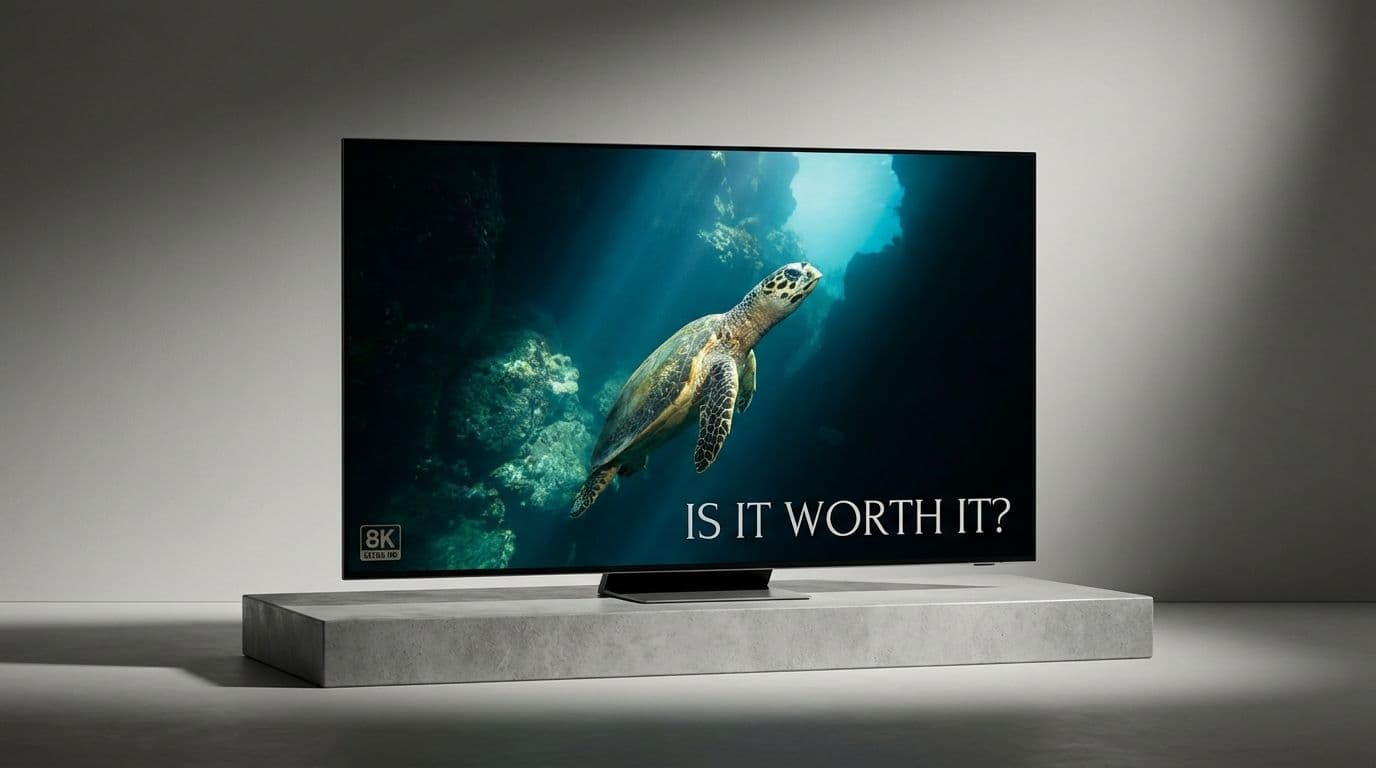
Is an 8K TV Worth It in 2026? The 4K vs 8K Reality Check

Team Gimmie

Team Gimmie

2/2/2026

Is an 8K TV Worth It in 2026? The 4K vs 8K Reality Check

The 8K TV Trap: Why You Should Skip the Hype and Save Your Money

Walking into a high-end electronics store feels a bit like stepping into a science fiction movie. You are greeted by massive, glowing rectangles displaying hyper-realistic slow-motion footage of ink dropping into water or a leopard prowling through tall grass. The colors are vibrant, the blacks are deep, and the sales tag proudly screams 8K. It looks incredible, and the marketing pitch is even more persuasive: four times the resolution of 4K, 33 million pixels, and a visual experience so real you could step through the glass.

But as a product reviewer who has spent years testing every major display technology to hit the market, I’m here to tell you to take a deep breath and step away from the credit card.

The industry is pushing 8K hard right now, but for 99% of people, buying an 8K TV in 2026 is a mistake. It is an investment in a future that hasn’t arrived, powered by technology that your own biology might not even be able to appreciate. If you want the best possible viewing experience for your living room, the smart money is still—and will be for a long time—firmly planted in the world of 4K.

The Biology Problem: Can You Even See It?

The biggest hurdle for 8K isn’t just the price or the lack of movies; it’s the human eye. There is a concept in display technology often referred to as Retina distance. This is the point at which the pixels on a screen become so small that the human eye can no longer distinguish them individually.

On a standard 65-inch 4K TV, if you are sitting more than about five feet away, your eyes are already at their limit for detail. Moving to 8K quadruples the pixel density, but unless you plan on pulling your sofa to within three feet of a 75-inch screen, those extra 25 million pixels are effectively invisible. You are paying for detail that your optic nerve literally cannot process.

For the average living room where the couch is eight to ten feet from the TV, a high-quality 4K screen already provides a perfect, seamless image. In this scenario, 8K doesn’t make the picture sharper; it just makes the price tag heavier.

The Content Conundrum and the Upscaling Myth

Even if you had the eyes of a hawk, you would still run into the single biggest problem in home theater today: there is almost nothing to watch in native 8K.

While 4K has become the standard for Netflix, Disney+, and physical 4K Blu-rays, 8K content is a ghost town. You can find some beautiful scenic loops on YouTube and a few experimental broadcasts in Japan, but your favorite blockbuster movies and prestige TV shows are not being delivered in 8K. The bandwidth required to stream 8K is massive, and most home internet connections simply can’t handle it reliably.

Manufacturers will counter this by talking about AI Upscaling. They claim the TV’s processor can take a 4K image and magically fill in the gaps to make it look like 8K. To be fair, the processing in a 2026 flagship like the Samsung QN900D is staggering, but it isn’t alchemy. You cannot create detail where none exists. Upscaling is essentially a very sophisticated way of smoothing out edges so a lower-resolution image doesn’t look blurry on a high-resolution screen. It looks good, but it doesn’t look like true 8K, and it certainly doesn't justify a $3,000 premium over a top-tier 4K model.

The Gift-Giver’s Dilemma: Spending 8K Money Wisely

If you are looking for a show-stopping gift for a spouse or a family member and you have an 8K budget—which usually starts around $4,000 and goes up rapidly—don’t waste it on resolution.

For the price of a mid-range 8K TV, you could buy a 4K setup that would actually change the recipient's life. Instead of a 65-inch 8K TV, buy an 83-inch LG G4 OLED. The sheer scale of an 83-inch screen provides a much more immersive cinema experience than a smaller 8K screen ever could.

If they already have a great screen, take that extra $2,000 or $3,000 and invest in a dedicated Dolby Atmos sound system or a high-end receiver and floor-standing speakers. A 4K image paired with a professional-grade sound system will beat an 8K image with a standard soundbar every single day of the week. That is how you create a wow factor that people actually feel.

The 4K Gold Standard: Where the Value Lives

If you want the best TV money can buy today, ignore the 8K aisle and look at the current 4K benchmarks. These TVs represent the peak of display technology, focusing on what actually matters: contrast, color accuracy, and brightness.

The LG C4 OLED remains the gold standard for most buyers. It offers perfect black levels and incredible gaming features at a price that leaves you room to actually buy some movies. If you want the absolute brightest screen for a sun-drenched living room, the Sony Brave 9 or the Samsung S95D (with its incredible anti-glare tech) are the real champions of 2026.

These 4K models are mature, refined, and compatible with everything you want to watch right now. They provide a vibrant, punchy image that looks spectacular from the couch, without the "early adopter tax" that comes with 8K.

The Verdict: Wait for the World to Catch Up

There will come a day when 8K makes sense. Eventually, cameras will all shoot in 8K, streaming codecs will become more efficient, and prices will drop to where 4K is today. But we aren’t there yet.

Buying an 8K TV right now is like buying a Ferrari to drive in a school zone. It has incredible potential, but there is nowhere to actually use it. You’re paying for a spec sheet, not a better viewing experience.

If you are in the market for a new display, stay disciplined. Look for a high-quality 4K OLED or Mini-LED from a reputable brand like LG, Sony, or Samsung. Focus on getting the largest screen that fits your space and the best sound system your budget allows. You’ll end up with a home theater that looks and sounds better than any 8K setup, and you’ll have thousands of dollars left in your pocket.

The future is coming, but for now, 4K is exactly where you want to be.

#4K vs 8K TV#native 8K content#TV viewing distance#best 4K TV 2026#8K upscaling