
Product Reviews
How Should Shopify Apparel Brands Respond to Pakistan BCI Cotton's 2.70% Price Jump?
Pakistan BCI cotton rose 2.70%, signaling possible yarn cost pressure. Shopify apparel brands should update product data, margins, and AEO content.
Pakistan BCI cotton rose 2.70%, signaling possible yarn cost pressure. Shopify apparel brands should update product data, margins, and AEO content.

By Team Gimmie
Updated September 2, 2026
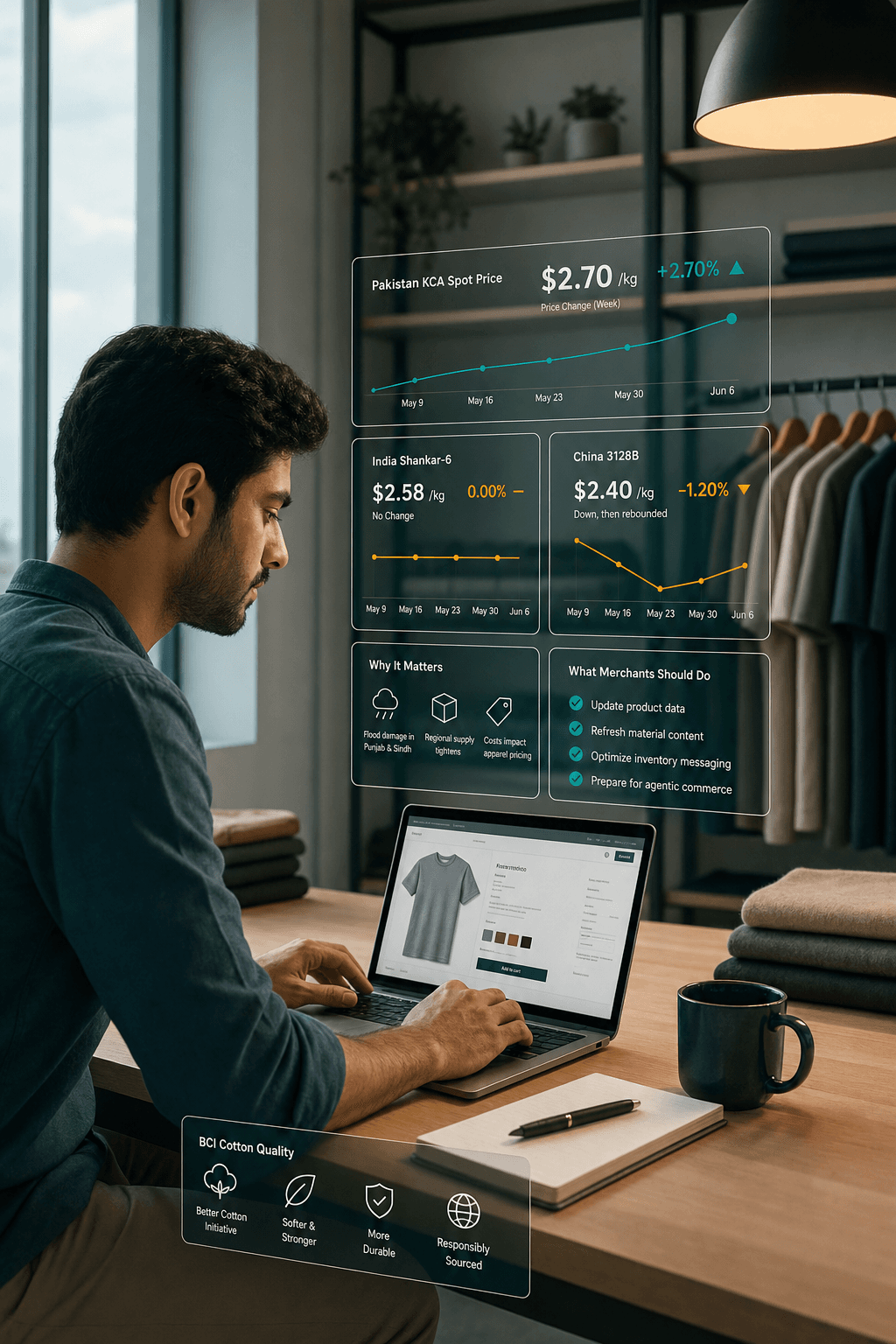
Pakistan BCI cotton's 2.70% spot price jump is a margin signal, not a reason to panic. For Shopify apparel, home textile, baby, sleepwear, and basics brands, the practical response is to audit cotton dependent SKUs, update material and origin attributes, refresh buying guides, and make pricing context readable to both shoppers and AI assistants.
TL;DR: Pakistan's KCA spot price rose 2.70% after flood damage in Punjab and Sindh, while India Shankar-6 stayed flat and China 3128B moved down, then partially rebounded. If your Shopify catalog depends on regional cotton yarn, now is the time to tighten product data, content freshness, inventory messaging, and agentic commerce readiness. The brands that explain material quality, sourcing, durability, and pricing clearly are easier for AI engines to cite and easier for shoppers to trust.
This is especially relevant for DTC operators selling cotton apparel, towels, bedding, babywear, underwear, socks, loungewear, and gifts. A small raw cotton move does not automatically mean retail prices must change tomorrow. It does mean your merchandising, content, and structured data should be ready if yarn suppliers revise quotes, lead times, or minimums.
A Pakistan BCI cotton increase matters because cotton price moves can flow into yarn costs, which then affect product margins, replenishment timing, and supplier negotiations. Fibre2Fashion reported Pakistan's KCA spot rose 2.70% after flood damage, while India remained flat and China moved unevenly, creating a regional cost signal rather than a global price shock.
For a Shopify merchant, the issue is not the spot market alone. The issue is whether your next purchase order, replenishment cycle, or seasonal launch relies on yarn from affected regions. BCI cotton is widely relevant to brands that position around responsible sourcing, comfort, and everyday wear.
Treat the news as an input to your operating model:
This is where AEO for Shopify becomes practical. AI assistants do not just parse product titles. They synthesize material claims, shipping data, reviews, availability, and explanatory content. If a shopper asks, "best organic cotton baby blanket that ships fast," incomplete material and shipping data can remove your product from consideration.
Cotton based Shopify brands should update material, fabric weight, origin, certifications, variant attributes, inventory status, shipping timelines, return policy, reviews, GTINs, and pricing fields first. These fields help AI shopping systems understand whether a product fits a shopper's request and whether it can be recommended with confidence.
The knowledge base is clear on this point: clean, complete, structured product data is the single lever merchants control across AI shopping platforms, search, and agentic commerce protocols. Products with richer structured attributes are more likely to be parsed correctly by AI engines, especially when shoppers compare material, fit, use case, price, or delivery speed.
Prioritize these fields for cotton products:
Do not write vague descriptions like "premium cotton tee." Write the answer an AI assistant needs: "A midweight organic cotton crewneck T-shirt for warm weather layering, made from 180 GSM jersey with a soft hand feel and pre-shrunk fit." That is more useful to customers and more machine readable.
For giftable cotton products, connect the product data to shopper intent. If you use an AI gifting app for Shopify stores, the recommendation engine needs more than category labels. It needs recipient fit, occasion, size flexibility, shipping confidence, and gift message availability.
Merchants should use AEO content to explain what changed, what has not changed, and how shoppers should choose. Answer first sections, FAQs, comparison content, and refreshed collection copy help AI engines cite your brand when customers ask about cotton quality, price differences, responsible sourcing, or product alternatives.
Do not publish a generic supply chain alarm post. Publish content that answers buyer questions tied to your catalog. A cotton market hook can support practical pages like:
Each article should start with a direct answer and use question based H2s. The knowledge base recommends 40 to 60 word answer blocks because AI systems extract concise passages more reliably than long explanatory sections. This article follows that pattern for the same reason.
Collection pages also need attention. Shopify collection pages are often the highest converting content type because they sit close to purchase intent. For a cotton bedding collection, add a short buying guide below the product grid that explains weave, thread count, GSM, certifications, care, and who each product is for. Then add FAQPage schema.
AEO does not replace pricing discipline. It supports it. If your costs rise and you raise price, explain durability, sourcing, return policy, and use case clearly. If you hold price, explain value without overclaiming. In either case, make sure your content is fresh. The grounding knowledge base notes that AI systems weight recent, useful updates more heavily for real time retrieval.
This connects to agentic commerce because AI agents need structured, accurate product information before they can recommend or buy on a shopper's behalf. Shopify's agentic commerce infrastructure can expose catalogs to AI systems, but merchants still control whether product attributes, availability, shipping, and policies are complete enough to be selected.
Agentic commerce is no longer theoretical infrastructure. The knowledge base notes that Shopify supports AI facing files and endpoints such as /llms.txt, /llms-full.txt, /agents.md, UCP discovery, and machine readable catalog access. Shopify also abstracts much of the protocol complexity for merchants.
That does not mean every store is ready. The weak point is usually product completeness.
If a shopper asks an AI assistant to buy "two breathable cotton gifts under $75 for a new parent, with fast shipping and gift message support," the agent needs to evaluate multiple fields at once:
This is where agentic gifting and catalog hygiene overlap. Gift purchases are often high intent but high uncertainty. The shopper may not know size, style preference, color preference, or recipient personality. A brand with complete product data and strong gift guidance gives AI agents more confidence.
Gimmie's glossary defines Agentic Gifting as the use of AI agents to automate and personalize gift selection, recommendations, and delivery. For Shopify brands, that means product data must describe who the item is for, not only what the item is. A cotton robe is not just "100% cotton." It might be a good gift for new homeowners, spa gift sets, postpartum care, bridesmaids, or holiday self care bundles. Those distinctions should live in product copy, metadata, and FAQ content.
This week, merchants should run a SKU level exposure audit, ask suppliers for cost and lead time updates, refresh cotton related product data, update key collection FAQs, and check AI visibility. The goal is to protect margin while making your catalog easier for customers, search engines, and AI assistants to understand.
Use this practical checklist:
If you run retention campaigns, connect cotton product merchandising to shopify gifting strategy. Cotton basics, baby gifts, home textiles, and comfort products often work well for customer anniversary, milestone, and surprise and delight programs because they are practical and easy to understand.
Merchants should not rush broad price increases, publish unsupported sourcing claims, rewrite every product page, or blame suppliers publicly. A single regional cotton price move is a signal to investigate exposure, not proof that every finished product cost will rise across every category.
Avoid these mistakes:
The best operating response is calm and specific. Find exposed SKUs, update the data AI systems need, improve your buying guides, and measure whether your brand is showing up in AI answers. Commodity volatility is not just a supply chain issue anymore. It is also a content, catalog, and AI visibility issue.
Shopify merchants are asking whether this price move should change pricing, product data, content, and AI visibility work. The short answer is yes for catalog hygiene and supplier checks, maybe for pricing, and definitely for AEO readiness if cotton quality, material claims, or giftability matter to your buyer.
Q: Should I raise prices because Pakistan BCI cotton rose 2.70%?
A: Not automatically. Check your own supplier quotes, open purchase orders, inventory position, fabric mix, and margin by SKU first. A regional spot market move can influence yarn costs, but finished goods pricing depends on contracts, lead times, manufacturing location, and existing inventory.
Q: Which Shopify products are most exposed to cotton yarn cost changes?
A: The most exposed products are cotton heavy SKUs with frequent replenishment, thin margins, and limited pricing power. Examples include T-shirts, underwear, socks, towels, bedding, babywear, loungewear, robes, canvas bags, and cotton gift bundles.
Q: What does BCI cotton mean for product pages?
A: BCI cotton refers to cotton associated with Better Cotton practices. If you claim BCI cotton, make the certification or sourcing basis clear, keep language accurate, and add the attribute consistently across product copy, metafields, schema, and collection filters.
Q: How can AEO help during supply chain volatility?
A: AEO helps by making your explanations easy for AI systems and shoppers to extract. Answer first buying guides, FAQ sections, updated product data, and schema can help your brand appear when customers ask why products differ in material, price, durability, or sourcing.
Q: What fields matter most for AI shopping assistants?
A: Material, price, availability, size, color, shipping time, shipping cost, return policy, reviews, ratings, SKU, GTIN, brand name, and product description matter most. For giftable products, add recipient fit, occasion, gift message support, and delivery confidence.
Q: How often should I refresh cotton product content?
A: Refresh high value product and collection pages whenever supplier terms, inventory, pricing, or material claims change. For stable pages, review quarterly. Fresh, accurate content supports both customer trust and AI retrieval.
Q: Can gift automation use cotton product data?
A: Yes. Gift automation can use material, use case, occasion, recipient fit, price, shipping, and review data to recommend cotton products more accurately. Better product data improves gift buying confidence and reduces choice friction.
The commodity hook comes from Fibre2Fashion's report on Pakistan BCI cotton pricing. The AEO, structured data, Shopify content, and agentic commerce recommendations are grounded in Gimmie's merchant knowledge base and cross checked against public resources including Shopify's Perplexity Shopping guide, Google's Universal Commerce Protocol overview, Search Engine Journal's agentic commerce analysis, and Commercetools' Agentic Commerce Radar.

A small team of friends and colleagues working together to produce useful content to help you...gift better.