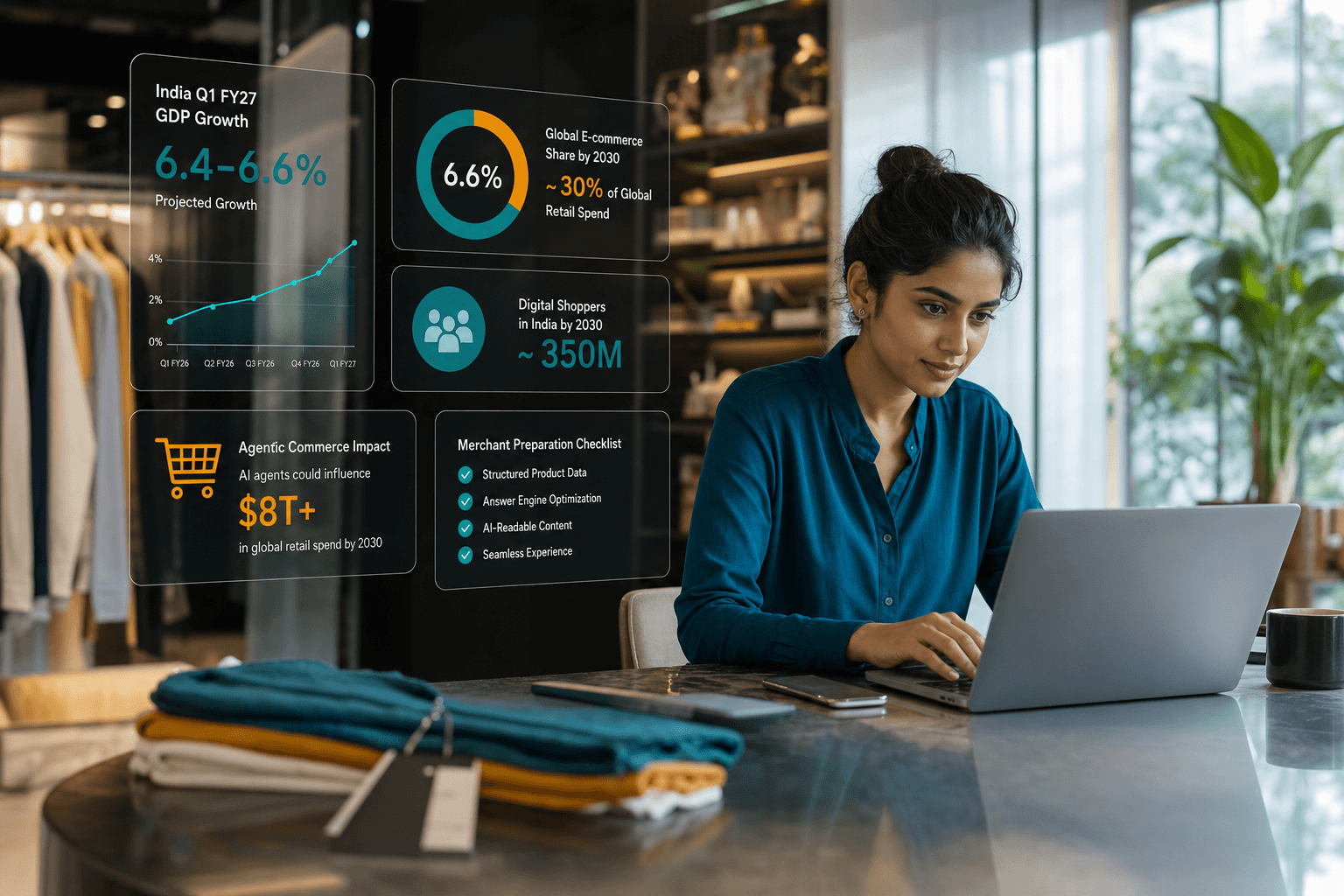
TL;DR: India's projected 6.4-6.6% Q1 FY27 GDP growth signals continued consumer spending momentum in one of the world's fastest-growing e-commerce markets. For Shopify merchants, this economic backdrop reinforces the urgency of preparing structured product data and answer engine optimization now—before AI shopping agents redirect trillions in global retail spend by 2030.
ICRA's latest projection places India's Q1 FY27 GDP growth between 6.4% and 6.6%, down from 7.7% in Q4 FY26 but still representing healthy expansion. The ICRA business activity monitor showed year-over-year economic activity jumped to 12% in June from 9.4% in May. For DTC brands on Shopify, this macroeconomic signal matters because India represents a massive and growing addressable market—and the infrastructure for reaching those consumers is shifting from traditional search to AI-powered discovery.
Why Should Shopify Merchants Care About India's GDP Growth?
India's sustained GDP growth of 6.4-6.6% indicates continued consumer spending capacity in a market where e-commerce adoption is accelerating rapidly. For Shopify merchants selling internationally or considering expansion, this economic resilience signals opportunity—but capturing it requires being visible where consumers now discover products: inside AI shopping assistants.
The connection between macroeconomic growth and AI commerce readiness is direct. McKinsey estimates agentic commerce could redirect $3 to $5 trillion in global retail spend by 2030. Markets with strong GDP growth like India will contribute significantly to that shift. The brands positioned to capture AI-referred traffic now will have structural advantages as these markets mature.
AI-referred traffic to Shopify stores grew 8x year over year by Q1 2026, and AI-attributed orders grew 13x in the same window. This is not a future trend—it is current reality. The question for merchants is whether their product data is complete enough for AI agents to recommend them.
What Does Structured Product Data Have to Do With Economic Growth?
Structured product data is the single lever Shopify merchants control across every AI platform, protocol, and shopping engine. Products with eight or more structured attributes are cited 4.3x more often in AI shopping results than products with fewer than three attributes. Economic growth creates demand; structured data determines who captures it.
When AI agents evaluate products on behalf of consumers, they parse structured data—not marketing copy. They need complete information: accurate pricing, real-time inventory, shipping details, variant specifications, GTINs, and comprehensive descriptions. The Shopify Catalog syndicates this data to AI channels automatically, and Shopify's internal data shows Catalog-fed AI searches convert at 2x the rate of searches using scraped product data.
The practical implication: a Shopify merchant with incomplete product data loses to a competitor with complete data, regardless of brand strength or marketing spend. In growing markets like India, where new consumers are entering e-commerce daily, the brands visible to AI agents win the discovery battle before traditional marketing even begins.
How Does Answer Engine Optimization Connect to Market Expansion?
Answer engine optimization ensures your brand becomes the source AI engines cite when consumers ask product questions. In markets experiencing economic growth, consumer queries increase—and AI Overviews now appear on 14% of all shopping queries, a 5.6x increase from November 2024. The brands structured for AI extraction capture this expanding demand.
AEO requires answer-first content formatting. Every section of content must lead with a direct 40-60 word answer that AI models can extract. Pages with FAQ schema are 3.2x more likely to appear in AI Overviews. The AEO content framework is identical whether you are targeting consumers in India, the US, or any other market—the technical requirements are universal.
The overlap between top Google search results and AI-cited sources has collapsed from 70% to below 20%. A strong Google ranking tells you almost nothing about where you stand in ChatGPT, Claude, or Gemini. These are now two separate games requiring separate strategies. Economic growth in markets like India amplifies the stakes of both.
What Is Agentic Commerce and Why Does It Matter for Growing Markets?
Agentic commerce refers to AI agents autonomously handling shopping transactions on behalf of consumers—from discovery and comparison to checkout. By 2030, nearly half of online shoppers will use AI shopping agents, accounting for roughly 25% of their total spending. Growing economies will see faster adoption as digital infrastructure improves.
Two protocols now govern how AI agents interact with merchants: ACP (developed by OpenAI and Stripe) and UCP (developed by Google and Shopify). Shopify has abstracted both protocols for merchants—UCP is enabled by default on every Shopify store with no setup required. The March 2026 UCP update added multi-item carts and live catalog queries, meaning AI agents can now build complete shopping carts directly from your product data.
For DTC brands, this infrastructure may enable bypassing Amazon entirely. When AI agents route high-intent customers directly to your checkout, you reduce dependence on marketplace commissions. In markets experiencing GDP growth, where new consumers are forming shopping habits, the brands accessible to AI agents establish early loyalty that compounds over time.
How Should Merchants Prepare Their Stores for AI Discovery?
Preparation starts with a product data audit. Every product in your catalog needs complete attributes: clear product names, accurate pricing inclusive of variants, real-time inventory status, shipping time and cost, return policy, minimum three product images including lifestyle shots, fully specified variant data, GTIN or barcode, brand name, AI-optimized descriptions, reviews and ratings, and categories using Shopify's standard taxonomy.
Shopify shipped six new AI-facing endpoints to every store in May 2026: /llms.txt, /llms-full.txt, /agents.md, /.well-known/ucp, /api/ucp/mcp, and an agentic sitemap. These files exist automatically but benefit from clean, complete product data. The Shopify admin now shows how your products perform inside ChatGPT, Gemini, and Copilot with specific guidance on improving visibility in each.
Technical foundations matter equally. Ensure your robots.txt allows AI crawlers (GPTBot, ClaudeBot, PerplexityBot). Verify Core Web Vitals pass—only 48% of Shopify stores pass all CWV on mobile, creating competitive opportunity. Implement FAQPage schema on product and collection pages. These technical elements determine whether AI engines can access and cite your content.
What Actions Should Merchants Take This Week?
The immediate priority is completing your product data. Audit your top 20 products and fill every attribute field. Add FAQ sections with five to eight questions per product page. Implement or verify Product schema with all recommended fields—these are effectively required for AI visibility.
Next, check your Shopify admin for the new AI performance dashboard. Review how your products score across ChatGPT, Gemini, and Copilot. The specific guidance Shopify provides tells you exactly which data gaps to address. Products with full schema appear 3-5x more often in AI-generated shopping recommendations.
Finally, update your highest-traffic content. A 2026 GEO benchmark study confirmed that e-commerce content updated within the last 30 days receives 3.2x more citations across AI platforms. Add fresh comparison data, update pricing, and ensure descriptions lead with direct answers. The 20-minute page refresh that adds benchmark data moves the needle immediately.
Frequently Asked Questions
How does India's GDP growth affect my Shopify store if I only sell domestically?
Even domestic-only merchants benefit from understanding global AI commerce trends. The same structured data requirements that capture AI-referred traffic in India apply universally. AI shopping agents use identical protocols regardless of geography, so preparing your product data now positions you for any market expansion.
What is the connection between economic indicators and AI shopping?
Economic growth signals consumer spending capacity. AI shopping agents are projected to redirect $3-5 trillion in global retail spend by 2030. Growing markets contribute disproportionately to this shift as new consumers adopt AI-assisted shopping habits. Merchants visible to AI agents capture this expanding demand.
How quickly can AI engines discover my updated product data?
Perplexity responds to new content within days through real-time retrieval. Google AI Overviews typically reflect indexed content within 2-4 weeks. ChatGPT and Claude, which rely more on training data, may take 3-6 months before content influences citations. Start now to capture near-term Perplexity and Google visibility.
What product attributes matter most for AI shopping agents?
Products with eight or more structured attributes are cited 4.3x more often than products with fewer than three. Priority attributes include accurate pricing, real-time inventory, shipping details, GTIN, complete variant specifications, and AI-optimized descriptions that lead with direct answers about what the product is and who it serves.
Does Shopify automatically enable agentic commerce features?
Yes. UCP is enabled by default on every Shopify store as of late March 2026. Shopify also auto-generates /llms.txt, /llms-full.txt, and /agents.md files. However, these features only work effectively when your underlying product data is complete and accurate.
How do I check my store's AI visibility performance?
Shopify's Summer '26 Edition added an admin section showing how products perform inside ChatGPT, Gemini, and Copilot. You can also manually test by asking AI assistants questions like "best [your product category]" and noting whether your brand appears in responses.
What is the difference between AEO and traditional SEO?
Traditional SEO optimizes for ranking in search results. AEO optimizes for becoming the answer AI engines cite. The overlap between Google rankings and AI citations has collapsed from 70% to below 20%—these are now separate strategies requiring different tactics, though both benefit from structured data.
Should I prioritize ChatGPT or Perplexity for AI shopping optimization?
Optimize for both simultaneously—the requirements are identical. ChatGPT Shopping converts at 15.9% and charges merchants 4% on completed purchases. Perplexity converts at 10.5% with zero fees. Complete product schema and structured attributes work across both platforms.
Sources