
Merchants
How Do Rising Textile Costs Affect Your Shopify Store's AI Visibility?
Rising polyester and yarn costs signal supply chain shifts. Shopify merchants must update product data and pricing in real-time to stay visible to AI shopping agents.
Rising polyester and yarn costs signal supply chain shifts. Shopify merchants must update product data and pricing in real-time to stay visible to AI shopping agents.

By Team Gimmie
Updated August 27, 2026
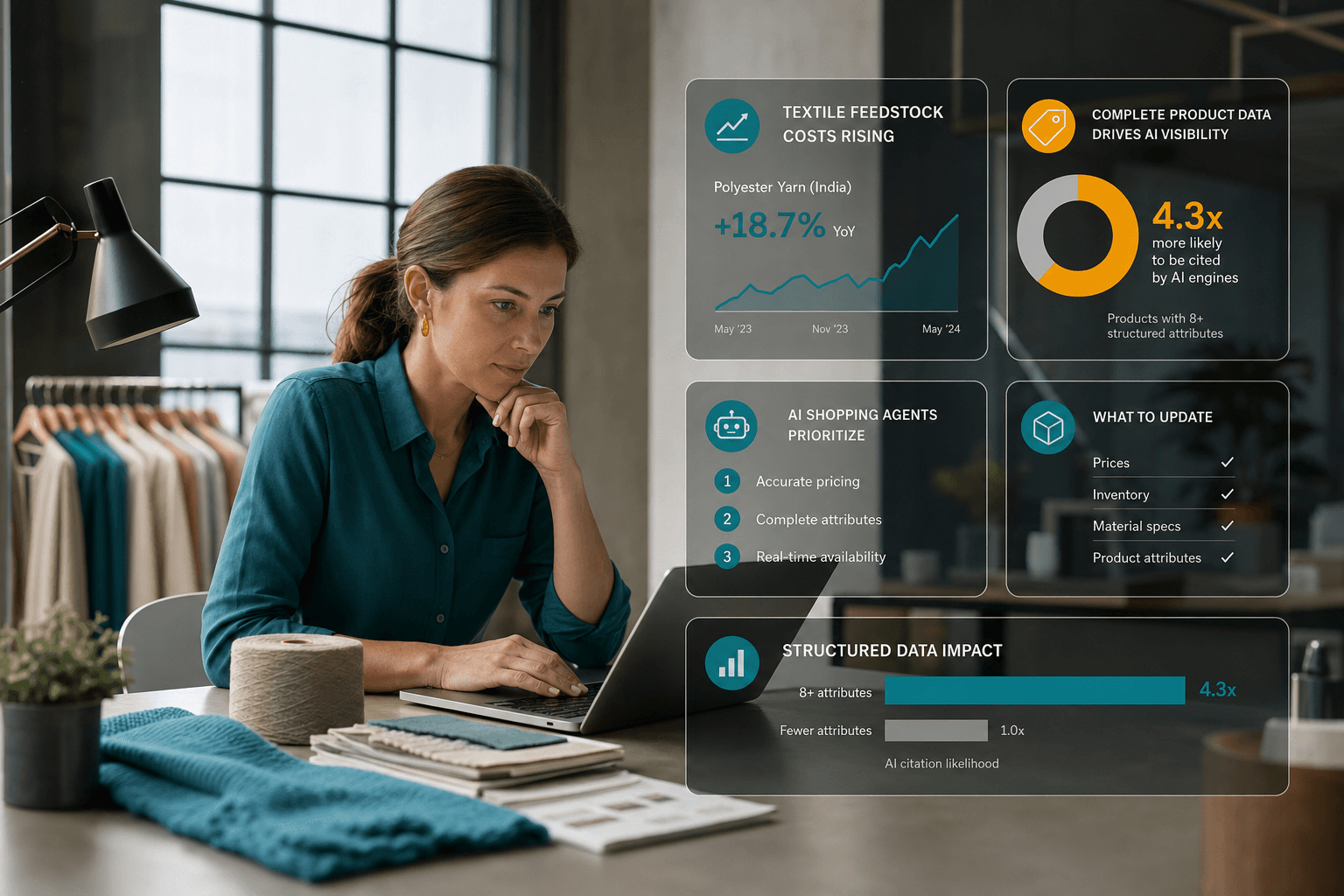
TL;DR: Rising raw material costs like India's polyester and PC yarn prices directly impact your product margins and catalog accuracy. For Shopify merchants, the real risk is not the cost increase itself but outdated product data that causes AI shopping agents to skip your listings. Products with 8 or more structured attributes get cited 4.3x more often by AI engines. Update your pricing, inventory, and material specifications now to stay visible in ChatGPT, Perplexity, and Google AI Overviews.
Rising polyester and PC yarn costs in India signal broader supply chain pressure that will ripple through apparel, home goods, and accessories categories globally. For DTC brands on Shopify, the immediate concern is not the commodity price itself but whether your product data reflects current reality. AI shopping agents now process live catalog queries through protocols like UCP, and outdated pricing or availability data causes agents to deprioritize or skip your products entirely.
The March 2026 UCP update enabled AI agents to query live inventory, variants, and pricing directly from merchant servers. This means the gap between your actual costs and your listed prices becomes visible to the systems recommending products to shoppers. When feedstock costs rise, brands that update their catalogs quickly maintain agent trust. Brands that lag get filtered out of recommendations.
McKinsey projects that agentic commerce could redirect $3 to $5 trillion in global retail spend by 2030. The brands capturing that spend are the ones whose product data agents can read and trust in real-time.
Complete product data means every required and recommended attribute is populated, accurate, and structured for machine parsing. Products with 8 or more structured attributes are cited 4.3x more often in AI shopping results than products with fewer than 3 attributes. This is not a marginal improvement; it is the difference between appearing in AI recommendations and being invisible.
For textile and apparel products specifically, complete data includes:
Shopify's Catalog now syndicates product data to AI channels automatically, and internal data shows Catalog-fed AI searches convert at 2x the rate of searches using scraped product data. The completeness of your data directly determines whether you appear in AI gift recommendations and product discovery flows.
AI shopping agents evaluate products based on data completeness, accuracy, freshness, and consistency across sources. When an agent like ChatGPT Shopping or Perplexity's Instant Buy processes a query like "best sustainable cotton t-shirt under $50," it pulls from structured product feeds and live catalog APIs. Products missing key attributes get filtered before the agent even considers them.
The selection criteria include:
ChatGPT Shopping converts at 15.9% and Perplexity at 10.5%, compared to 1.76% for traditional Google organic traffic. The merchants winning these high-converting sessions are the ones whose product pages are optimized for AI extraction.
When feedstock costs rise, your immediate action list focuses on catalog accuracy and margin protection. Start with pricing: if your costs increased, either update your listed prices or document why you are absorbing the margin hit. AI agents and their users both respond poorly to checkout surprises where the final price differs from the listed price.
Update these elements within 48 hours of any cost change:
Content updated within the last 30 days receives 3.2x more citations across AI platforms than stale content. This applies to product pages as much as blog posts. A 20-minute refresh of your top product pages with current pricing and availability data moves your AI visibility more than most marketing activities.
Structured data is the language AI shopping agents speak. Products with full Product schema appear 3 to 5 times more often in AI-generated shopping recommendations than products without it. FAQPage schema drives 3.1x higher answer extraction rates. Pages with comprehensive schema receive 2.7x more impressions than those without.
For Shopify stores, the critical schema types are:
Shopify's Dawn v15.0+ includes built-in schema using the structured_data Liquid filter, but many stores have apps adding conflicting or duplicate markup. Audit your schema regularly using Google's Rich Results Test. The answer engine optimization playbook applies to product pages as much as editorial content.
Supply chain shifts like rising textile costs create content opportunities that most merchants miss. When feedstock prices change, shoppers search for explanations: "Why are cotton prices rising?" "Will clothing get more expensive?" "Best affordable sustainable fabrics." These informational queries trigger AI Overviews 83% of the time for "best product" searches.
The brands answering these questions with structured, answer-first content get cited. The brands silent on the topic get skipped. This is AEO for Shopify in practice: create content that directly answers the questions your customers are asking AI assistants, formatted so AI engines can extract and cite it.
A blog post explaining how your brand is responding to material cost increases, what it means for your pricing, and why your quality remains consistent positions you as the authoritative source. AI engines favor content with clear expertise signals, and supply chain transparency demonstrates exactly that.
Agentic commerce readiness means your store can be discovered, queried, and transacted through AI agents without human intervention. Shopify shipped six AI-facing endpoints to every store in May 2026: /llms.txt, /llms-full.txt, /agents.md, /.well-known/ucp, /api/ucp/mcp, and an agentic sitemap. These exist on your store by default, but they only work well if your underlying product data is complete.
The preparation checklist:
Merchants implementing both UCP and ACP protocols capture 40% more agentic traffic than those using only one. Shopify abstracts this complexity, but the quality of your product data determines whether agents choose you over competitors. The universal checkout protocol enables the transaction; your data quality determines whether you get selected for it.
How quickly do AI shopping agents reflect my price changes? Perplexity responds to new content within days through real-time retrieval. Google AI Overviews typically reflect indexed content changes within 2 to 4 weeks. ChatGPT's training-based citations take 3 to 6 months, but its web search features can access current data faster.
What happens if my product data is incomplete? AI agents filter out products missing key attributes before making recommendations. Products with fewer than 3 structured attributes appear 4.3x less often in AI shopping results than products with 8 or more attributes.
Do I need to update my llms.txt file manually? Shopify auto-generates /llms.txt as of May 2026, but you can customize it. The file benefits from clean, complete product data in your store. Focus on product data quality first; the llms.txt will reflect it.
How do rising material costs affect my AI visibility? Directly, if your prices or availability change and you do not update your catalog. AI agents deprioritize listings where the data appears stale or inconsistent with checkout reality.
What is the ROI of updating product data for AI? ChatGPT Shopping converts at 15.9% and Perplexity at 10.5%, compared to 1.76% for traditional Google organic. AI-referred visitors convert at 4 to 23 times the rate of traditional organic visitors.
Should I mention supply chain challenges in my product descriptions? Yes, if relevant. Transparency about sourcing and pricing builds trust signals that AI engines weight when selecting authoritative sources. Frame it as expertise, not excuse-making.
How do I test my AI visibility? Query ChatGPT, Perplexity, and Google AI Overviews with searches like "best [your product category]" and "recommend a [your product] for [use case]." Track whether your brand appears and in what context.
What is the minimum product data for agentic commerce? Product name, price, inventory status, shipping details, return policy, at least 3 images, variant data, GTIN, brand name, AI-optimized description, reviews, and Shopify standard taxonomy categories.

A small team of friends and colleagues working together to produce useful content to help you...gift better.