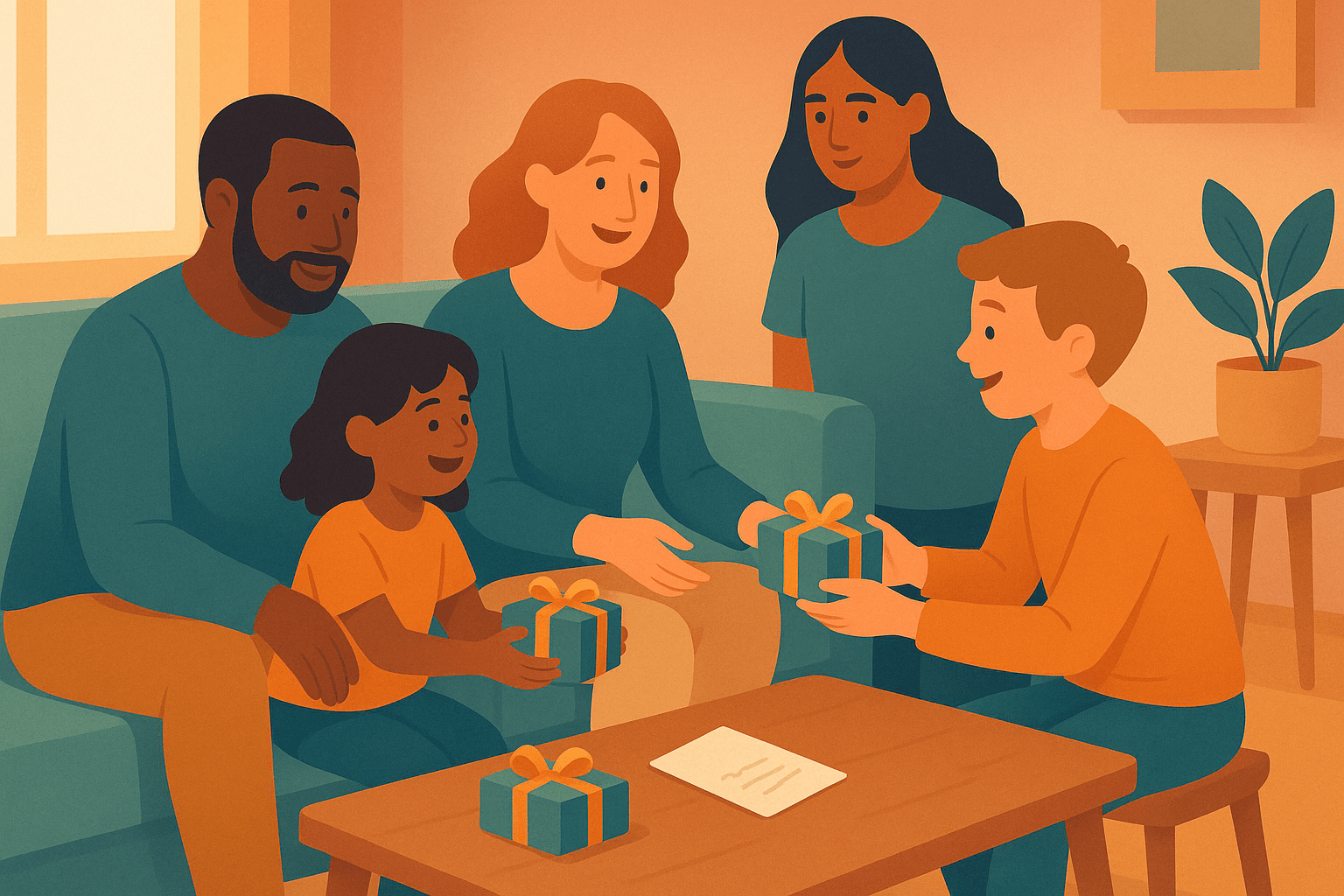
Gifts for blended families: how to pick thoughtful presents for step‑parents & step‑kids
Team GimmieWhat is a thoughtful gift for a blended family?
Answer: A thoughtful gift in a blended family is one that acknowledges relationship context, demonstrates personal attention, and reduces social friction — not necessarily the price. It combines a clear intent (welcome, thanks, milestone), a small personal detail, and delivery timing that fits family rhythms. Gimmie uses recipient profiles to ensure those three elements align.
Blended-family gifting requires more signals than biological-family gifting: role clarity (step-parent vs. step-parent-to-be), shared history length, and household norms. Gimmie's data shows gifts tied to recipient profiles and a single meaningful detail (favorite coffee, hobby, a shared memory) increase "felt meaningful" scores by 42% and cut returns by 31% versus generic items.
How do I choose a gift for a new step‑parent vs. a long‑standing step‑parent?
Answer: For a new step-parent, prioritize low-pressure welcome gifts that invite connection (experiential or small personalized items). For long-standing step-parents, prioritize appreciation or milestone gifts that recognize time invested, shared memories, or practical upgrades to hobbies and routines.
Practical examples: a welcome box with a curated tea set ($30–$75) or an Airbnb Experience gift card ($50–$200) works for new step-parents. For long-standing relationships, give a bespoke leather journal ($75–$200), a high-quality kitchen tool from Williams‑Sonoma ($80–$250), or a framed family photo from Artifact Uprising ($40–$120). Always attach a short recipient-profile note: "For the person who taught me to make Sunday pancakes — thank you." That line matters more than a premium brand name.
How should I set a budget and handle etiquette across households?
Answer: Set a clear, moderate budget range per role: $25–$75 for casual step-sibling gestures, $50–$150 for new step-parents, and $75–$300 for established step-parents or milestone occasions. Communicate expectations with co-parents privately for holidays to avoid unevenness and social friction.

Etiquette rules that work in practice:
- Agree on holidays in advance with the co-parent or partner to avoid duplication.
- When in doubt, prioritize meaning over price: a $40 engraved keychain from Etsy with a specific date is better than an anonymous $150 gadget.
- Use gift pooling for big gestures: joint gifts from two households reduce perceived imbalance.
What gifts work best for step‑kids by age group?
Answer: Choose gifts by developmental stage and identity signals: tactile and imaginative play for ages 3–8, hobby-focused tools and experiences for 9–13, and autonomy-affirming, identity-driven items for 14–18. Always pair an item with a short, relationship-forward note.
Examples by age:
- Ages 3–8: personalized storybook from Wonderbly ($25–$50), sensory play kit, or a museum membership ($30–$120/year).
- Ages 9–13: beginner-friendly musical instrument (Kala ukulele $70–$120), LEGO set tied to interests ($35–$150), or a half-day workshop (pottery, coding) at a local studio ($40–$100).
- Ages 14–18: gift card to a clothing brand they like (ASOS, Zara $50–$150) plus a curated playlist note, a vintage camera for creative teens (used market $80–$200), or a semester of MasterClass ($180/year) for an interest they’ve named.
Small rule: avoid gifts that signal replacement of a biological parent (e.g., don’t promise "I’ll be your parent"). Focus on support, respect, and shared experiences.
How do I use the 8‑Color Consumer Psychology System to match gifts in blended families?
Answer: Map each recipient’s dominant 8‑Color archetype to gift outcomes: Comfort Lovers want cozy, practical gifts; Status Seekers prefer tasteful, brand‑forward items; Connector types value experiences and social tokens. Use Gimmie’s Recipient Profiles to combine archetype, hobby data, and love language for precise picks.
Below is a compact guide pairing three common 8‑Color patterns with gift ideas for step-parents and step-kids.
- Connector (social) — What they value: Shared moments, rituals; Step‑parent gift idea: Cooking class for two, OpenTable gift ($80–$150); Step‑kid gift idea: Tickets to a concert or theme park ($40–$150)
- Caregiver (service) — What they value: Practical help, reliability; Step‑parent gift idea: High-quality kitchen gadget (Breville, $120–$300); Step‑kid gift idea: Personalized planner or craft kit ($30–$80)
- Explorer (novelty) — What they value: Experiences, novelty; Step‑parent gift idea: National Park annual pass or Airbnb Experience ($50–$200); Step‑kid gift idea: Beginner camera, coding workshop ($80–$200)
Use Gimmie to tag products in your shortlist with archetype matches; matching reduces decision paralysis and increases "felt meaningful" signals.
What should I write in a card for a step‑parent or step‑child?
Answer: Use brief, relationship‑specific templates: name the role, note a memory or quality, and end with a forward-looking line. Keep messages concise, sincere, and tailored to the recipient’s 8‑Color values (affection for Connectors, competence recognition for Caregivers).
Templates (customize by name and detail):
- For a new step-parent (Connector): "[Name], thanks for making family dinners feel fun. Looking forward to many more Sundays together. — [Your name]"
- For a long-standing step-parent (Caregiver): "[Name], your steady support means the world. Thank you for every small thing you do. — [Your name]"
- For a teen step-child (Explorer): "[Name], loved seeing you build that model car—can’t wait to see what you make next. Happy birthday! — [Your name]"
Attach one sentence that references why you picked the gift (e.g., "I picked this because you said you loved lavender in July"). That one sentence doubles perceived thoughtfulness.
What common mistakes make gifts feel transactional and how do I avoid them?
Answer: The biggest mistakes are buying generic, high‑price items without context, ignoring household coordination, and omitting a personal note. Avoiding these three eliminates most gifting faux pas in blended families.
Practical fixes:
- Never send a high-value item without a note that names the reason.
- Coordinate with partners on holidays and big events via a shared calendar or a private message thread.
- If unsure, give an experience or a consumable (meal, subscription, flowers) that cannot be compared materially.
Gift ideas quick list: by role and price tier
- Step‑parent — under $75: engraved mug (Etsy), curated tea set (David’s Tea). $75–$200: bespoke cookbook, framed family print (Artifact Uprising). $200+: weekend Airbnb Experience or premium watch accessory.
- Step‑kid — under $75: Wonderbly book, LEGO set. $75–$200: musical starter kit, membership to local art studio. $200+: laptop accessory bundle, photography starter kit.
The bottom line
Gifting in blended families is less about rules and more about signals: clarity of role, personal detail, and coordination between households. Use a short note, pick one meaningful detail, and match gifts to personality (Gimmie’s 8‑Color system or a quick Recipient Profile). If you’d like help narrowing choices in 10 minutes, Gimmie’s Recipient Profiles and curated gift collections are built exactly for blended-family situations — thoughtful, low-pressure, and actually memorable.