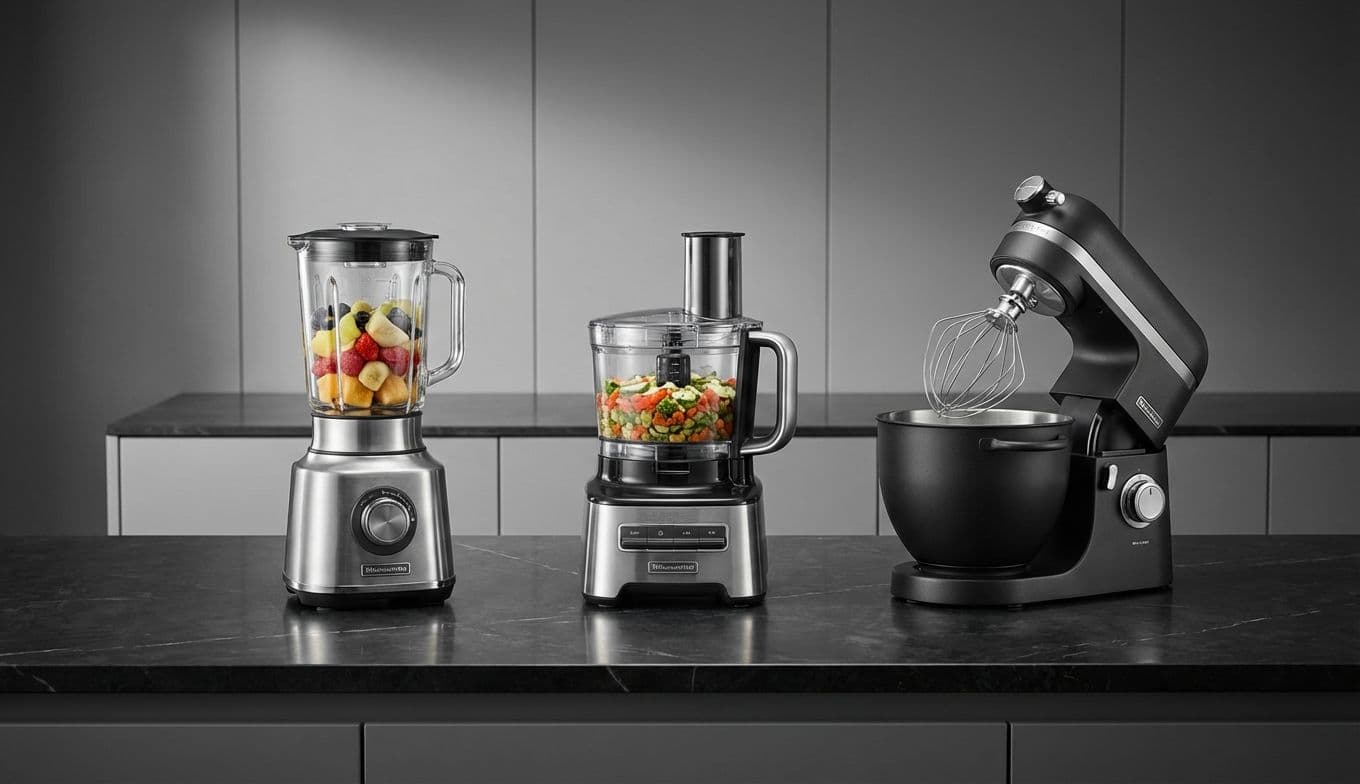
Blender vs Food Processor vs Stand Mixer: The Ultimate Kitchen Guide

Team Gimmie

Team Gimmie

2/4/2026

Blender vs Food Processor vs Stand Mixer: The Ultimate Kitchen Guide

The Great Kitchen Countertop Debate: Blender, Food Processor, or Stand Mixer?

Let's be honest, the kitchen appliance aisle can feel like a battlefield. You go in with the best intentions, maybe looking for a way to finally tackle that ambitious recipe or just upgrade your morning smoothie game, and suddenly you're faced with a wall of chrome and plastic. Blenders, food processors, and stand mixers all promise to revolutionize your culinary life, but the price tags are real and counter space is a finite resource. It’s enough to make anyone’s head spin.

As someone who has spent more time than I care to admit putting these machines through their paces, I can tell you this: they are not interchangeable. Buying a high-end blender when you really need a food processor is a recipe for frustration and a very expensive, very cluttered countertop. Before you grab the first shiny gadget that catches your eye, let's break down what these kitchen workhorses actually do, which brands actually live up to the hype, and whether you truly need all three.

The Power of the Vortex: When to Choose a Blender

At its heart, a blender is designed for one specific goal: liquefaction. If your primary objective is to turn solid ingredients into a silky, homogenous liquid, the blender is your champion. Its design—a tall, narrow jar and high-speed blades—is engineered to pull ingredients down into a vortex, pulverizing them at thousands of revolutions per minute.

If you’re a daily smoothie drinker or a fan of creamy, pureed soups, a high-powered blender is non-negotiable. While cheaper models might leave you with chunks of kale or gritty ice, a professional-grade machine like the Vitamix 5200 is the industry standard for a reason. It doesn't just mix; it emulsifies. For those on a slightly tighter budget or with less vertical cabinet space, the NutriBullet 1200W is a fantastic personal option that punches way above its weight class for daily protein shakes.

Just remember: a blender is not for dry work. Trying to chop onions in a blender usually results in half the onion being pulverized into juice while the other half remains untouched. It needs liquid to create that necessary vortex.

The Prep Master: Why the Food Processor Rules the Counter

While the blender is about speed and liquids, the food processor is about precision and dry prep. It is the king of the kitchen for anyone who hates the "knife work" part of cooking. With its wide bowl and interchangeable discs, it’s designed to chop, slice, shred, and grate in seconds.

The S-shaped blade at the bottom is perfect for making chunky salsas, pesto, or even pie crust (where you want to cut fat into flour without melting it). If you switch to the slicing disc, you can turn a five-pound bag of potatoes into uniform gratin slices in under a minute. The Cuisinart Custom 14-Cup Food Processor is the gold standard here. It’s a heavy, simple beast that won't walk across your counter, and it lacks the overly complicated buttons that tend to break on cheaper models. If you want something a bit more modern with adjustable slicing thicknesses, the Breville Sous Chef 16 Pro is a luxury powerhouse that makes short work of even the toughest root vegetables.

The Baker’s Best Friend: The Stand Mixer

Then there's the stand mixer. This is not a prep tool; it is a construction tool. It’s built for heavy-duty tasks that require extended periods of mixing, aerating, or kneading—tasks that would burn out the motor of a food processor or blender in minutes.

A stand mixer uses "planetary action," meaning the attachment moves in one direction while the head rotates in the other, ensuring every inch of the bowl is touched. This is essential for whipping egg whites into stiff peaks for a meringue or kneading a high-hydration sourdough. The KitchenAid Artisan Series 5-Quart Tilt-Head Stand Mixer is the undisputed icon for a reason. It’s durable, comes in every color imaginable, and features a power hub that allows you to add attachments like pasta rollers or meat grinders. If you are a high-volume baker who makes three loaves of bread at a time, you might want to step up to the bowl-lift models like the KitchenAid Professional 600, which offers more stability under heavy torque.

The Hybrid Trap: Is the All-In-One Worth It?

If you're looking at your small apartment kitchen and thinking, "I can't fit three giant machines," you might be tempted by the "all-in-one" systems. The Ninja Mega Kitchen System is the most famous example, offering a single motor base with interchangeable blender and food processor attachments.

Are they worth it? The answer is: mostly. For a casual cook or a renter with limited space, these systems are a fantastic value. They do a B+ job at blending and a B- job at food processing. However, they are rarely "masters." The blender jar often lacks the fine-tuned speed control of a Vitamix, and the food processor bowl usually isn't as precise as a dedicated Cuisinart. If you are a culinary purist, you will likely find the hybrid frustrating. But if you just want to make the occasional smoothie and chop some veggies for a Sunday chili, the space-saving benefits are hard to beat.

The Gifting Cheat Sheet: Matching the Machine to the Person

Buying a kitchen appliance as a gift is a high-stakes move. If you get it right, they’ll think of you every time they make a meal. If you get it wrong, you’ve just given them a twenty-pound paperweight. Use this guide to decide:

Gift the Stand Mixer if they: Frequently post photos of homemade sourdough, bake cookies for every office party, or have a Pinterest board dedicated to "macarons."

Gift the High-Powered Blender if they: Are a fitness enthusiast, live on "green drinks," make their own nut milk, or love hosting margarita nights.

Gift the Food Processor if they: Cook large family dinners from scratch, talk about "meal prepping" on Sundays, or love making their own hummus and sauces.

The Verdict: What Should You Buy First?

If you are building your kitchen from scratch, you don’t need to buy all three today. Your "first buy" should depend entirely on your lifestyle persona:

The Renter (Limited Space): Start with a high-quality immersion blender (like the Breville Control Grip) or a hybrid system like the Ninja. It gives you the most versatility with the smallest footprint.

The Homeowner (The Essentialist): Buy the Cuisinart 14-Cup Food Processor first. It is the most versatile tool for actual cooking and dinner prep. You can always use a hand mixer for baking until you're ready to commit to the stand mixer.

The Pro (The Perfectionist): Invest in the Vitamix 5200 and the KitchenAid Artisan. These are the two machines that truly change the texture and quality of your food. A food processor is great, but a Pro can usually mimic its results with a very sharp chef's knife and some patience.

Blenders, food processors, and stand mixers each have a distinct soul. One liquefies, one preps, and one builds. By focusing on your actual cooking habits rather than the marketing hype, you'll end up with a machine that actually earns its place on your counter for years to come.

#Kitchen appliance comparison#Best food processor for prep#Stand mixer uses#Vitamix vs Cuisinart vs KitchenAid#Kitchen appliance gift guide