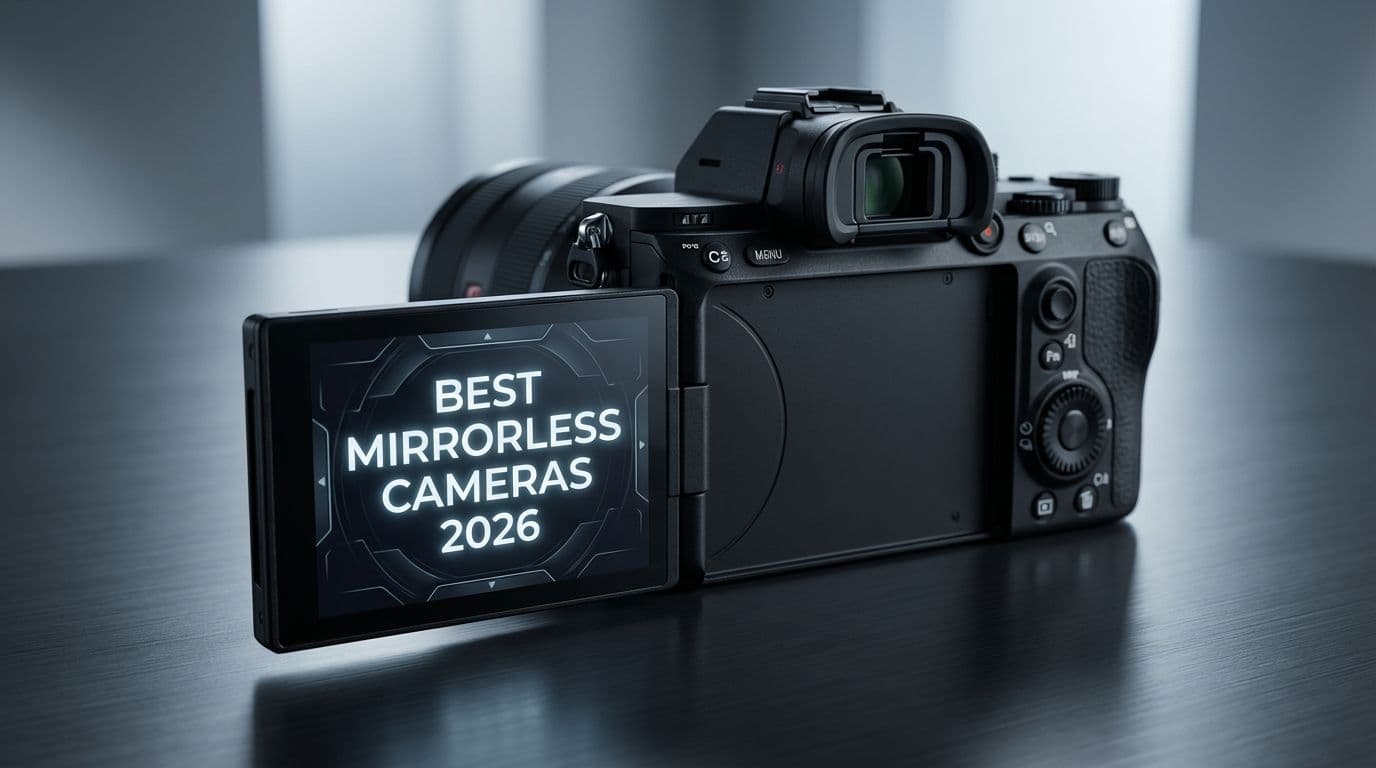
Best Mirrorless Cameras 2026: AI Tech & Top Picks Guide
Team Gimmie
1/31/2026

Mirrorless Cameras in 2026: Why the Smartest Gear Isn't Always the Most Expensive
For years, we’ve heard the same refrain: mirrorless cameras are the future of photography. In 2026, that future hasn't just arrived—it has evolved into something far more intelligent than we anticipated. We are no longer just talking about the lack of a mechanical mirror; we are talking about cameras that think.
If you are looking to upgrade your gear or buy a gift for a creative soul this year, the landscape looks different than it did even two years ago. The "megapixels wars" are largely over, replaced by a race for the most sophisticated Artificial Intelligence. Today’s mirrorless bodies aren’t just smaller DSLRs—they are high-performance computers that happens to have a lens attached. But with all this tech comes a common pitfall: buying more camera than you actually need.
The 2026 Intelligence Shift: Beyond the Sensor
The biggest shift we’ve seen in the last 24 months is the migration of "computational photography" from our smartphones into high-end mirrorless bodies. In the past, you needed a decade of experience to nail focus on a bird in flight or a toddler running through a dim living room. Today, AI-driven subject recognition has become standard.
Current generation processors can now distinguish between a human eye, a car tire, and a hawk’s wing in real-time. This means the barrier to entry for "pro-level" shots has never been lower. However, this intelligence comes at a premium. Before you drop three thousand dollars on a flagship body, you need to ask if you’re paying for features that will actually improve your life, or just specs that look good on a box.
Choosing Your Lane: The 2026 Persona Guide
Buying a camera in 2026 is about matching the device's brain to the user's lifestyle. Here is how the current market breaks down for the most common types of shooters.
The Aspiring Content Creator For those building a brand on YouTube, TikTok, or whatever the next big platform is, video is the only language that matters. Pros: Internal 4K/60p recording without overheating, AI auto-framing that mimics a human camera operator, and high-quality built-in microphones. Cons: High storage demands and the need for external lighting to truly make that sensor shine. Pro Tip: Look for a camera with a dedicated Tally Light (the red light on the front). It sounds small, but knowing for sure that you’re recording when you’re standing in front of the lens saves hours of frustration.

The Global Traveler Travelers need a balance of durability and portability. By 2026, weather-sealing has become a standard on mid-range bodies, which is a massive win for anyone shooting in the rain or at the beach. Pros: Compact form factor, incredible dynamic range for landscapes, and USB-C charging. Cons: Smaller bodies can sometimes feel cramped for those with larger hands; lens weight still adds up. Pro Tip: Prioritize weather-sealing over extra megapixels. A 24MP photo taken in a rainstorm is better than a 60MP camera that you had to keep in your bag because it wasn't waterproof.
The Family Documentarian This is the person who wants to freeze time. They need speed and reliability above all else. Pros: Industry-leading "Sticky" autofocus that won't lose a child’s face in a crowd, and silent shutters that won't disrupt a school play. Cons: Can be overkill for casual snapshots; requires a bit of a learning curve to master the AF settings. Pro Tip: Invest in a high-speed "UHS-II" SD card. The camera’s AI can think fast, but if your memory card is slow, the camera will freeze up while trying to save your photos.
The 2026 Shortlist: Proven Classics and New Icons
If you are shopping today, the market has settled into a few clear winners. While the "latest and greatest" models from 2025 are still the buzz of the industry, some slightly older models have earned "proven classic" status and offer incredible value.
The All-Rounder King: Sony Alpha 7 V The successor to the legendary a7 IV, the a7 V is the benchmark for 2026. It features a new AI processing unit that handles subject tracking with eerie accuracy. It is the safest bet for anyone who does a little bit of everything—from portraits to high-end video.
The Creative’s Choice: Fujifilm X-T6 Fujifilm continues to dominate the "experience" of photography. The X-T6 (which replaced the beloved T5) maintains the retro dials and tactile feel that photographers love, but inside, it uses an APS-C sensor that rivals full-frame quality for most users. It’s smaller, prettier, and arguably more fun to use than its rivals.
The Ergonomic Master: Canon EOS R6 Mark III If you prioritize how a camera feels in your hand, Canon is still the leader. The R6 Mark III is a low-light beast, making it the favorite for wedding photographers and anyone shooting indoors. Their "Color Science" remains the gold standard—meaning skin tones look natural right out of the camera without hours of editing.
The Value Play: Nikon Z6 III Nikon has made a massive comeback in the mirrorless space. The Z6 III offers professional-grade build quality and video features that usually cost twice as much. For the budget-conscious buyer who still wants a "pro" feel, this is the hidden gem of 2026.
Modern Solutions to Old Problems
In the past, mirrorless cameras had two major flaws: they died quickly and they were difficult to learn. By 2026, the industry has largely solved these issues.
Battery Anxiety is (Mostly) Gone We used to tell people to carry five spare batteries. Today, while mirrorless cameras still use more power than old DSLRs, the advent of universal USB-C Power Delivery (PD) has changed the game. You no longer need a wall outlet; you can charge your camera from the same power bank you use for your phone, even while you’re shooting. This has turned a 2-hour battery life into a multi-day experience.
The Hidden Cost of Glass The most important thing to remember in 2026 is that the camera body is only half the story. High-end mirrorless lenses (the glass) are often more expensive than the camera itself. If you have a $2,000 budget, you will get better results by spending $1,000 on a body and $1,000 on a high-quality "prime" lens than by spending $1,800 on a flagship body and using a cheap kit lens.
The Final Verdict: Experience Over Specs
Mirrorless technology in 2026 is truly remarkable. We have reached a point where the hardware is rarely the bottleneck for creativity. Whether you’re looking at a Sony, Fujifilm, or Canon, the image quality will be stunning.
The "best" camera is no longer the one with the most megapixels or the fastest burst rate. It’s the one that feels right in your hands and doesn't get in your way. For the person who just wants to capture their life, a mid-range APS-C camera like the Fujifilm X-series is likely the smarter, more joyful purchase. For the pro-level creator, the AI-integrated full-frame beasts from Sony or Canon are tools that will pay for themselves.
In 2026, don’t buy the hype—buy the tool that fits the life you actually live. Happy shooting!